Sodium-Ion Batteries Cut Total Ownership Cost 21% Over 20 Years
Wood Mackenzie says sodium-ion battery systems average $229/kWh upfront versus $200/kWh for LFP, but deliver 21% lower total cost of ownership over a 20-year project life.

CTJ Desk
Published •8 min read
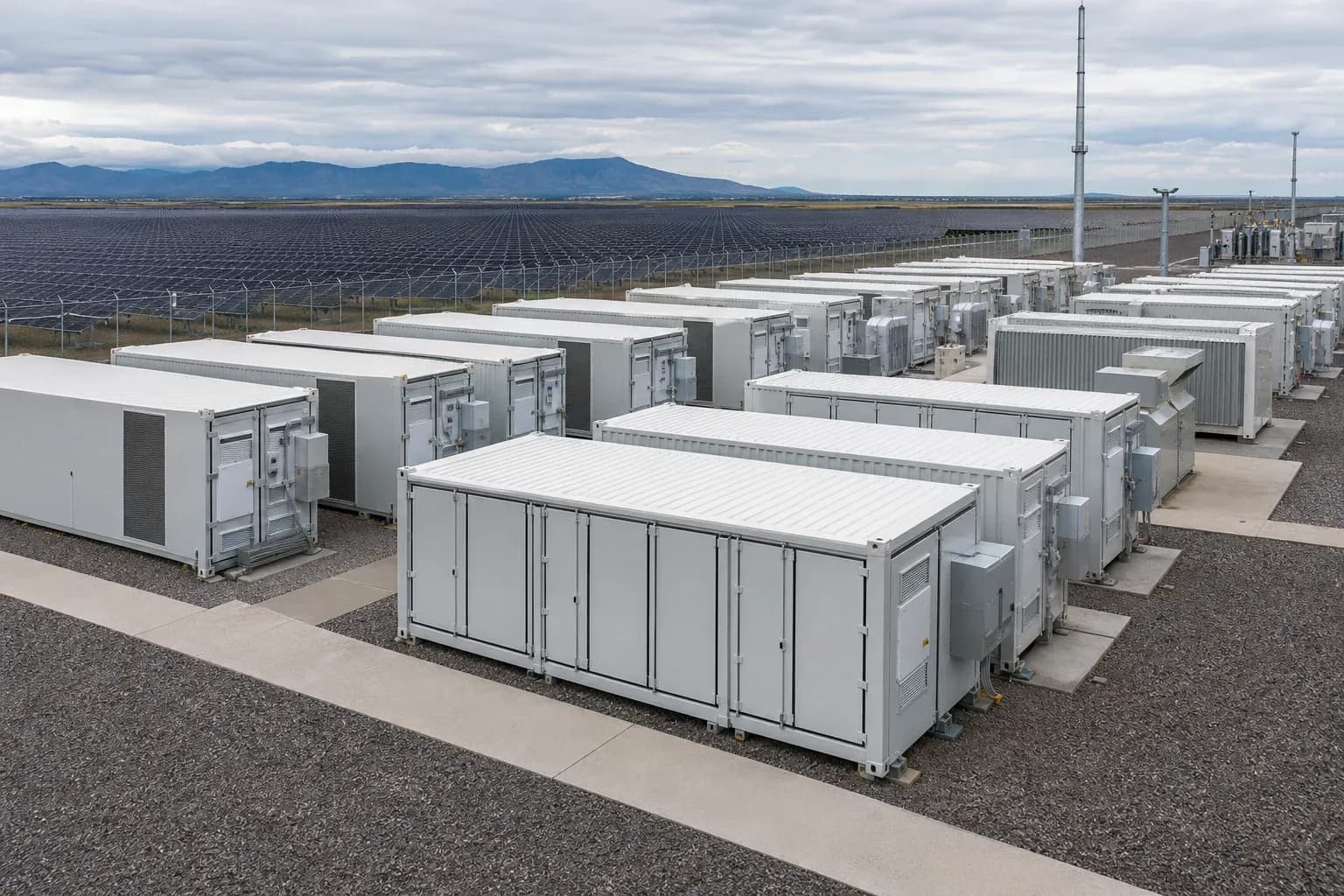
Sodium-ion battery systems can reduce lifetime project costs even with a higher initial price, according to Wood Mackenzie. The firm said sodium-ion systems have a global average upfront cost of $229/kWh, compared with $200/kWh for lithium iron phosphate (LFP), but total cost of ownership is 21% lower over a 20-year project life. Wood Mackenzie attributed the lower lifetime cost to the elimination of augmentation events and lower operating expenditure, and said system economics remain stable across 2 to 4 hour durations.
Wood Mackenzie Puts Sodium-Ion TCO 21% Below LFP Over 20 Years
Wood Mackenzie said sodium-ion batteries, or SIB, are moving into commercial production and are establishing themselves as the most cost-effective emerging alternative to lithium-ion battery storage. In Wood Mackenzie's analysis of sodium-ion battery commercialization, the firm examined the market in China, the US, Germany and India.
The central project-economics comparison in the analysis is between higher upfront system cost and lower lifetime ownership cost. Wood Mackenzie put the global average upfront capital cost for sodium-ion at $229/kWh, versus $200/kWh for LFP. Even with that higher entry cost, the firm said sodium-ion delivers 21% lower total cost of ownership over a 20-year project life.
According to Wood Mackenzie, that lower ownership cost comes from two operational effects: avoiding augmentation events and reducing operating expenditure. In battery storage, augmentation usually means adding capacity later in a project to maintain performance over time. Wood Mackenzie said sodium-ion changes that cost profile enough to lower ownership cost across the full 20-year life it modeled.
The firm also said system economics remain stable across 2 to 4 hour durations. That duration range covers a large share of utility-scale battery applications, and Wood Mackenzie used it as the basis for comparing sodium-ion and LFP economics.
Cell-Level Cost Parity Is Expected By End-2026, With System Parity Post-2030
Wood Mackenzie said cell-level cost parity between sodium-ion and LFP among market leaders is expected by the end of 2026. The firm drew a distinction between cells and complete battery systems, however, and said module-level and system-level cost parity will come later, after 2030.
That timing matters for current project decisions. For projects being deployed today, Wood Mackenzie said LFP remains the bankable choice for 2 to 4 hour duration assets. At the same time, the firm said the economics shift more decisively in the 2030 to 2035 period.
Wood Mackenzie also said the most probable outcome is a battery market served by different technologies, with each chemistry optimized for distinct applications and duration profiles. Within that framework, sodium-ion is being positioned as an alternative chemistry whose economics improve over time as production scales and system costs move closer to LFP.
The firm added that market leaders are expected to reach cell-level parity first, while the later module and system parity reflects the broader balance-of-system and packaging costs that sit above the cell itself.
Supply Agreements Exceed 70 GWh As China Builds 30 GWh Of Planned Capacity
Wood Mackenzie said sodium-ion batteries are entering commercial production with more than 70 GWh of supply agreements. The firm said those agreements indicate confidence among downstream clients as the chemistry moves from development into early commercial deployment.
China is the lead market in manufacturing, according to Wood Mackenzie, with capacity development running ahead of demand. The firm said BYD has 30 GWh of planned manufacturing capacity in China, while CATL is targeting at least 1 GWh of sodium-ion shipments by the end of 2026.
Wood Mackenzie said China, the US and Europe already have significant offtake agreements in place, while India remains in the early commercial validation stage. It also said China has the most mature learning rate in the sector, at 18% to 20% during the 2026-35 period.
Those manufacturing and offtake figures sit alongside the cost timeline described by Wood Mackenzie: early commercial volumes are now being committed, cell costs are expected to converge with LFP first, and broader system-cost convergence is expected after 2030.
China Exempts Sodium-Ion From Its Consumption Tax While LFP Moves To 2% And 4%
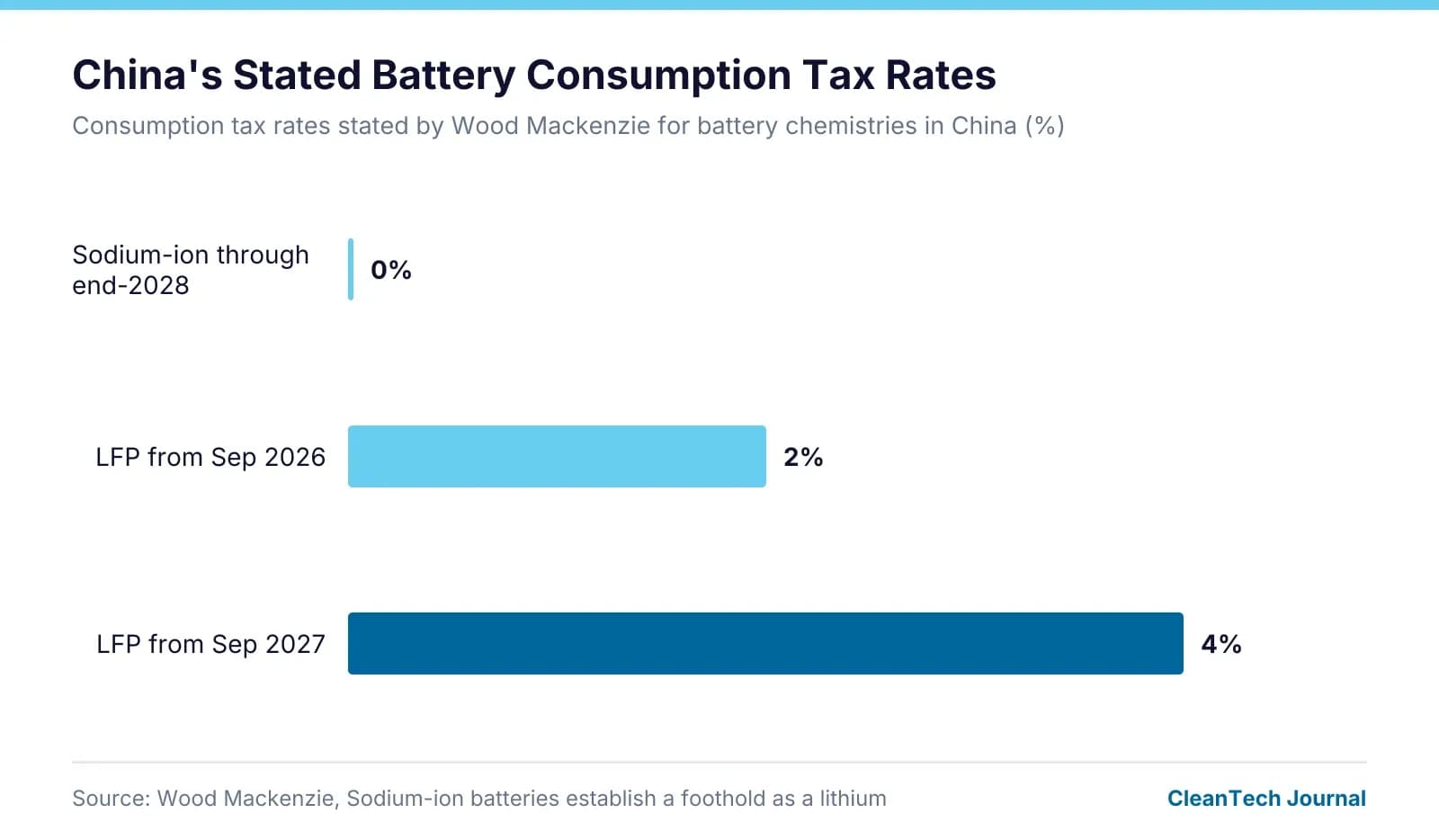
Wood Mackenzie said policy measures are currently a stronger market driver than cost alone. In China, the firm said the reimposition of a consumption tax on lithium-ion batteries in July 2026 explicitly exempts sodium-ion through the end of 2028. Under the same framework, LFP faces a 2% levy from September 2026, rising to 4% from September 2027.
In the US, Wood Mackenzie said Section 301 tariffs of approximately 58% on Chinese energy storage cells are part of the structure encouraging domestic sodium-ion production, alongside IRA 45X manufacturing credits.
In Europe, Wood Mackenzie pointed to carbon-footprint disclosure requirements under the EU Battery Regulation. In India, the firm said local capacity is being developed through a $1.25 billion incentive scheme and duty exemptions on manufacturing equipment.
Taken together, those measures describe the near-term commercial setting for sodium-ion in the markets Wood Mackenzie reviewed. The firm's cost outlook shows a chemistry with a higher upfront average cost than LFP today, lower modeled ownership cost over 20 years, and a path in which cell-level parity arrives by the end of 2026 while full system parity follows after 2030.