Top 10 Biggest Wind Farms in the World by Installed Capacity
The biggest wind farms in the world by installed capacity, led by the 3,650 MW SunZia project in New Mexico and the UK's giant North Sea offshore farms.

Suraj Kadam
Published •27 min read
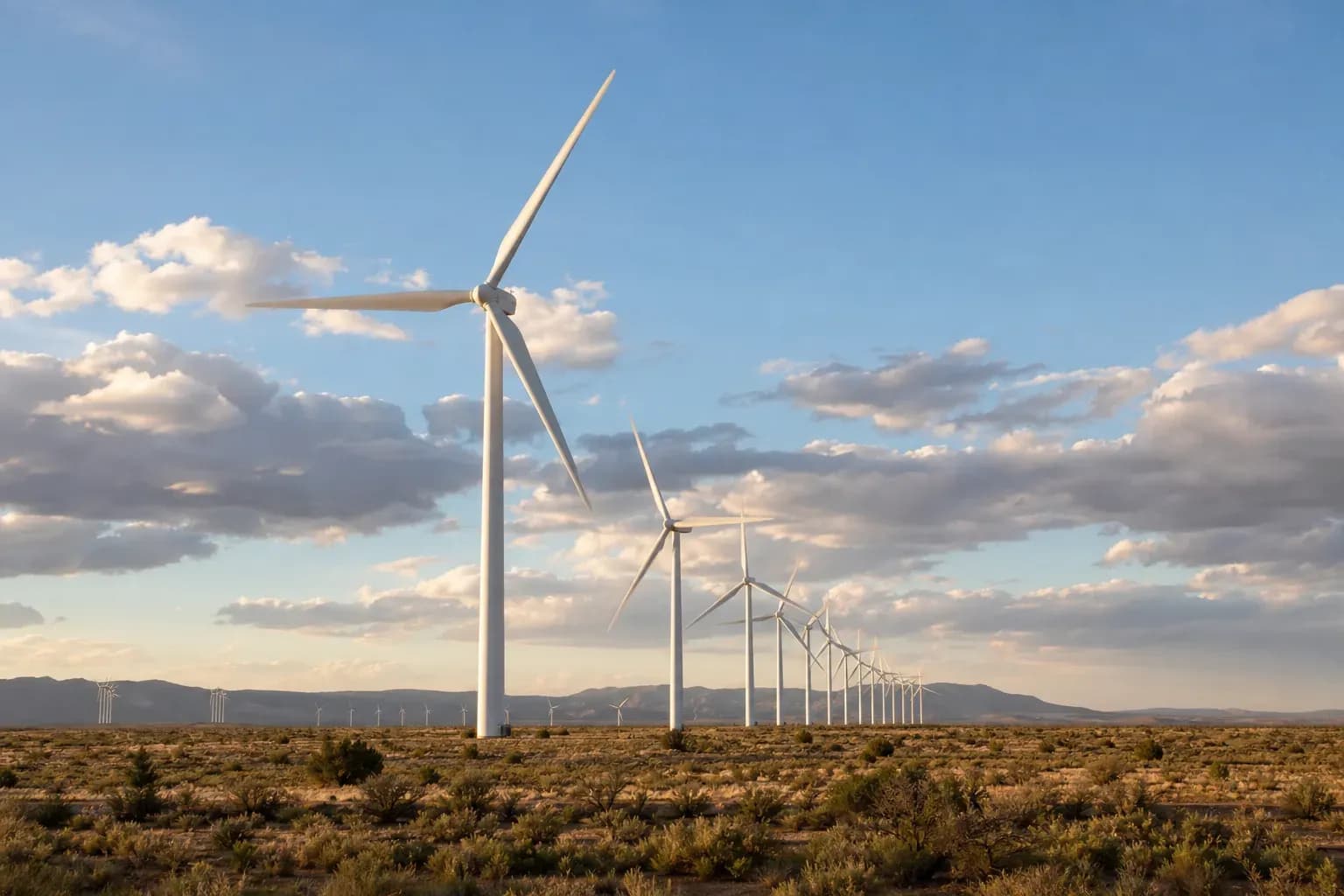
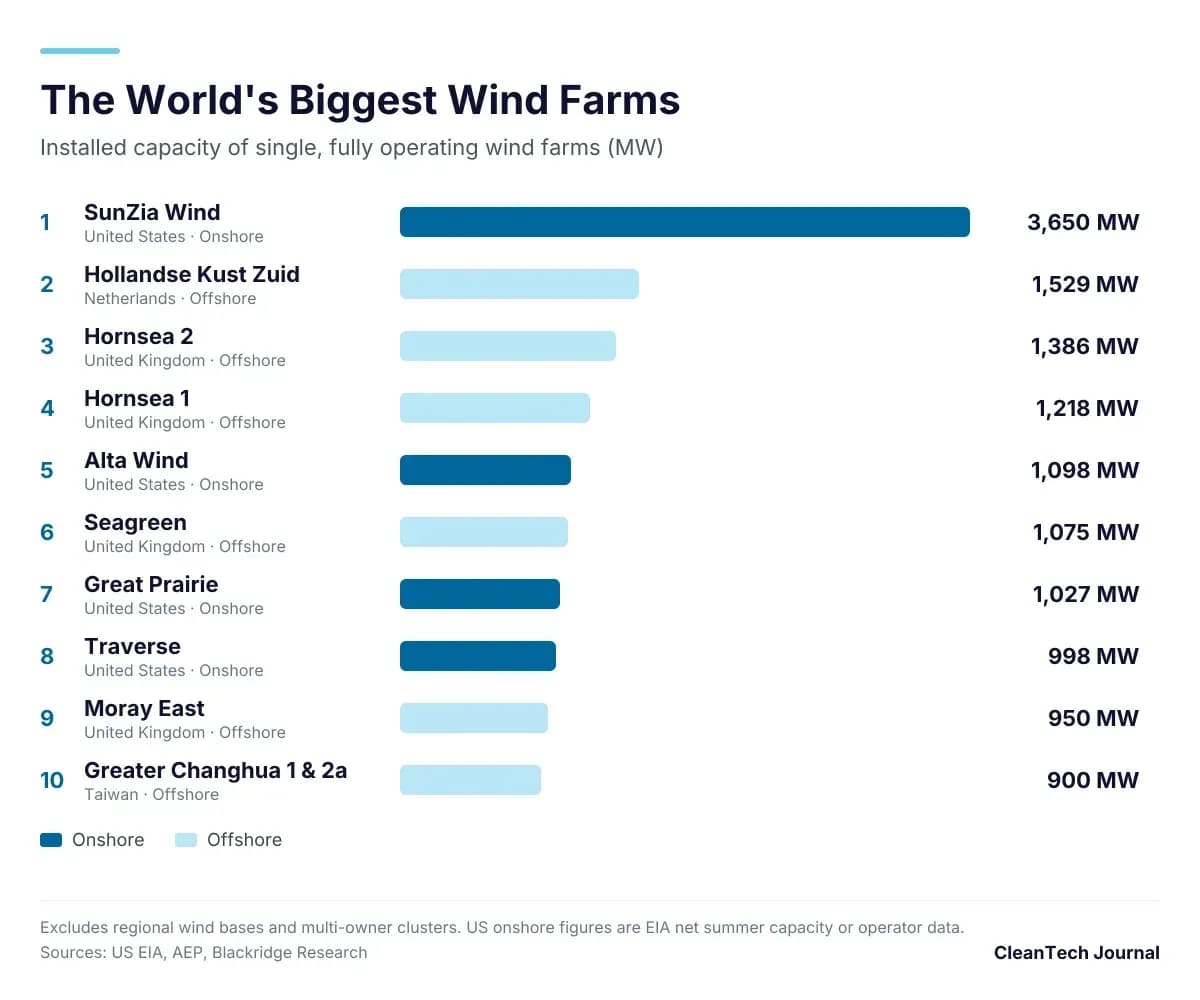
The biggest wind farms in the world used to be measured in hundreds of megawatts. That changed in 2026, when SunZia in New Mexico reached full commercial operation with 3,650 MW, more than twice the size of any other single wind farm on this list.
We ranked single wind farms that are fully operating today by installed capacity, using figures from operators, the US Energy Information Administration and project trackers. We left out regional wind bases and clusters of separately owned projects, which we cover at the end.
Biggest Wind Farms in the World at a Glance
Rank | Wind farm | Country | Onshore or offshore | Installed capacity |
|---|---|---|---|---|
1 | SunZia Wind | United States | Onshore | 3,650 MW |
2 | Hollandse Kust Zuid | Netherlands | Offshore | 1,529 MW |
3 | Hornsea 2 | United Kingdom | Offshore | 1,386 MW |
4 | Hornsea 1 | United Kingdom | Offshore | 1,218 MW |
5 | Alta Wind Energy Center | United States | Onshore | 1,098 MW |
6 | Seagreen | United Kingdom | Offshore | 1,075 MW |
7 | Great Prairie | United States | Onshore | 1,027 MW |
8 | Traverse Wind Energy Center | United States | Onshore | 998 MW |
9 | Moray East | United Kingdom | Offshore | 950 MW |
10 | Greater Changhua 1 and 2a | Taiwan | Offshore | 900 MW |
US onshore figures are net summer capacity reported to the Energy Information Administration or by the operator. Offshore figures are installed capacity.
1. SunZia Wind, United States
The largest wind farm in the world built as a single project
Pattern Energy's SunZia has 916 turbines across central New Mexico. The US Energy Information Administration puts its net summer capacity at 3,650 MW, more than three times the size of the next-largest US wind farms.
SunZia began commercial operation in mid-2026. Its power travels west along a high-voltage direct current line of about 885 kilometers across Arizona to customers in California.
2. Hollandse Kust Zuid, Netherlands
Hollandse Kust Zuid sits in the North Sea off the Dutch coast and is run by Vattenfall, which co-owns it with BASF and Allianz. Its 139 turbines total 1,529 MW, and the farm became fully operational in 2024.
It was also one of the first large offshore wind farms built without government subsidies for the electricity it produces.
3. Hornsea 2, United Kingdom
Ørsted's flagship, about 89 kilometers off the Yorkshire coast
Hornsea 2 has 165 turbines with a combined 1,386 MW and came online in 2022. Ørsted owns it with AXA IM Alts and Crédit Agricole Assurances. At its launch, it overtook its neighbor, Hornsea 1, as the largest offshore wind farm in the world.
4. Hornsea 1, United Kingdom
Hornsea 1 entered full commercial operation in 2019 with 174 turbines and 1,218 MW of capacity. It was the first offshore wind farm to pass 1 GW.
Hornsea 1 and 2 share the same zone in the North Sea, where Ørsted is building a third, larger project.
5. Alta Wind Energy Center, United States
Alta Wind sits in the Tehachapi Mountains of Southern California, one of the earliest large wind regions in the US. It was built in phases and has 1,098 MW of net summer capacity, according to the EIA.
6. Seagreen, United Kingdom
Seagreen, off the coast of Angus in Scotland, is owned by SSE Renewables, TotalEnergies and PTTEP. It reached 1,075 MW in 2023, making it Scotland's largest wind farm.
Its turbines stand in some of the deepest waters used for fixed-bottom offshore wind in the world.
7. Great Prairie, United States
Great Prairie in the northern Texas Panhandle has 1,027 MW of net summer capacity, according to the EIA. The Texas Panhandle has some of the strongest and steadiest winds in the country, which is why so many large US wind farms are built there.
8. Traverse Wind Energy Center, United States
One of the largest wind farms in North America built at one time
American Electric Power completed Traverse in Oklahoma in 2022. Its 356 turbines total 998 MW and supply customers in Arkansas, Louisiana and Oklahoma.
9. Moray East, United Kingdom
Moray East in the Moray Firth off northeast Scotland has 100 turbines and 950 MW of capacity. It was commissioned in 2022 and is owned by Ocean Winds, Kansai Electric Power and Mitsubishi Corporation, among others.
10. Greater Changhua 1 and 2a, Taiwan
Ørsted's Greater Changhua 1 and 2a project off Taiwan's west coast became fully grid-connected in April 2024. Its 900 MW of capacity makes it one of the largest offshore wind farms in Asia outside mainland China.
Wind Bases, Clusters and Projects on the Way
China's wind bases: regions such as Jiuquan in Gansu and Ulanqab in Inner Mongolia host wind complexes with several gigawatts of combined capacity. The Ulanqab base alone is planned at 6 GW by State Power Investment Corporation. However, these bases are made up of many separately built and connected projects, so they are not directly comparable with single wind farms.
India's wind parks: Muppandal in Tamil Nadu, at about 1,500 MW, and Jaisalmer in Rajasthan, at about 1,064 MW, are clusters of wind farms with many different owners.
Dogger Bank, United Kingdom: when complete, its three phases will total 3.6 GW from 277 turbines, making it the largest offshore wind farm in the world. Turbines are installed at Dogger Bank A, installation at Dogger Bank B passed the halfway mark in October 2026, and Dogger Bank C is due to start in 2027.
What Makes a Wind Farm the Largest
The largest wind farm in the world by capacity is not necessarily the one with the most turbines. Offshore turbines are much bigger, so Hollandse Kust Zuid reaches 1,529 MW with 139 machines, while SunZia uses 916 onshore turbines for its 3,650 MW.
Location also matters for output. Offshore winds are usually stronger and steadier, so a megawatt of offshore capacity typically generates more electricity in a year than a megawatt on land. Among the biggest wind farms in the world, the US leads on land and the UK leads at sea.
Frequently Asked Questions
How big are the turbines at the largest offshore wind farms?
They keep getting bigger. Dogger Bank uses GE Haliade-X turbines rated at 13 MW and 14 MW each. That is more than three times the average turbine at SunZia, which works out to about 4 MW.
How many homes can a 1,000 MW wind farm power?
It depends on how windy the site is and how much electricity local homes use. Wind farms generate at well below their full capacity most of the time, so output, not capacity, is the better guide.
Why are offshore wind farms more expensive to build?
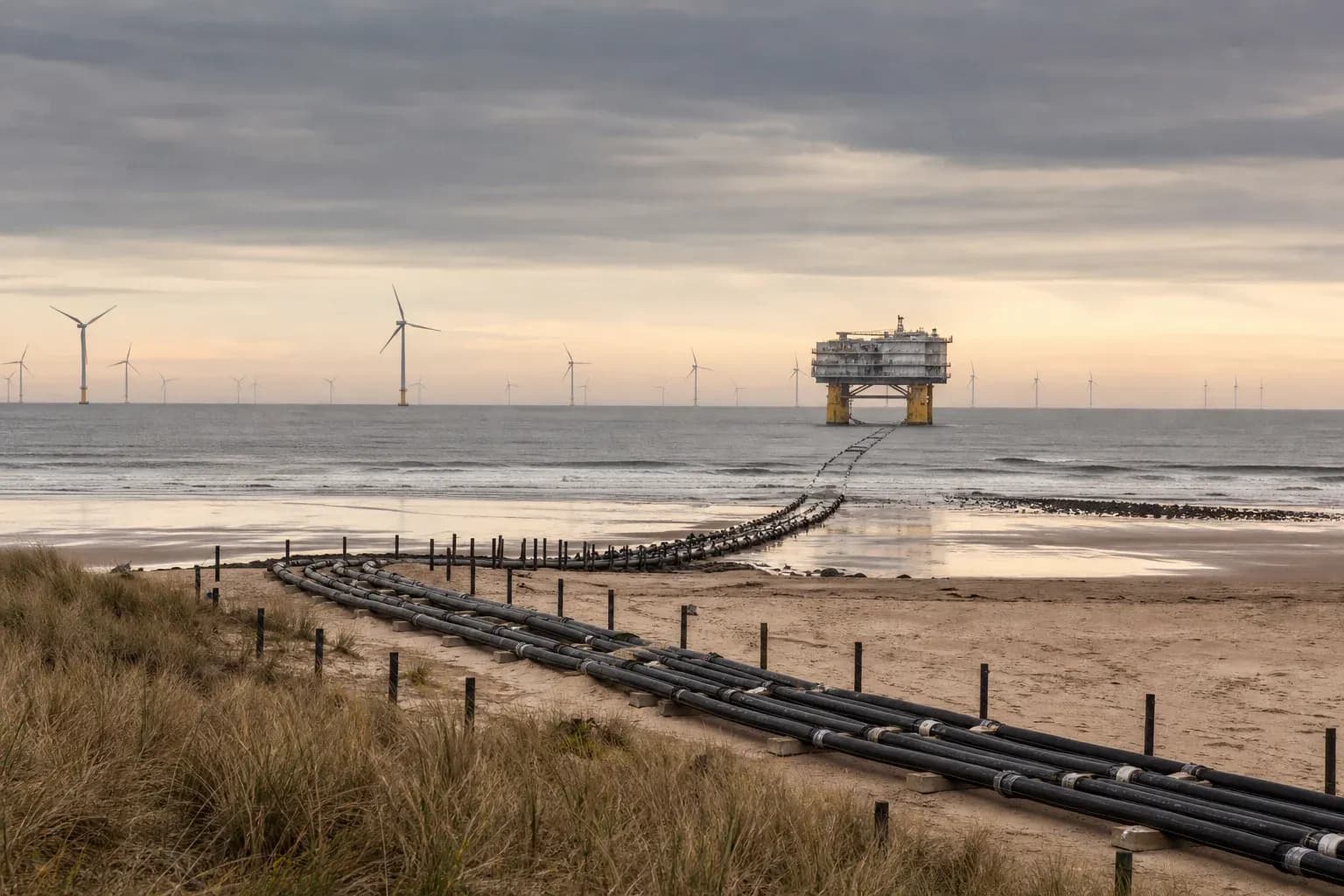
They need specialized installation vessels, foundations that can withstand waves and storms, and undersea cables to bring power to shore. Maintenance at sea is also costlier and depends on the weather.
How long does a wind farm last?
Most modern wind turbines are designed for about 25 to 30 years of operation. Older sites are often repowered, with old turbines replaced by fewer, larger ones on the same land.
Can a wind farm operate when there is no wind?
No. Turbines need a minimum wind speed to start turning and shut down in extremely high winds for safety. Grid operators balance wind with other sources and, increasingly, with battery storage.
SOURCES
- US Energy Information Administration: SunZia, the largest wind farm in the US
- American Electric Power: Traverse Wind Energy Center
- Renewable Energy Industry: SunZia fully commissioned at 3,650 MW
- Blackridge Research: Largest offshore wind farms in the world
- offshoreWIND.biz: Dogger Bank B turbine installation passes halfway mark
- China Daily: Wind turbine generates energy for first time at north China power base
- NS Energy: Top wind power farms in India
Written by
Suraj Kadam
Suraj Kadam is a journalist and Chief Editor of CleanTech Journal, a knowledge and media platform covering clean technology, solar energy, and renewable energy. He reports on emerging technologies, industry developments, policy trends, and innovations shaping the global clean energy transition. Through his editorial work, Suraj aims to make complex clean technology topics accessible to industry professionals, researchers, policymakers, and readers interested in sustainable energy. His work focuses on delivering insightful, informative, and engaging coverage of the evolving renewable energy landscape.