Top 10 Clean Energy Startups in the US by 2026 Funding
The top 10 clean energy startups in the US ranked by their biggest 2026 funding round, from Valar Atomics and Base Power to Form Energy, Helion and Sila.

Suraj Kadam
Published •31 min read
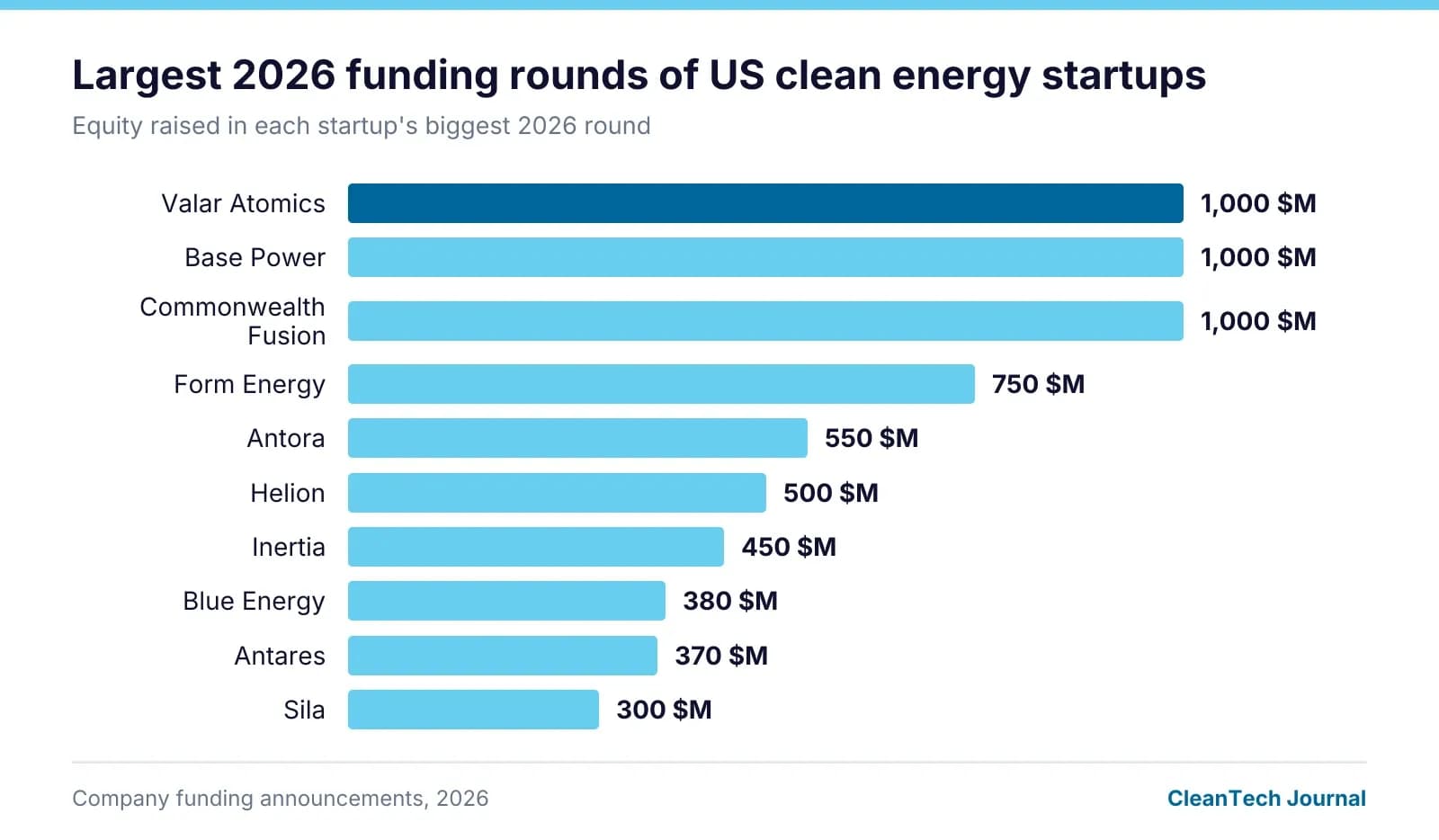
Six of the 10 biggest funding rounds raised by US clean energy startups in 2026 went to companies building nuclear reactors or fusion machines. The other four went to batteries and battery materials, from multi-day iron-air systems for the grid to large home batteries.
Together, these 10 companies raised about $6.3 billion in their largest 2026 rounds. We ranked them by the size of that single round, using each company's own funding announcement, and counted only equity, not loans or credit lines. Where two rounds were the same size, the more recent one is listed first.
Top 10 Clean Energy Startups in the US at a Glance
Rank | Startup | Round | Amount | Announced | Technology |
|---|---|---|---|---|---|
1 | Valar Atomics | Series B | $1 billion | August 2026 | Nuclear reactors |
2 | Base Power | Series D | $1 billion | August 2026 | Home batteries |
3 | Commonwealth Fusion Systems | Growth round | About $1 billion | July 2026 | Fusion |
4 | Form Energy | Series G | $750 million | August 2026 | Iron-air batteries |
5 | Antora | Series C | $550 million | July 2026 | Thermal batteries |
6 | Helion | Series G | $500 million | June 2026 | Fusion |
7 | Inertia | Series A | $450 million | February 2026 | Laser fusion |
8 | Blue Energy | Financing round | $380 million | April 2026 | Prefabricated nuclear plants |
9 | Antares | Series C | $370 million (equity) | July 2026 | Microreactors |
10 | Sila | Private round | $300 million | July 2026 | Battery anode materials |
1. Valar Atomics
Valar Atomics closed a $1 billion Series B led by Sequoia Capital in August 2026, alongside a separate $200 million credit facility. The company wants to build standardized nuclear power plants and produce them in fleets, and it plans to make its own reactor fuel.
Its test reactor, Ward 250, reached self-sustaining criticality in June. Valar describes that as a first for a company working outside a national laboratory.
2. Base Power
Austin-based Base Power raised a $1 billion Series D at a $13 billion post-money valuation, led by Ribbit, Addition and Valor Equity Partners. Alongside the round, it launched Base Core, a US-built home battery available in 39.2 kWh and 78.4 kWh sizes.
- Fleet: more than 500 MWh of batteries
- Utility partners: El Paso Electric, Austin Energy and CoServ, covering more than 200 MW of capacity
- Where it sells: select regions of Texas and Illinois
3. Commonwealth Fusion Systems
Commonwealth Fusion Systems raised roughly $1 billion in July 2026, backed by sovereign wealth funds, pension funds and infrastructure partners. That brings its total to about $4 billion since it was founded.
The new money is going entirely to ARC, its first commercial fusion power plant, planned for Virginia. Its demonstration machine, SPARC, is about 80% built, according to the company.
4. Form Energy
Form Energy raised $750 million in a Series G round led by T. Rowe Price, which also led its previous round. The company makes iron-air batteries that store electricity for multiple days, far longer than the few hours typical of lithium-ion grid batteries.
The funding will speed up manufacturing at its factory in Weirton, West Virginia. Form says its order backlog has grown fourfold, from about 20 GWh to 80 GWh.
5. Antora
Antora raised $550 million in an oversubscribed Series C round in July 2026, co-led by G2 Venture Partners and Eclipse. Its thermal batteries store low-cost electricity as heat in insulated blocks of solid carbon, then deliver it around the clock as heat or power for factories.
The company builds its batteries in San Jose, California, at what it calls one of the country's largest battery gigafactories, recently expanded into a three-building campus.
6. Helion
Helion announced a $465 million Series G in June 2026 at a $15.5 billion valuation, led by Thrive Capital, and later said the round closed at $500 million. The Washington-based company has now raised $1.5 billion in total.
The money supports Orion, its first fusion power plant, which is under construction in Malaga, Washington.
7. Inertia
Inertia raised $450 million in a Series A round led by Bessemer Venture Partners with GV and others.
What it is building: a fusion pilot plant based on the laser fusion physics proven at the National Ignition Facility, a grid-scale laser called Thunderwall, and a production line for fuel targets. Its co-founders include former Twilio chief executive Jeff Lawson and Lawrence Livermore National Laboratory scientist Annie Kritcher.
8. Blue Energy
Blue Energy raised $380 million in April 2026, led by VXI Capital with significant backing from Engine Ventures. It is developing prefabricated nuclear power plants, built offsite in existing fabrication yards to make construction faster and more predictable.
Its first project is in Texas, with construction expected to begin in the third quarter of 2026. The plant is designed to deliver up to 1.5 GW, including power for AI data centers.
9. Antares
Antares, based in Torrance, California, announced a $470 million Series C, made up of $370 million in equity and $100 million in debt. On our equity-only basis, the round counts as $370 million.
The company builds compact microreactors for defense and space applications. The round was jointly led by Paradigm and Caffeinated Capital.
10. Sila
Sila raised $300 million in a private equity round led by Atreides Management and Sutter Hill Ventures. It makes Titan Silicon, a silicon-carbon anode material that the company says gives batteries 20% to 40% higher energy density than traditional graphite.
Its plant in Moses Lake, Washington, began operating in fall 2025 with 2 GWh of initial capacity. Sila plans to expand it to as much as 250 GWh over the next five years.
Other Clean Energy Startups With Big 2026 Rounds
EnerVenue, which makes nickel-hydrogen batteries for grid storage, also raised $300 million in a Series B extension in March 2026. It just misses the top 10 because Sila's round of the same size was announced more recently.
Geothermal developer Mazama Energy raised $135 million in a Series B in September 2026, one of several sizable rounds for next-generation geothermal this year.
What These Rounds Say About Clean Energy Investment
The common thread is electricity demand. Blue Energy says its first plant will supply power to AI data centers, and Valar showed its test reactor generating electricity to run an Nvidia AI chip.
Investors are also backing hardware at a scale rarely seen in startups. Fusion and advanced nuclear alone account for six of the 10 rounds, a sign that the market is betting on firm, around-the-clock clean power alongside solar, wind and batteries.
Frequently Asked Questions
What counts as a clean energy startup?
Here, it means a privately held, venture-backed US company developing technology to generate, store or supply low-carbon energy. Public companies, project developers and utilities are not included.
Why are nuclear and fusion startups raising so much money?
Building reactors and fusion machines requires large, expensive prototypes and factories before any revenue arrives. Rising electricity demand, especially from data centers, has also made investors more willing to fund firm, carbon-free power.
Does a big funding round mean a startup will succeed?
No. Large rounds give companies time and money to build, but many still face technical, regulatory and commercial hurdles. Funding is a sign of investor confidence, not a guarantee of results.
What is the difference between equity and debt in a funding round?
Equity investors buy a share of the company, while debt is a loan that must be repaid. Some announcements combine both, so this ranking counts only the equity portion to compare rounds fairly.
How can I invest in clean energy startups?
Most are private, so their shares are usually available only to venture funds and accredited investors. Ordinary investors typically get exposure through public clean energy stocks or funds, or occasionally through equity crowdfunding platforms.
SOURCES
- Valar Atomics – Announcing our $1B Series B led by Sequoia
- Base Power – Base Power announces $1B Series D and launches Base Core
- Commonwealth Fusion Systems raises $1 billion from a new class of institutional investors
- Form Energy raises $750 million Series G
- Antora closes $550 million in Series C funding
- Helion – Helion raises $465 million Series G funding round
- Inertia raises $450 million to commercialize fusion
- Blue Energy raises $380M to build project-financeable nuclear plant
- Antares raises $470 million Series C
- Sila secures $300 million in private funding
Written by
Suraj Kadam
Suraj Kadam is a journalist and Chief Editor of CleanTech Journal, a knowledge and media platform covering clean technology, solar energy, and renewable energy. He reports on emerging technologies, industry developments, policy trends, and innovations shaping the global clean energy transition. Through his editorial work, Suraj aims to make complex clean technology topics accessible to industry professionals, researchers, policymakers, and readers interested in sustainable energy. His work focuses on delivering insightful, informative, and engaging coverage of the evolving renewable energy landscape.