1. Khavda Renewable Energy Park, Gujarat — 30 GW (planned)
Khavda is rewriting the rulebook. Built across roughly 538 sq km of barren salt desert in Kutch, an area about five times the size of Paris, it is being developed as the world’s largest single-location renewable energy project. Adani Green Energy (AGEL) leads the build, with NTPC Green and others also contributing capacity.
As of April 2026, AGEL alone had installed a cumulative 9.7 GW at the site, against a planned 30 GW by 2029. The full park is a hybrid solar-plus-wind complex with a project cost near INR 1.5 lakh crore (about USD 18.7 billion), evacuated through a dedicated high-capacity green corridor into the central grid.
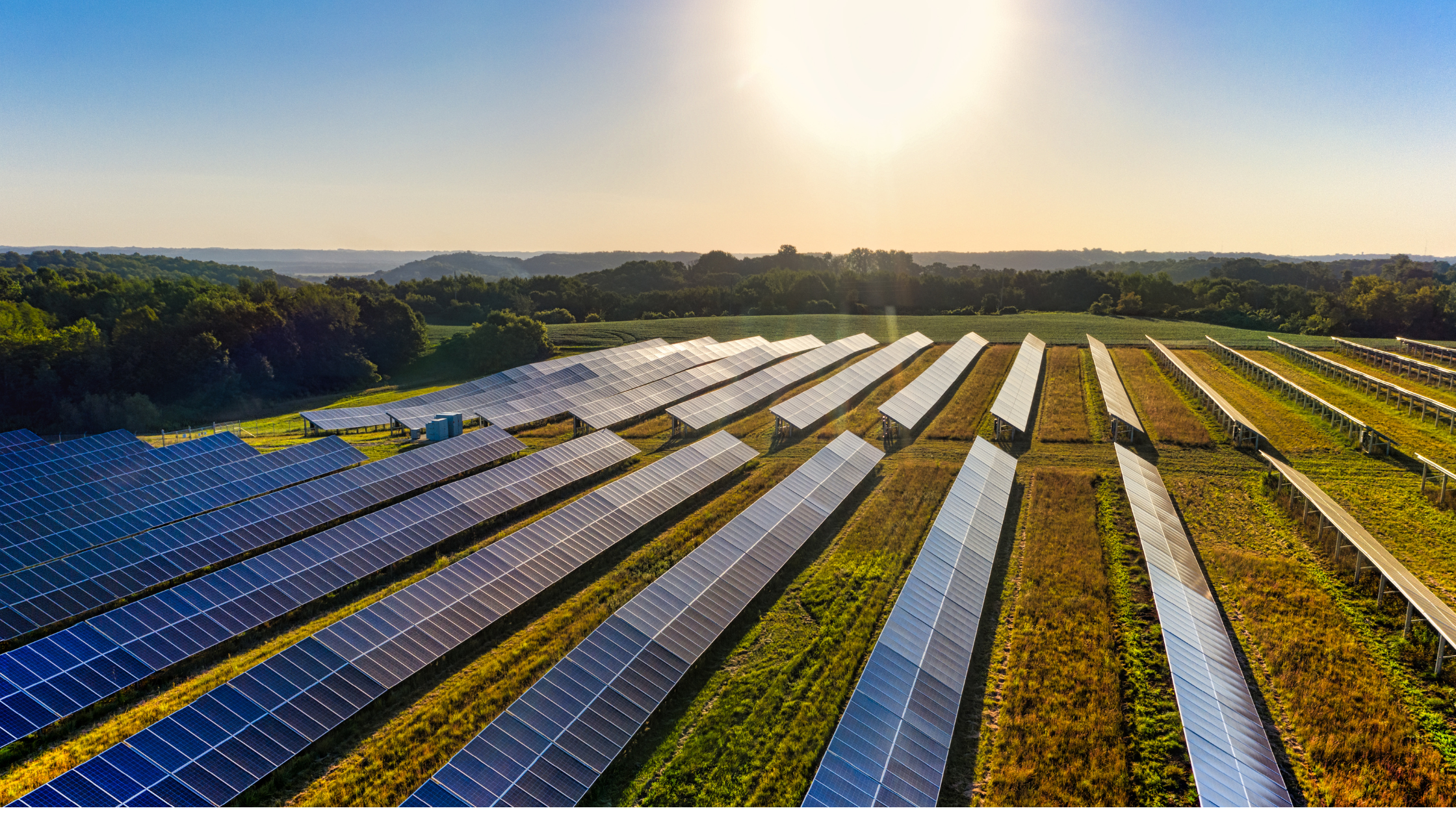
Technically, Khavda is a showcase. It deploys advanced bifacial solar modules that capture irradiance on both faces, lifting bifacial gain by capturing albedo reflected off the pale desert floor, paired with horizontal single-axis trackers (HSAT) that follow the sun east to west and add an estimated 15 to 25% to annual yield.
Wind generation comes from 5.2 MW turbines, among the most powerful onshore units globally, while waterless cleaning robots run autonomous cycles across the entire solar fleet to counter soiling losses and conserve scarce water in the arid Kutch region.
Note: Khavda is a hybrid renewable park, not a pure-solar plant. It tops this list on sheer scale, but the entries below are predominantly solar parks.
2. Bhadla Solar Park, Rajasthan — 2,245 MW
Bhadla is the benchmark, India’s largest dedicated solar park and one of the biggest on Earth. Sitting in the Thar Desert near Phalodi in Jodhpur district, it sprawls across roughly 56 sq km (over 14,000 acres) of sandy, dry terrain.
The site’s punishing 46 to 48 degree Celsius summer temperatures are a double-edged sword. The high GHI and minimal cloud cover boost generation, but elevated cell temperatures raise the thermal coefficient losses, since crystalline silicon output drops roughly 0.3 to 0.4% per degree above the 25 degree rating point. Commissioned in phases between 2015 and 2020, the park drew total investment near USD 2.17 billion (INR 10,000 crore).
On the engineering side, Bhadla runs solar trackers and automated cleaning robots to lift yield and cut O&M costs in a dust-heavy environment where soiling can erode output by several percent per week if unmanaged. The robotic dry-cleaning regime is what keeps the performance ratio (PR) high across the sprawling array. It remains the nation’s top dedicated solar installation and a global reference point for utility-scale design.
3. Pavagada Solar Park, Karnataka — 2,050 MW
Known as “Shakti Sthala,” Pavagada sits in the Tumkur district of Karnataka and spreads over roughly 13,000 acres. It started generating power in 2018 and is India’s second-largest dedicated solar park.
The development model here is notable. It was built through Karnataka Solar Park Development Corporation Limited (KSPDCL), a joint venture involving SECI, Karnataka Renewable Energy (KREDL), and NTPC, using a plug-and-play framework where the park developer pre-builds internal roads, water, and pooling substations so individual block developers can plug in directly. The park leased land from farmers on an annual rental model rather than acquiring it, de-risking the project legally.
The land-pooling design also slashed development timelines because grid connectivity and evacuation infrastructure were ready before module installation began. In September 2023, Karnataka announced plans to add 3 GW more to Pavagada. Once commissioned, that expansion would make it one of the largest such facilities in Asia.
4. Kurnool Ultra Mega Solar Park, Andhra Pradesh — 1,000 MW
Kurnool was an early proof point for India’s ultra-mega ambitions. Built on a 6,000-acre field and functional since 2017, it houses around 4.5 million crystalline silicon modules generating 1,000 MW, wired through string and central inverters into the state transmission backbone.
The numbers are striking. It received roughly INR 7,000 crore in combined public and private support and supplies electricity to around 800,000 homes annually, with output stepped up through dedicated pooling substations for grid synchronization.
Its environmental footprint is equally compelling, with the park facilitating CO2 emission reductions estimated at 1.9 million tonnes per year. For its era, Kurnool set the template for fixed-tilt and tracker-based block design that later parks would scale further.
5. NP Kunta / Ananthapuramu Ultra Mega Solar Park, Andhra Pradesh — ~978 MW
Also in Andhra Pradesh, the NP Kunta park (Ananthapuramu Ultra Mega Solar Park) carries a capacity of roughly 978 MW across about 8,000 acres. It was commissioned starting 2016 and built out in multiple phases.
State policy heavily favored this project, helping it scale steadily through staged development where each tranche was bid separately and tied into shared evacuation infrastructure. It is a core contributor to Andhra Pradesh’s standing as a solar powerhouse alongside Kurnool.
The phased approach here is a recurring engineering theme in Indian solar. Breaking a gigawatt-class target into bid-able blocks reduces execution risk, allows tariff discovery in stages, and keeps the common transmission corridor utilized as capacity ramps.
6. Kadapa Ultra Mega Solar Park, Andhra Pradesh — ~1,000 MW (phased)
Approved by the Union Government in August 2015, Kadapa is another Andhra heavyweight built in tranches. Its initial 250 MW block was awarded to Solairedirect in 2017 and commissioned in February 2020.
The remaining 750 MW was split evenly among three developers, namely SB Energy, Sprng Soura Kiran Vidyut, and Ayana Renewable Power, at 250 MW each. These blocks moved through staged construction, each with independent inverter stations feeding a shared pooling substation.
The multi-developer structure is a deliberate risk-distribution strategy. By parceling capacity across players while standardizing the grid interface, SECI and the state avoid single-point execution failures and accelerate overall buildout without duplicating evacuation assets.
7. Rewa Ultra Mega Solar Project, Madhya Pradesh — 750 MW
Rewa is one of India’s most-cited solar success stories. Developed by Rewa Ultra Mega Solar Limited (RUMSL), a JV between the Madhya Pradesh government and SECI incorporated in 2015, it delivers 750 MW across three 250 MW units.
Its claim to fame is grid innovation, not just size. Rewa was among the first large-scale solar plants to supply power directly to Indian Railways through an open-access interstate transmission arrangement, breaking the conventional utility-only offtake model and routing roughly a quarter of its output to traction loads.
The project also made headlines for record-low tariffs at the time of bidding, with a payment-security mechanism and a tariff-escalation structure that made the bankability strong enough to crash the levelized cost of energy (LCOE) below conventional thermal power.
8. Kamuthi Solar Power Project, Tamil Nadu — 648 MW
Kamuthi, in Tamil Nadu’s Ramanathapuram district, holds 648 MW and was for a time one of the largest single-location solar plants in the world. It was notable for being commissioned at remarkable speed across a tight construction window.
The plant integrated robotic cleaning systems early, running an automated dry-clean regime daily to hold the performance ratio steady in dusty, high-humidity coastal conditions where soiling and morning dew both degrade output.
Kamuthi also demonstrated southern India’s solar viability beyond the desert states, proving that high-capacity utility solar performs in coastal and peninsular geographies where diffuse irradiance is a larger share of the total.
9. NTPC Green Khavda-II Solar Project, Gujarat — 1.25 GW (phased)
Within the broader Khavda complex, NTPC Green is building its own 1.25 GW Khavda-II solar project as part of a seven-phase program. It commissioned an initial 165 MW block in February 2026.
This is a useful reminder that Khavda is a multi-developer ecosystem, not a single company’s project. State-owned NTPC and AGEL are both scaling independent capacity on contiguous land while sharing the regional transmission backbone.
The shared infrastructure model, with common transmission corridors, roads, and grid connectivity, is what makes such concentrated capacity economically viable. Multiple developers amortize the same heavy backbone, lowering the per-MW cost of evacuation and balance-of-system.
10. Rajasthan Ultra Mega Solar Clusters (Jaisalmer, Barmer, Jodhpur) — 10 GW+ aggregate
Beyond Bhadla, Rajasthan hosts a sprawling network of ultra-mega solar clusters across Jaisalmer, Barmer, and Jodhpur districts that together exceed 10 GW of capacity. These leverage some of the highest GHI values in the country.
Jaisalmer in particular anchors India’s first and the world’s largest wind-solar hybrid cluster, a model AGEL has explicitly replicated at Khavda. The hybrid approach smooths generation across the day because wind and solar peaks are complementary, lifting the combined capacity utilization and improving the use of a single shared grid connection.
As a region, Rajasthan’s combined solar footprint makes it the single most important state for India’s clean energy buildout, a function of cheap desert land, sparse population, low atmospheric attenuation, and relentless sun.
List of Top 10 Solar Power Plants in India Based on Capacity (2026)
| Solar Plant (Location) | Capacity |
|---|---|
| Khavda Renewable Park, Gujarat | 30 GW planned (~9.7 GW live) |
| Bhadla Solar Park, Rajasthan | 2,245 MW |
| Pavagada Solar Park, Karnataka | 2,050 MW |
| Kurnool UMSP, Andhra Pradesh | 1,000 MW |
| Kadapa UMSP, Andhra Pradesh | ~1,000 MW (phased) |
| NP Kunta / Ananthapuramu, Andhra Pradesh | ~978 MW |
| Rewa UMSP, Madhya Pradesh | 750 MW |
| Kamuthi Solar Project, Tamil Nadu | 648 MW |
| NTPC Green Khavda-II, Gujarat | 1.25 GW (phased) |
| Rajasthan UMS Clusters (Jaisalmer/Barmer/Jodhpur) | 10 GW+ aggregate |
Frequently Asked Questions
Q1. Which is the largest solar power plant in India? Among dedicated solar parks, Bhadla Solar Park in Rajasthan is the largest at 2,245 MW. If hybrid renewable parks are counted, the Khavda Renewable Energy Park in Gujarat is by far the biggest, targeting 30 GW with roughly 9.7 GW already operational by mid-2026.
Q2. Where is the Bhadla Solar Park located? Bhadla is in the Thar Desert near Phalodi in the Jodhpur district of Rajasthan, spread across about 56 sq km. Its extreme heat and high irradiance make it ideal for solar generation, though high cell temperatures do impose thermal coefficient losses.
Q3. What technology do these mega-parks use? The latest plants deploy bifacial N-Type TOPCon modules (which generate from both faces), horizontal single-axis trackers, string and central inverters, and waterless robotic cleaning systems to manage soiling without consuming scarce water.
Q4. Why are most large solar parks in Rajasthan and Gujarat? These states offer barren, low-cost desert land, very high global horizontal irradiance, 300+ sunny days a year, low atmospheric attenuation, and sparse populations, which is the ideal combination for utility-scale solar with minimal land conflict.
Q5. What is India’s total solar capacity and target? As of 31 December 2025, India’s cumulative installed solar capacity reached about 136 GW. The government targets 500 GW of non-fossil capacity by 2030, with solar as the central pillar.
Q6. How much new solar capacity is India adding? India installed roughly 37.8 GW of solar in calendar year 2025 and is projected to add about 42.5 GW in 2026, including utility-scale, rooftop, and off-grid segments.