Top 10 States With the Most EV Charging Stations in the US
The top 10 states with the most EV charging stations in the US, led by California's 70,072 public ports, with charging density per 100,000 residents.

Suraj Kadam
Published •30 min read
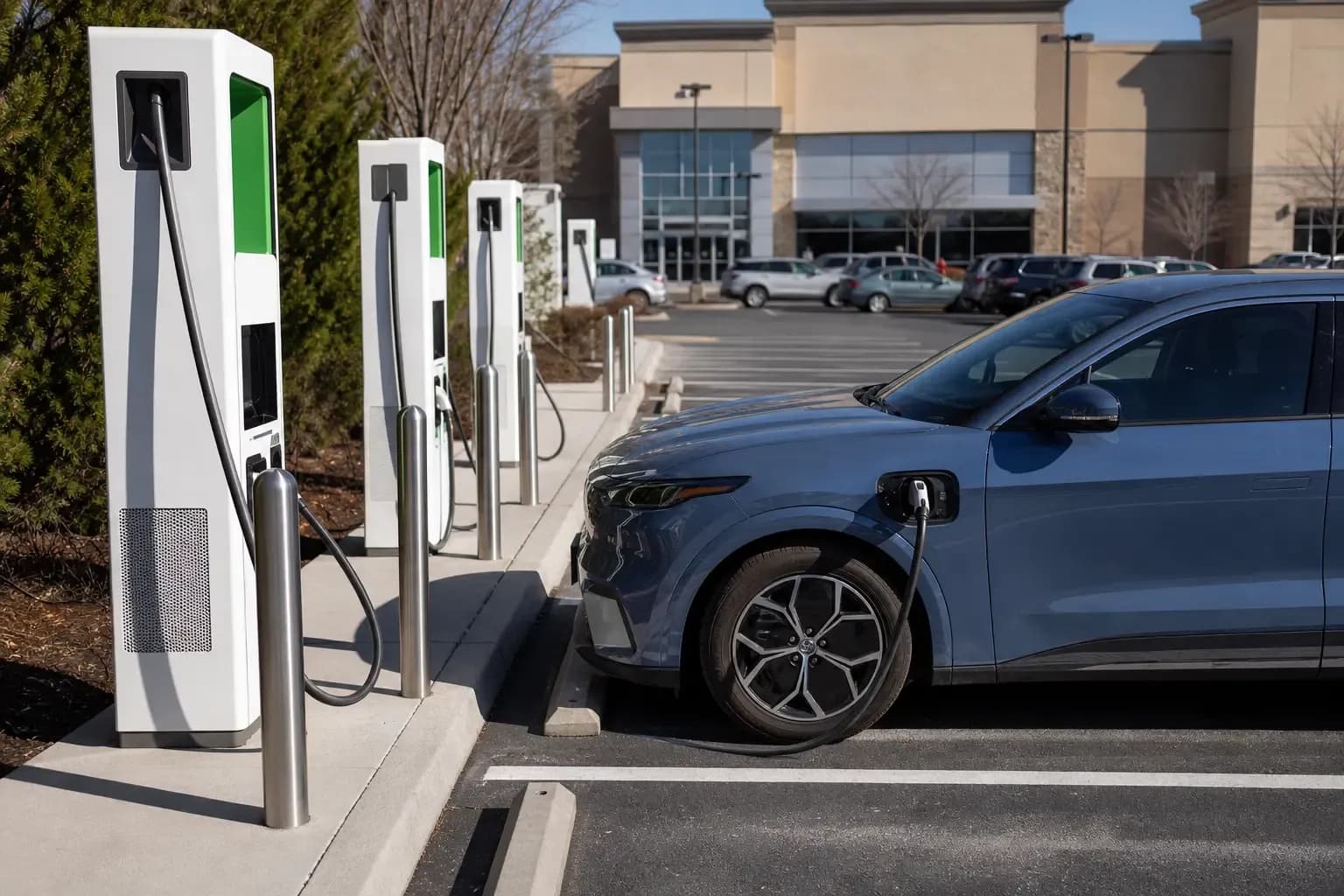
There are now 264,591 public electric vehicle (EV) charging ports at 84,204 EV charging stations in the US, according to the U.S. Department of Energy's Alternative Fuels Data Center (AFDC), with data updated on November 13, 2026. That works out to about 77 charging ports for every 100,000 Americans, but they are spread very unevenly across the country.
CleanTech Journal has ranked the 10 states with the most EV charging stations by the number of public charging ports, the individual plugs where a car can charge, using AFDC data. Ports per 100,000 residents are based on the Census Bureau's 2025 population estimates.
California leads by a wide margin, with more than a quarter of all public ports in the country, while Texas, despite ranking fourth, has some of the thinnest coverage for its population.
EV Charging Stations in the US by State: Top 10 Ranked
Rank | State | Public charging ports | Charging locations | Share of US ports | Ports per 100,000 residents |
|---|---|---|---|---|---|
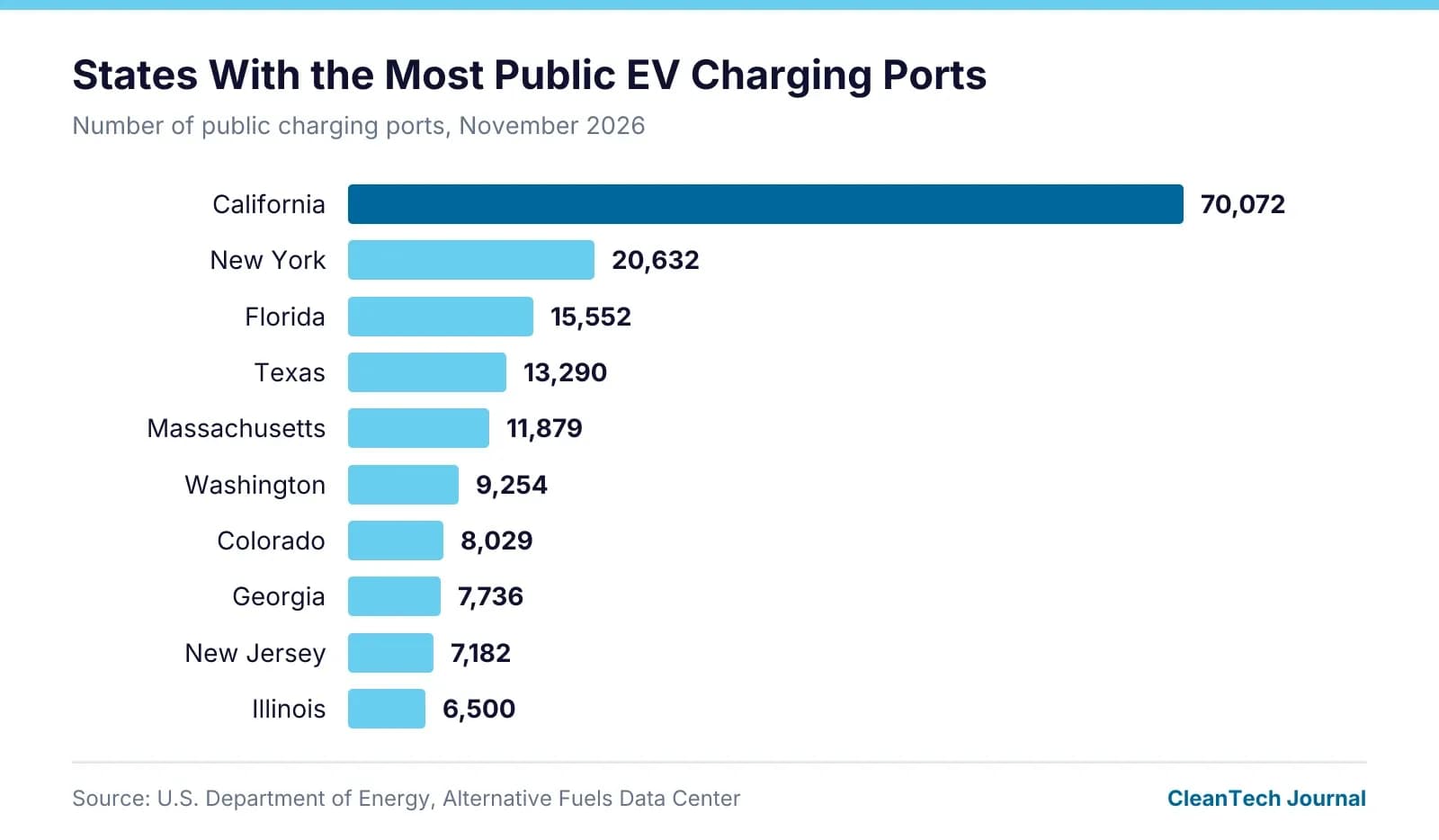
1 | California | 70,072 | 20,671 | 26.5% | 178.0 |
2 | New York | 20,632 | 5,555 | 7.8% | 103.1 |
3 | Florida | 15,552 | 4,466 | 5.9% | 66.3 |
4 | Texas | 13,290 | 3,875 | 5.0% | 41.9 |
5 | Massachusetts | 11,879 | 4,632 | 4.5% | 166.0 |
6 | Washington | 9,254 | 3,237 | 3.5% | 115.7 |
7 | Colorado | 8,029 | 2,969 | 3.0% | 133.5 |
8 | Georgia | 7,736 | 2,413 | 2.9% | 68.4 |
9 | New Jersey | 7,182 | 2,164 | 2.7% | 75.2 |
10 | Illinois | 6,500 | 1,957 | 2.5% | 51.1 |
1. California
California is in a league of its own. It has 70,072 public charging ports at 20,671 EV charging stations, more than New York, Florida, Texas and Massachusetts combined.
That adds up to 26.5% of every public port and about a quarter of all EV charging stations in the US. Only about one in nine Americans lives in California, so the state's share of chargers is more than twice its share of the population.
Its network is also one of the densest, with 178 ports for every 100,000 residents. Only Vermont, with a far smaller population, has more chargers per person.
2. New York
- Public charging ports: 20,632
- Charging locations: 5,555
- Share of US ports: 7.8%
- Ports per 100,000 residents: 103
New York's locations average about 3.7 ports each, the highest in the top 10, so many sites can charge several cars at once. Its density is well above the national average of about 77 ports per 100,000 residents.
3. Florida
Florida has 15,552 public charging ports at 4,466 locations, enough for third place, but its size works against it on density. As the third most populous state, it has 66 ports per 100,000 residents, below the national average and well behind New York and California.
4. Texas
Texas has the fourth-largest network, with 13,290 public charging ports at 3,875 EV charging stations. The total looks large until you factor in the state's population of nearly 32 million.
That leaves Texas with about 42 ports per 100,000 residents. It is the lowest density in the top 10 and just over half the national average, making Texas the state where the gap between size and coverage is widest.
5. Massachusetts
Massachusetts has 11,879 public charging ports, fewer than Florida or Texas, yet more charging locations than either, at 4,632. Its sites are smaller, averaging about 2.6 ports each.
Why it stands out: with 166 ports per 100,000 residents, Massachusetts has the third-densest network in the country, behind only Vermont and California.
6. Washington
Washington has 9,254 public charging ports at 3,237 locations, the most of any state in the Pacific Northwest and well ahead of Oregon's 4,381.
At about 116 ports per 100,000 residents, its network is roughly 50% denser than the national average.
7. Colorado
- Public charging ports: 8,029
- Charging locations: 2,969
- Ports per 100,000 residents: 134
Colorado is the only Mountain West state in the top 10. Despite having far fewer people, it has a denser network than New York, Florida or Texas.
8. Georgia
Georgia has 7,736 public charging ports at 2,413 locations, the third-highest total in the South after Florida and Texas. Its density, at about 68 ports per 100,000 residents, is almost the same as Florida's and a little below the national average.
9. New Jersey
New Jersey has 7,182 public charging ports at 2,164 locations, averaging about 3.3 ports per site.
Its density sits right around the national average, at about 75 ports per 100,000 residents. That puts it well behind its neighbor New York, which has about 103.
10. Illinois
Illinois completes the top 10 with 6,500 public charging ports at 1,957 locations, and it is the only Midwestern state on the list.
Its density is about 51 ports per 100,000 residents, second-lowest in the top 10 after Texas. The race for 10th place is close: North Carolina has 5,934 ports and Pennsylvania 5,929.
Where Charging Is Easiest to Find
Total ports favor big states, so density tells a different story. Vermont has the most public charging ports per person, at 212 per 100,000 residents, followed by California at 178 and Massachusetts at 166.
The District of Columbia, with 157 ports per 100,000 residents, Connecticut and Colorado complete the top six. At the other end, Louisiana has just 18.5 ports per 100,000 residents, followed by Mississippi, Alaska and Kentucky, all below 27.
A Network Concentrated in a Few States
The 10 states in this ranking hold 64.3% of all public charging ports at EV charging stations in the US. California alone has more public ports than the 35 states with the fewest chargers and the District of Columbia combined.
That means EV drivers in much of the South, the Great Plains and Alaska still face far fewer charging options. For road trips, the AFDC's free Station Locator shows every public EV charging station, including fast chargers along major highways.
Frequently Asked Questions
What is the difference between an EV charging station and a charging port?
A charging station is a location, such as a parking lot or service area, while a charging port is a single outlet that can charge one vehicle at a time. One station can have many ports, so the number of ports is a better measure of how many cars can charge at once.
What are Level 1, Level 2 and DC fast chargers?
Level 1 chargers use a standard household outlet and add only a few miles of range per hour. Level 2 chargers, common at homes, workplaces and parking lots, are several times faster, while DC fast chargers can add a large share of a battery's range in under an hour and are mostly found along highways.
How long does it take to charge an electric car?
It depends on the charger, the size of the battery and how empty it is. A DC fast charger can often take a car from low to around 80% in 20 to 60 minutes, while a Level 2 charger usually needs several hours for a full charge, which is why many drivers charge overnight at home.
Do all electric cars use the same charging plug?
Not yet. Most non-Tesla EVs in the US have used the CCS connector, while Tesla uses its own plug, now standardized as SAE J3400 and often called NACS. Many carmakers are moving to the J3400 plug, and adapters let drivers use either type of charger.
Is it cheaper to charge an EV at home or at a public charger?
Charging at home is usually cheaper, because you pay your normal residential electricity rate. Public DC fast chargers often charge higher prices per kWh to cover the cost of the equipment and fees, although prices vary widely by network and location.
SOURCES
- U.S. Department of Energy, Alternative Fuels Data Center: Alternative Fueling Station Counts by State (updated November 13, 2026)
- U.S. Census Bureau, State Population Totals: Vintage 2025 Estimates
- U.S. Department of Energy, Alternative Fuels Data Center: Station Locator
Written by
Suraj Kadam
Suraj Kadam is a journalist and Chief Editor of CleanTech Journal, a knowledge and media platform covering clean technology, solar energy, and renewable energy. He reports on emerging technologies, industry developments, policy trends, and innovations shaping the global clean energy transition. Through his editorial work, Suraj aims to make complex clean technology topics accessible to industry professionals, researchers, policymakers, and readers interested in sustainable energy. His work focuses on delivering insightful, informative, and engaging coverage of the evolving renewable energy landscape.