Top 10 Biggest Electric Car Companies in the World
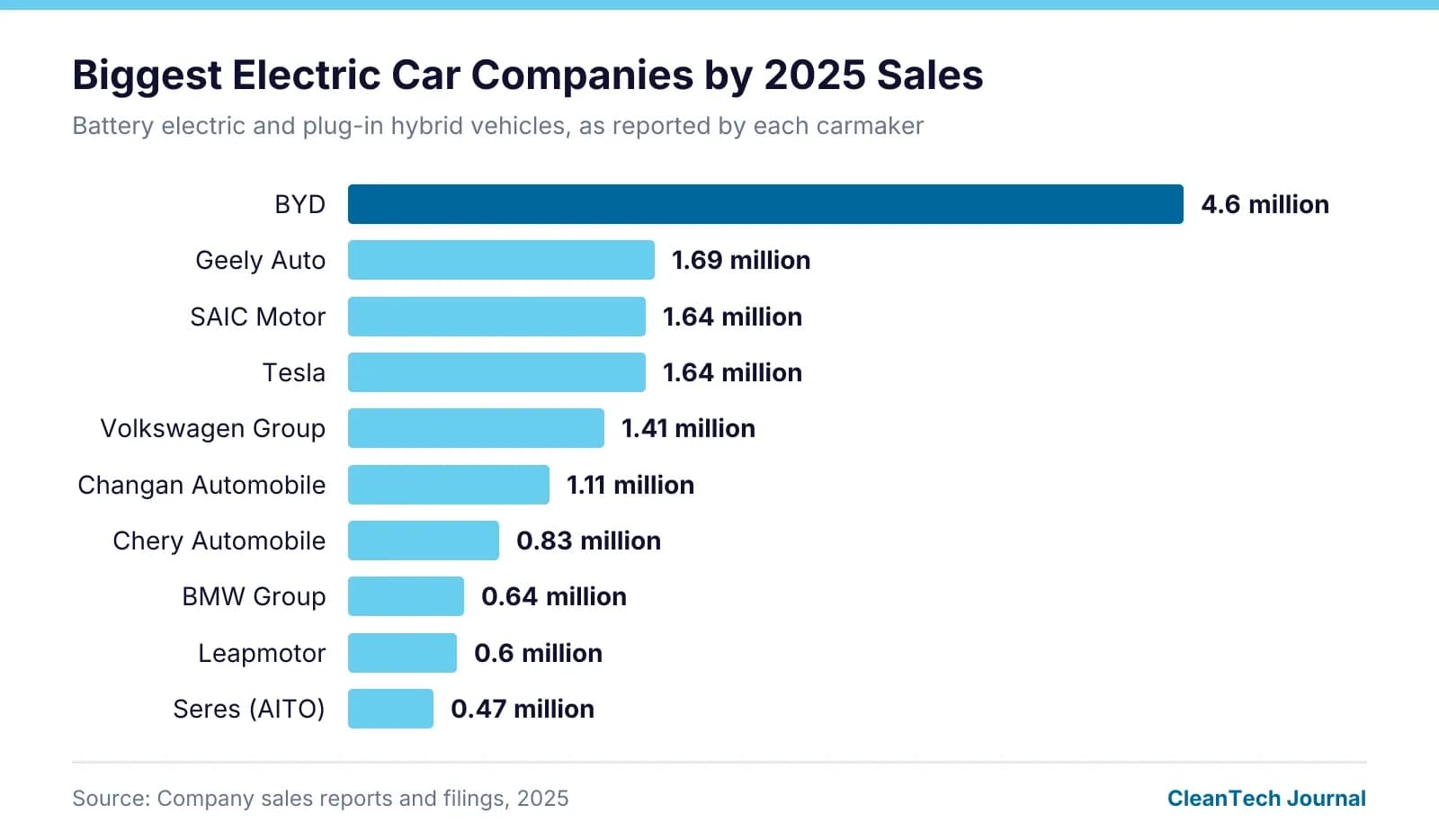
BYD leads the top 10 biggest electric car companies in the world, ahead of Geely, SAIC and Tesla, ranked by the carmakers' own 2025 sales figures.

Suraj Kadam
Published •25 min read
These are the 10 biggest electric car companies in the world, ranked by how many electric vehicles each sold in 2025, using the figures the carmakers themselves reported. Battery electric cars and plug-in hybrids are counted together, the same way the International Energy Agency measures the global electric car market, which passed 20 million sales in 2025.
BYD leads by a wide margin with more than 4.6 million sales, more than the next two companies combined. Seven of the 10 are Chinese, while Tesla, Volkswagen Group and BMW Group are the only carmakers from outside China.
Electric Car Companies Ranked by 2025 Sales
Rank | Company | Electric vehicle sales in 2025 | Main electric brands |
|---|---|---|---|
1 | BYD | 4,602,436 | BYD, Denza, Fangchengbao, Yangwang |
2 | Geely Auto | 1,687,767 | Geely Galaxy, Zeekr, Lynk & Co |
3 | SAIC Motor | About 1.64 million | MG, IM, Roewe, Wuling, Baojun |
4 | Tesla | 1,636,129 | Tesla |
5 | Volkswagen Group | 1,411,100 | Volkswagen, Škoda, Audi, CUPRA, Porsche |
6 | Changan Automobile | About 1.11 million | Deepal, Avatr, Changan Nevo |
7 | Chery Automobile | About 827,000 | Chery, iCAR, Luxeed, Exeed, Jetour |
8 | BMW Group | 642,087 | BMW, MINI |
9 | Leapmotor | 596,555 | Leapmotor |
10 | Seres | 472,269 | AITO |
1. BYD
BYD sold 4,602,436 electric vehicles in 2025, up about 8% from the year before. Almost all were passenger cars, at 4,545,423, with the rest made up of buses and other commercial vehicles.
Its car sales were split almost evenly between battery electric and plug-in hybrid models, at 2,256,714 and 2,288,709. BYD stopped making petrol-only cars in 2022, so every car it sells is electric.
Overseas sales are now a key part of its growth. In December 2025 alone, BYD exported 133,172 electric vehicles.
2. Geely Auto
Geely Auto sold 1,687,767 electric vehicles in 2025, up 90% from 2024. That made up more than half of its total sales of 3,024,567 vehicles.
Most of this growth came from its Geely Galaxy range, which sold about 1.24 million vehicles. Its premium brands, Zeekr and Lynk & Co, also add electric models to the group.
Its parent company, Zhejiang Geely Holding, also owns Volvo Cars and Polestar, which report their sales separately and are not counted here.
3. SAIC Motor
SAIC Motor sold about 1.64 million electric vehicles in 2025, up 33% from 2024. It sold 4.5 million vehicles in total.
Its electric sales include its own brands, such as MG, IM and Roewe, as well as joint ventures. The largest of these is SAIC-GM-Wuling, which sold about 1 million electric vehicles, led by small, affordable city cars.
SAIC's total also includes electric cars from its joint ventures with Volkswagen and General Motors in China. Some of these vehicles are also counted in Volkswagen Group's figures.
4. Tesla
Tesla delivered 1,636,129 vehicles in 2025, all of them battery electric. That makes it the largest electric carmaker from outside China. Only BYD sold more battery electric cars.
Its deliveries fell about 9% from 2024, the second year in a row of decline. Tesla delivered 418,227 vehicles in the fourth quarter.
Unlike most carmakers in this list, Tesla sells only a few models, led by the Model Y and Model 3.
5. Volkswagen Group
Volkswagen Group sold 1,411,100 electric vehicles in 2025, made up of 983,120 battery electric and 427,980 plug-in hybrid models. Its battery electric deliveries rose 32%, while plug-in hybrids grew 58%.
The group sells electric cars under many brands. Its best sellers include the Volkswagen ID.4 and ID.3, the Škoda Elroq and Enyaq, the CUPRA Born, the Audi Q4 e-tron and the Porsche Macan.
Electric vehicles made up close to 16% of all its deliveries in 2025.
6. Changan Automobile
Changan Automobile sold about 1.11 million electric vehicles in 2025, a record and up 51% from the year before. Its total sales were 2.91 million vehicles.
Its electric cars are sold mainly under three names: Deepal, which sold 325,096 vehicles, Avatr, at 123,472, and the Changan Nevo range.
7. Chery Automobile
Chery Automobile sold about 827,000 electric vehicles in 2025, according to its first annual report since listing in Hong Kong. Its total sales were 2,631,381 vehicles.
Chery is also China's largest car exporter. Its electric models are sold under several brands, including iCAR, Luxeed, Exeed and Jetour, as well as Chery itself.
8. BMW Group
BMW Group sold 642,087 electric vehicles in 2025, up 8% from 2024. Of these, 442,072 were battery electric, about 69% of the total.
The group's MINI brand is now among the most electrified premium brands. More than one in three MINIs delivered in 2025 were fully electric.
BMW's new generation of electric models, known as the Neue Klasse, began production in 2025.
9. Leapmotor
Leapmotor delivered 596,555 vehicles in 2025, more than double its 2024 total, and posted its first full-year profit. It sells both battery electric and extended-range electric models.
Founded in 2015, it is one of the youngest companies in this list. Stellantis, the owner of brands such as Peugeot, Fiat and Jeep, holds a stake in Leapmotor and sells its cars outside China.
10. Seres
Seres sold 472,269 electric vehicles in 2025. Most of them were sold under the AITO brand, which Seres builds in partnership with technology company Huawei.
AITO focuses on large, premium SUVs, such as the AITO M7, M8 and M9. Most of these models are extended-range electric vehicles, which use a small petrol engine to charge the battery.
China Leads the Electric Car Race
Seven of the 10 companies in this list are Chinese. Together, BYD, Geely Auto and SAIC Motor sold close to 8 million electric vehicles in 2025.
Their lead comes from a large home market and a wide range of affordable models. Chinese carmakers are also growing quickly overseas, especially in Southeast Asia, Latin America and Europe.
Other well-known names were close behind the top 10. XPeng delivered 429,445 vehicles and Li Auto 406,343, while Mercedes-Benz sold 368,600 electric cars.
Plug-In Hybrids Are Growing Fast
Battery electric cars still make up most electric sales outside China. Tesla sells only battery electric cars, while about 70% of Volkswagen Group's and BMW Group's electric sales were battery electric.
Plug-in hybrids are catching up. At BYD, they now make up just over half of electric car sales, and Volkswagen Group's plug-in hybrid sales grew almost twice as fast as its battery electric sales in 2025.
Frequently Asked Questions
What is the difference between a battery electric car and a plug-in hybrid?
A battery electric car runs only on electricity stored in its battery and has no petrol engine. A plug-in hybrid has both a battery that can be charged from the grid and a petrol engine, so it can drive short distances on electricity and switch to petrol for longer trips.
What share of new cars sold worldwide are electric?
About one in four new cars sold worldwide in 2025 was electric, more than 20 million in total, according to the International Energy Agency. The agency expects electric cars to reach about 28% of global car sales in 2026, or around 23 million.
Which country buys the most electric cars?
China is by far the largest electric car market. Nearly 55% of new cars sold in China in 2025 were electric, compared with 28% in Europe and just under 10% in the United States.
What is an extended-range electric vehicle?
An extended-range electric vehicle (EREV) is driven only by electric motors but carries a small petrol engine that works as a generator to recharge the battery. The engine never drives the wheels directly, which gives these cars a long total range while most daily driving stays electric.
Are electric cars cheaper than petrol cars?
In China, about 70% of battery electric cars sold in 2025 cost less than the average petrol or diesel car, according to the International Energy Agency. In most other markets electric cars still cost more to buy, but the gap is closing: in Thailand prices have matched petrol cars for two years, and in Indonesia the average premium fell to about 40%.
SOURCES
Written by
Suraj Kadam
Suraj Kadam is a journalist and Chief Editor of CleanTech Journal, a knowledge and media platform covering clean technology, solar energy, and renewable energy. He reports on emerging technologies, industry developments, policy trends, and innovations shaping the global clean energy transition. Through his editorial work, Suraj aims to make complex clean technology topics accessible to industry professionals, researchers, policymakers, and readers interested in sustainable energy. His work focuses on delivering insightful, informative, and engaging coverage of the evolving renewable energy landscape.