Top 10 Countries With the Biggest Biogas Potential From Waste
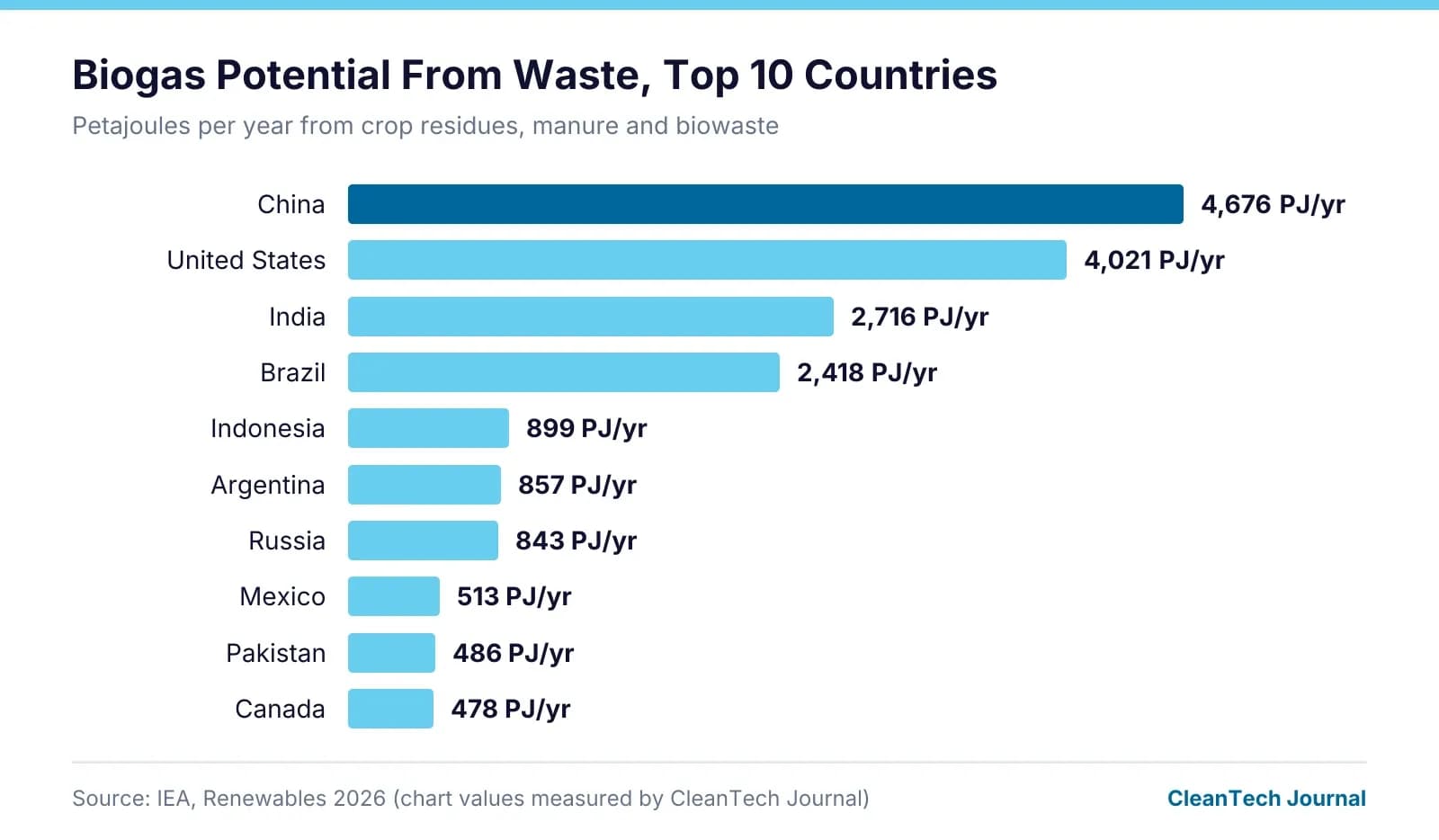
China leads the top 10 countries with the biggest biogas potential from waste, at 4,676 PJ a year, ahead of the United States, India and Brazil.

Suraj Kadam
Published •30 min read
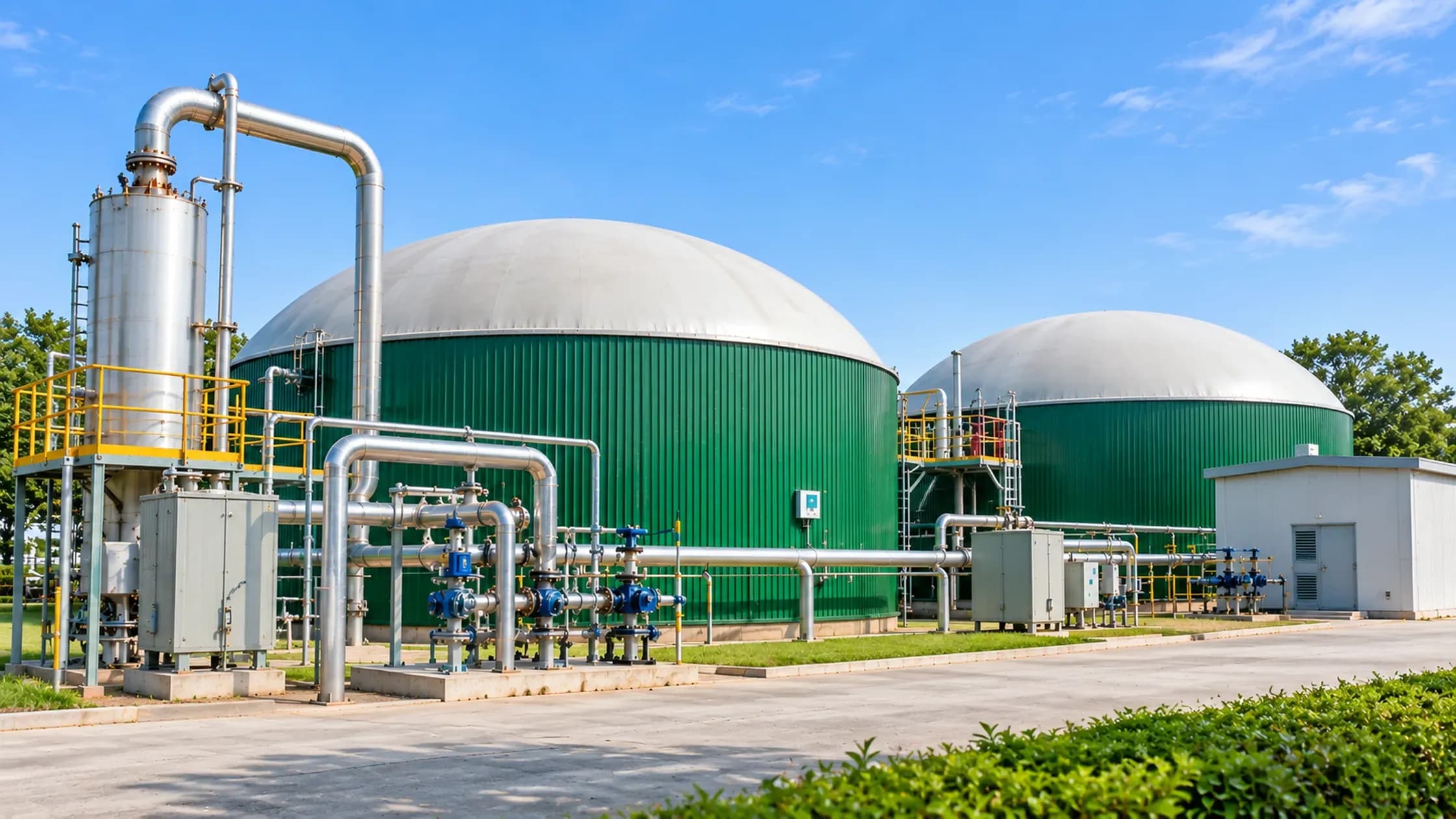
These are the top 10 countries with the biggest biogas potential from waste, based on data in the International Energy Agency's Renewables 2026 report. The ranking measures how much biogas each country could sustainably produce every year from crop residues, animal manure and biowaste such as food and city waste.
China leads with 4,676 petajoules (PJ) a year, ahead of the United States, India and Brazil, which together hold most of the potential in the list. In almost every country, only a small part of this potential is used today, which leaves large room for growth.
Countries Ranked by Biogas Potential From Waste
Rank | Country | Biogas potential from waste (PJ per year) | About (billion cubic metres of gas equivalent) | Largest feedstock |
|---|---|---|---|---|
1 | China | 4,676 | 130 | Crop residues |
2 | United States | 4,021 | 112 | Crop residues |
3 | India | 2,716 | 75 | Crop residues |
4 | Brazil | 2,418 | 67 | Crop residues |
5 | Indonesia | 899 | 25 | Crop residues |
6 | Argentina | 857 | 24 | Crop residues |
7 | Russia | 843 | 23 | Crop residues |
8 | Mexico | 513 | 14 | Crop residues |
9 | Pakistan | 486 | 13 | Animal manure |
10 | Canada | 478 | 13 | Crop residues |
How We Ranked These 10 Countries
- Ranked by: each country's yearly potential to produce biogases from waste and residues that can be collected sustainably: crop residues, animal manure and biowaste. This is the only measure used for the order.
- Data source: IEA, Renewables 2026: Analysis and forecasts to 2031, chapter 4 (biogases), retrieved 2026-11-11.
- Included: the 10 countries in the report's chart of waste feedstock potential. We also checked the report's separate chart of European countries. The largest there, Ukraine, has about 435 PJ a year, below 10th-placed Canada.
- Excluded: Europe, which the chart shows as one region (3,080 PJ a year), and countries not shown in the report's charts.
- Ties: none.
- Figures: the source chart has no printed values, so CleanTech Journal measured each bar from the chart data in the report and rounded it to the nearest PJ. Gas equivalents use the report's conversion of 36 PJ per billion cubic metres. Comparisons between entries are our own calculation from these figures.
1. China
China has the largest biogas potential in this ranking, at 4,676 PJ a year, or about 130 billion cubic metres of gas equivalent. Crop residues make up 61% of it, animal manure 29% and biowaste 11%.
China produced about 409 PJ of biogases in 2025, equal to around 9% of its waste potential. According to the report, the country once had 42 million small household digesters, a number that peaked in 2015 before falling.
Since 2019, China has shifted towards larger industrial plants that upgrade biogas into biomethane. It has set production targets of 10 billion cubic metres a year by 2025 and 20 billion cubic metres by 2030, although the report says progress has been slower than planned.
2. United States
The United States ranks second with 4,021 PJ a year, about 112 billion cubic metres of gas equivalent. Crop residues dominate, at 76% of the total.
The country already has the world's largest market for renewable natural gas, or upgraded biogas. The report puts its 2025 output at around 151 PJ, 38% of global production, driven by the Renewable Fuel Standard and California's Low Carbon Fuel Standard.
Most of this gas comes from landfills, with dairy manure the next biggest source. Across North America, the industry added a record 130 new renewable natural gas facilities in 2025, led by food waste projects.
3. India
India's biogas potential is 2,716 PJ a year, about 75 billion cubic metres of gas equivalent. Its mix is the most balanced of the top four: crop residues make up 50%, manure 33% and biowaste 17%.
India has used small biogas units for clean cooking in rural areas since the 1980s, but output is still low at about 1.4% of its potential. The government now requires city gas companies to blend compressed biogas into their supply, starting at 1% in 2025-26 and rising to 5% by 2028-29.
The first-year target was met, with blending reaching 1.05%. A new national scheme launched in 2026 aims to raise compressed biogas production nearly tenfold, according to the report.
4. Brazil
Brazil ranks fourth with 2,418 PJ a year, about 67 billion cubic metres of gas equivalent. Crop residues make up 59% of the potential and manure 31%, reflecting the country's large farming and livestock sectors.
Its 2025 production equalled only about 2% of this potential. That could change under the Fuel of the Future Law, which requires natural gas producers and importers to cut emissions by using biomethane or buying biomethane certificates.
The obligation starts in 2026. The report notes the first-year target was set at 0.5%, revised down from an initial 1%.
5. Indonesia
Indonesia's potential is 899 PJ a year, about 25 billion cubic metres of gas equivalent. Crop residues make up 68% of it, and manure 24%.
The report says Indonesia has the most abundant biogas feedstock in Southeast Asia because of its large palm oil industry, including wastewater from palm oil mills. Treating this wastewater also cuts methane emissions, and policy is shifting from on-site power towards biomethane that can replace imported LPG.
In 2025, state-owned PalmCo broke ground on the country's first compressed biogas plant using palm oil mill waste, in North Sumatra. It is due to start full operations in the fourth quarter of 2026.
6. Argentina
Argentina has 857 PJ a year of potential, about 24 billion cubic metres of gas equivalent, just 42 PJ behind Indonesia. Crop residues from its large grain sector make up 75% of the total.
Production is still small, at under 1% of the potential. Reporting by La Nación in 2024 counted about 30 biogas plants in operation, mostly in Córdoba, San Luis, Buenos Aires and Santa Fe.
The country's renewable energy chamber estimates that 324 biomethane plants could be built using available waste.
7. Russia
Russia's potential is 843 PJ a year, about 23 billion cubic metres of gas equivalent, only 14 PJ behind Argentina. Crop residues make up 75% of it, reflecting the country's role as a major grain producer.
The chart shows almost no biogas production in Russia today, so nearly all of this potential is still unused.
8. Mexico
Mexico has 513 PJ a year of potential, about 14 billion cubic metres of gas equivalent. It has the most even mix in the list: crop residues make up 40%, manure 39% and biowaste 21%.
That biowaste share, from sources such as food and city waste, is the highest of any country in the ranking. The chart shows very little biogas production in Mexico so far.
9. Pakistan
Pakistan's potential is 486 PJ a year, about 13 billion cubic metres of gas equivalent. It is the only country in the ranking where animal manure, not crop residues, is the largest feedstock, at 65% of the total.
This reflects the country's large livestock sector. The chart shows almost no biogas production in Pakistan today, even though small household digesters are already used in some rural areas.
10. Canada
Canada completes the list with 478 PJ a year, about 13 billion cubic metres of gas equivalent, just 8 PJ behind Pakistan. Crop residues make up 76% of the total.
Its 2025 production equalled about 8% of its potential, one of the highest rates in the list. According to the report, Canada still imports almost half of the renewable natural gas it uses, and domestic output is expected to grow 75% by 2031.
Provincial rules are a key driver. British Columbia requires 15% renewable natural gas in its pipelines by 2030.
Crop Residues Make Up Most of the Potential
Crop residues are the largest feedstock in nine of the 10 countries. Pakistan is the only exception, with animal manure making up most of its potential.
Biowaste, such as food scraps and city waste, is the smallest of the three sources in eight of the 10 countries. Its share ranges from 5% in Argentina to 21% in Mexico.
This matters because crop residues are spread across large farming areas. Collecting and transporting them is one of the main challenges in turning this potential into actual gas.
Most of This Potential Is Still Unused
In 2025, production in China and Canada equalled only about 8-9% of their waste potential, and in the United States about 6%. In India, Brazil, Indonesia and Argentina, the figure was below 3%.
For comparison, production in Europe, which the report shows as one region, equalled about 26% of its potential. The gap shows how much room the top 10 countries still have to grow.
Together, the 10 countries hold about 497 billion cubic metres of gas equivalent a year. That is around 61% of the global waste-based potential of more than 810 billion cubic metres estimated in the report.
SOURCES
- IEA, Renewables 2026: Analysis and forecasts to 2031
- Bioenergy News: North American RNG industry adds record 130 facilities in 2025
- Swarajya: India surpasses FY26 compressed biogas blending target
- Mayer Brown: Brazil regulates the national biomethane program
- Petromindo: PalmCo breaks ground on Indonesia's first palm waste CBG plant
- La Nación: 324 biomethane plants could transform Argentina's energy supply
Written by
Suraj Kadam
Suraj Kadam is a journalist and Chief Editor of CleanTech Journal, a knowledge and media platform covering clean technology, solar energy, and renewable energy. He reports on emerging technologies, industry developments, policy trends, and innovations shaping the global clean energy transition. Through his editorial work, Suraj aims to make complex clean technology topics accessible to industry professionals, researchers, policymakers, and readers interested in sustainable energy. His work focuses on delivering insightful, informative, and engaging coverage of the evolving renewable energy landscape.