Top 10 European Countries by Biogas Potential From Waste
Ukraine leads the top 10 European countries by biogas potential from waste, at 435 PJ a year, ahead of Germany, France and Türkiye. See the full ranking.

Suraj Kadam
Published •27 min read
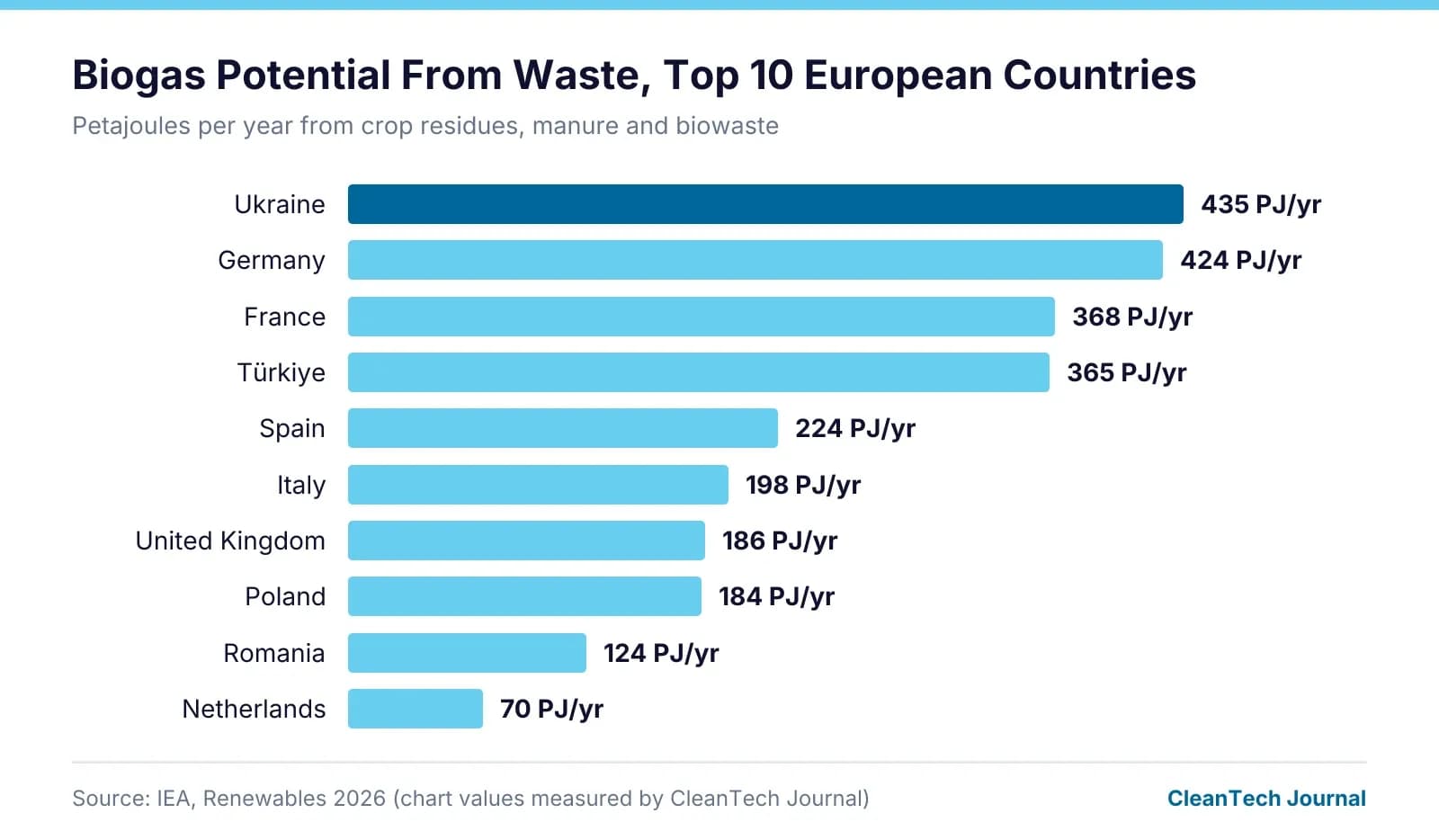
These are the top 10 European countries by biogas potential from waste, based on data in the International Energy Agency's Renewables 2026 report. The ranking measures how much biogas each country could sustainably produce every year from crop residues, animal manure and biowaste such as food and city waste.
Ukraine leads with 435 petajoules (PJ) a year, just ahead of Germany, but it produces almost none of it today. Germany, the United Kingdom and Italy already turn a large part of their potential into gas, while Ukraine, Romania and Spain have barely started.
European Countries Ranked by Biogas Potential From Waste
Rank | Country | Biogas potential from waste (PJ per year) | About (billion cubic metres of gas equivalent) | Largest feedstock |
|---|---|---|---|---|
1 | Ukraine | 435 | 12.1 | Crop residues |
2 | Germany | 424 | 11.8 | Crop residues |
3 | France | 368 | 10.2 | Crop residues |
4 | Türkiye | 365 | 10.1 | Crop residues |
5 | Spain | 224 | 6.2 | Animal manure |
6 | Italy | 198 | 5.5 | Crop residues |
7 | United Kingdom | 186 | 5.2 | Crop residues |
8 | Poland | 184 | 5.1 | Crop residues |
9 | Romania | 124 | 3.4 | Crop residues |
10 | Netherlands | 70 | 2.0 | Animal manure |
How We Ranked These 10 Countries
- Ranked by: each country's yearly potential to produce biogases from waste and residues that can be collected sustainably: crop residues, animal manure and biowaste. This is the only measure used for the order.
- Data source: IEA, Renewables 2026: Analysis and forecasts to 2031, chapter 4 (biogases), retrieved 2026-11-11.
- Included: the 14 European countries in the report's chart of waste feedstock potential. Hungary is 11th, at 63 PJ a year.
- Excluded: European countries not shown in that chart, and Russia, which the report counts outside its Europe region.
- Ties: none.
- Figures: the source chart has no printed values, so CleanTech Journal measured each bar from the chart data in the report and rounded it to the nearest PJ. Gas equivalents use the report's conversion of 36 PJ per billion cubic metres. Comparisons between entries are our own calculation from these figures.
1. Ukraine
Ukraine has the largest biogas potential in Europe, at 435 PJ a year, or about 12 billion cubic metres of gas equivalent. Crop residues from its huge grain and oilseed farms make up 89% of it, the highest share in the list.
Yet its 2025 production equalled only about 1% of this potential. The report notes that the European Union is building rules to allow biomethane imports from Ukraine, which is already linked to EU markets by gas pipelines and storage.
Exports have started on a small scale. Ukraine's government reported its first pipeline export of biomethane to the EU in February 2025, a shipment of 67,000 cubic metres.
2. Germany
Germany ranks second with 424 PJ a year, just 11 PJ behind Ukraine. Crop residues make up 77% of its potential and manure 19%.
It is Europe's biggest producer. Its 2025 output of about 321 PJ equalled 76% of its waste potential, the highest ratio in the list.
For years, Germany's Renewable Energy Sources Act has supported biogas plants mainly to make electricity. New rules, including a green gas quota for energy distributors from 2028, aim to shift more output into biomethane.
3. France
France has 368 PJ a year of potential, about 10 billion cubic metres of gas equivalent. Crop residues make up 68% of it and manure 24%.
Its 2025 production equalled about 26% of this potential. According to the report, France has led Europe's biomethane growth with Italy, increasing production elevenfold over the past six years.
From 2026, gas suppliers must surrender biomethane certificates in proportion to their sales. The report expects French biomethane output to double again by 2031.
4. Türkiye
Türkiye ranks fourth with 365 PJ a year, just 3 PJ behind France. It has one of the most balanced mixes in the list: crop residues make up 44%, manure 30% and biowaste 26%.
Its 2025 production equalled about 13% of its potential. As a large importer of natural gas, Türkiye could use more of this domestic resource to reduce its import needs.
5. Spain
Spain has 224 PJ a year of potential, about 6 billion cubic metres of gas equivalent. It is one of only two countries in the list where animal manure, at 40%, is the largest feedstock.
Production is still low, equal to about 7% of its potential in 2025. The report lists Spain among the countries where biomethane has recently taken off, with announced projects adding 8.5 TWh a year of capacity.
Spain's updated climate plan targets 20 TWh a year of biogas by 2030. A 2026 law also requires the government to set mandatory biomethane targets for gas use outside transport.
6. Italy
Italy's potential is 198 PJ a year, about 5.5 billion cubic metres of gas equivalent. Biowaste makes up 34% of it, the highest share of any country in the list.
Its 2025 production equalled about 43% of this potential. The report says Italian biomethane production grew eightfold over the past six years, and Italy has Europe's largest biomethane project pipeline, with 83 PJ a year of new capacity planned.
Italy targets 5.7 billion cubic metres of biomethane a year by 2030. Larger biogas power plants will need to switch to biomethane after 2030 to keep receiving public support.
7. United Kingdom
The United Kingdom has 186 PJ a year of potential, about 5.2 billion cubic metres of gas equivalent. Crop residues make up 61% of it.
Its 2025 production equalled about 55% of this potential, the second-highest ratio in the list after Germany. The report notes that UK biomethane output grew by more than 12% in both 2024 and 2025.
The Green Gas Support Scheme, the main subsidy for new plants, has been extended, with a final registration deadline of 31 March 2030. Separate food waste collection for households in England is also becoming mandatory in 2026.
8. Poland
Poland ranks eighth with 184 PJ a year, just 2 PJ behind the United Kingdom. Crop residues make up 65% of its potential and manure 26%.
Its 2025 production equalled only about 9% of this potential, leaving most of it unused. As one of Europe's largest farm producers, Poland has crop residues and manure available across the country.
9. Romania
Romania has 124 PJ a year of potential, about 3.4 billion cubic metres of gas equivalent. Crop residues make up 71% of it.
The chart shows almost no biogas production in Romania today, so nearly all of this potential is unused.
10. Netherlands
The Netherlands completes the list with 70 PJ a year, about 2 billion cubic metres of gas equivalent. It is the other country where manure is the largest feedstock, at 48% of the total.
Its 2025 production equalled about 28% of this potential. The SDE++ scheme supports green gas plants, and the government has proposed an obligation for gas suppliers to blend green gas from 2027.
Crop Residues Lead, but Manure and Waste Matter in the South
Crop residues are the largest feedstock in eight of the 10 countries. Ukraine, Germany and Romania rely on them most, with shares above 70%.
The picture is more mixed in southern Europe. Manure is the largest source in Spain, while Italy, Spain and Türkiye have the highest shares of biowaste, between 26% and 34%.
Western Europe Uses Its Potential, the East Has Barely Started
The biggest gap in the list is between production and potential. Germany, the United Kingdom and Italy already produce gas equal to 43% to 76% of their waste potential.
At the other end, Ukraine and Romania produce almost no biogas. Together they hold about 559 PJ a year of potential that is almost entirely unused, more than Germany's entire waste potential.
SOURCES
Written by
Suraj Kadam
Suraj Kadam is a journalist and Chief Editor of CleanTech Journal, a knowledge and media platform covering clean technology, solar energy, and renewable energy. He reports on emerging technologies, industry developments, policy trends, and innovations shaping the global clean energy transition. Through his editorial work, Suraj aims to make complex clean technology topics accessible to industry professionals, researchers, policymakers, and readers interested in sustainable energy. His work focuses on delivering insightful, informative, and engaging coverage of the evolving renewable energy landscape.