Top 10 Wind Power Countries Ranked By Installed Capacity
Wind power countries ranked by installed capacity in 2025 from IRENA, led by China at 640,626 MW. See the top 10 to the Philippines.

Suraj Kadam
Published •20 min read
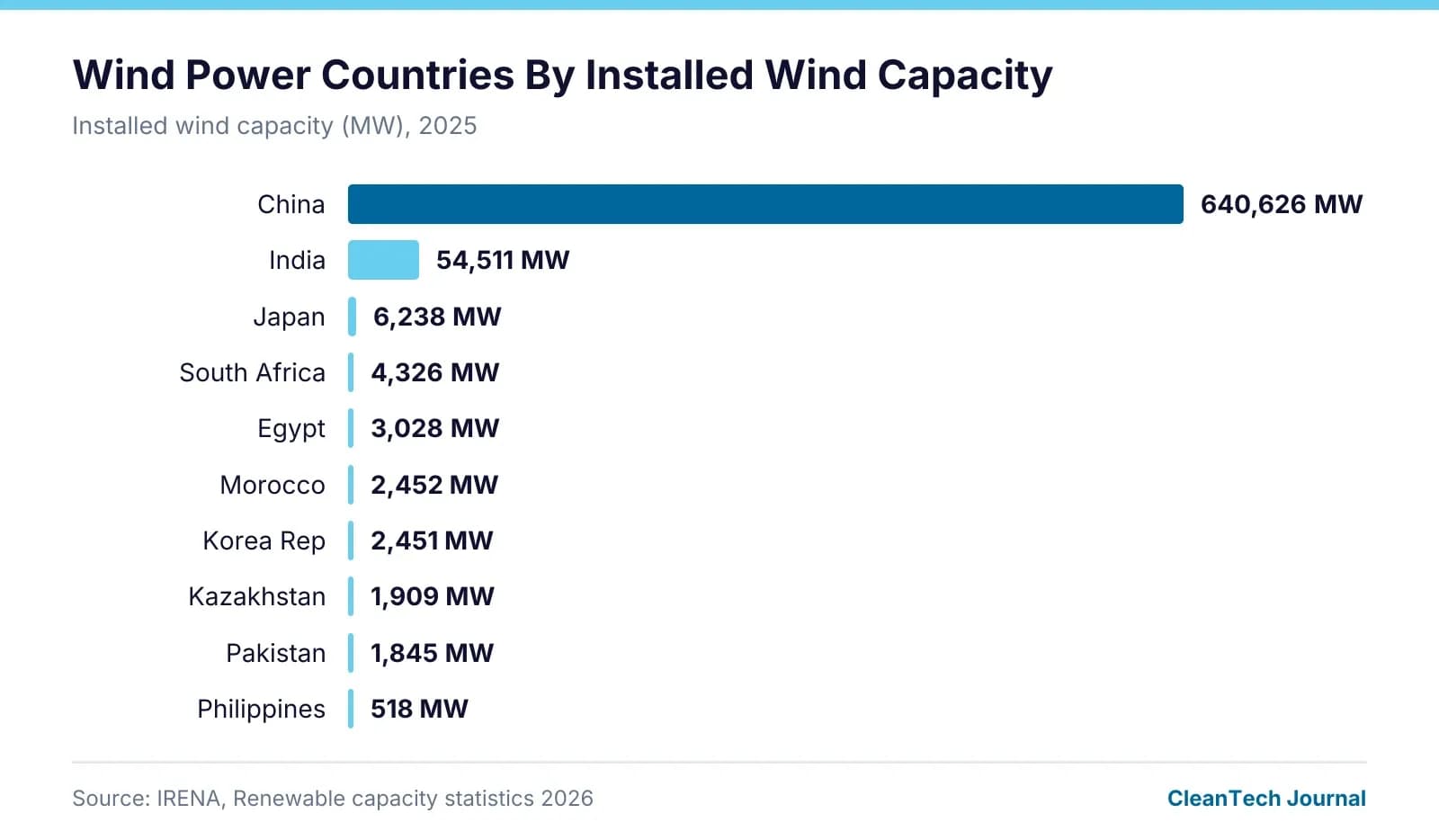
These wind power countries are ranked by installed wind capacity in MW for 2025, using IRENA data from Renewable capacity statistics 2026. The figures reflect capacity installed and connected at the end of the calendar year, with data presented in megawatts rounded to the nearest one megawatt.
China sits at the top of this wind power countries ranking with 640,626 MW in 2025, far ahead of India at 54,511 MW and Japan at 6,238 MW. The list then runs through South Africa, Egypt, Morocco, Korea Rep, Kazakhstan, Pakistan and the Philippines.
Wind Power Countries Ranked By Installed Wind Capacity
Rank | Country | Installed wind capacity (MW) |
|---|---|---|
1 | China | 640,626 |
2 | India | 54,511 |
3 | Japan | 6,238 |
4 | South Africa | 4,326 |
5 | Egypt | 3,028 |
6 | Morocco | 2,452 |
7 | Korea Rep | 2,451 |
8 | Kazakhstan | 1,909 |
9 | Pakistan | 1,845 |
10 | Philippines | 518 |
How We Ranked These 10 Countries
- Ranked by: installed wind capacity (MW), 2025 data. This is the only measure used for the order.
- Data source: IRENA, Renewable capacity statistics 2026, retrieved 2026-11-09.
- Included: Countries by installed wind capacity at the end of the latest year, onshore and offshore.
- Excluded: Planned capacity.
- Ties: none in this list. If two entries had the same figure, new capacity added in the year would decide.
- Figures: reported exactly as published by the source. CleanTech Journal does not estimate or adjust them; comparisons between entries are our own calculation from these figures.
1. China: 640,626 MW
China ranks first with 640,626 MW of installed wind capacity in 2025. That equals 89.2% of the list total, and the gap to second-placed India is 586,115 MW, the largest gap between neighbours in this ranking. China’s 2024 figure in the same dataset was 521,266 MW. IRENA’s report says 2025 saw 159 GW of wind energy added worldwide, while global wind capacity reached 1,291,368 MW by year-end. China is listed in Asia, the region that reached 723,843 MW of wind capacity in 2025.
2. India: 54,511 MW
India is second with 54,511 MW of installed wind capacity in 2025. It accounts for 7.6% of the list total and sits 586,115 MW behind China, while remaining 48,273 MW ahead of Japan in third. The ranking notes India at 48,163 MW in 2024, showing a higher 2025 total in IRENA’s latest release. In the broader IRENA tables, India also appears among Asia’s major renewable power markets, and the agency says renewables made up 49% of global installed power capacity by the end of 2025.
3. Japan: 6,238 MW
Japan places third with 6,238 MW in installed wind capacity for 2025. That gives it 0.9% of the list total. The gap to India above is 48,273 MW, while the gap to South Africa below is 1,912 MW. Japan’s 2024 figure was 5,858 MW. IRENA’s wind tables also show Japan with both onshore and offshore wind capacity in 2025. Within this top 10, Japan marks the point where the ranking shifts from the two largest totals to a much tighter group of countries below.
4. South Africa: 4,326 MW
South Africa ranks fourth with 4,326 MW of installed wind capacity in 2025, representing 0.6% of the list total. It stands 1,912 MW behind Japan and 1,298 MW ahead of Egypt. The source note shows South Africa at 3,442 MW in 2024. IRENA’s foreword says Africa recorded its highest capacity increase in 2025, rising by 15.9% to reach 82 GW in total renewable capacity, driven by Ethiopia, South Africa and Egypt. In the wind tables, South Africa is also the top entry for Africa in this ranking.
5. Egypt: 3,028 MW
Egypt is fifth with 3,028 MW of installed wind capacity in 2025. That equals 0.4% of the list total. Egypt trails South Africa by 1,298 MW and leads Morocco by 576 MW. Its 2024 figure was 2,199 MW, according to the ranking notes. IRENA also highlights Egypt in Africa’s 2025 renewable growth story, alongside Ethiopia and South Africa. In the wind tables, Egypt’s total places it clearly in the middle of this top 10, above the closely packed group of Morocco, Korea Rep, Kazakhstan and Pakistan.
6. Morocco: 2,452 MW
Morocco takes sixth place with 2,452 MW of installed wind capacity in 2025, or 0.3% of the list total. It sits 576 MW behind Egypt and just 1 MW ahead of Korea Rep, the smallest gap between neighbours anywhere in the ranking. Morocco’s 2024 figure was 2,395 MW. In IRENA’s wider renewable capacity tables, Morocco appears in Africa, and the agency notes that data in the publication reflects installed and connected capacity at the end of the year, presented in megawatts.
7. Korea Rep: 2,451 MW
Korea Rep is seventh with 2,451 MW of installed wind capacity in 2025. That is also 0.3% of the list total. It is only 1 MW behind Morocco and 542 MW ahead of Kazakhstan, placing it in one of the closest parts of the ranking. The 2024 figure in the list notes is 2,261 MW. IRENA’s detailed wind tables show Korea Rep with both onshore and offshore wind capacity in 2025, making it one of the entries in this top 10 with capacity in both segments.
8. Kazakhstan: 1,909 MW
Kazakhstan ranks eighth with 1,909 MW of installed wind capacity in 2025, equal to 0.3% of the list total. It is 542 MW behind Korea Rep and 64 MW ahead of Pakistan, another narrow gap within the lower half of the ranking. Kazakhstan’s 2024 figure was 1,520 MW. In IRENA’s country listings, Kazakhstan appears in Asia. The dataset notes that renewable power capacity figures represent the maximum net generating capacity of installations using renewable energy sources to produce electricity.
9. Pakistan: 1,845 MW
Pakistan is ninth with 1,845 MW of installed wind capacity in 2025, accounting for 0.3% of the list total. It is 64 MW behind Kazakhstan and 1,327 MW ahead of the Philippines. Pakistan’s 2024 figure was also 1,845 MW, the same as its 2025 total in this ranking. In the IRENA tables, Pakistan is listed in Asia, where total wind capacity reached 723,843 MW in 2025. Within this top 10, Pakistan remains part of the tightly grouped lower tier before the drop to the Philippines.
10. Philippines: 518 MW
The Philippines rounds out the ranking with 518 MW of installed wind capacity in 2025. That equals 0.1% of the list total and leaves a 1,327 MW gap to Pakistan above. The ranking note shows the Philippines at 443 MW in 2024. IRENA’s wind tables indicate that the country’s total is onshore wind in 2025. Even as the smallest figure in this top 10, the Philippines remains part of the wider global wind market that IRENA says reached 1,291,368 MW by the end of 2025.
The Top Three Hold 97.7% Of The List's Wind Capacity
Together, the 10 ranked countries have 717,904 MW of installed wind capacity in 2025. The top three alone account for 701,375 MW, or 97.7% of that total, showing how heavily this list is concentrated at the top. China by itself makes up 89.2%, while India contributes 7.6% and Japan 0.9%.
The spread from first to tenth is 640,108 MW. The largest gap between neighbouring entries is from China to India at 586,115 MW, while the smallest is between Morocco and Korea Rep at just 1 MW. Below Japan, the rankings become much tighter, especially from fifth through ninth place.
SOURCES
Written by
Suraj Kadam
Suraj Kadam is a journalist and Chief Editor of CleanTech Journal, a knowledge and media platform covering clean technology, solar energy, and renewable energy. He reports on emerging technologies, industry developments, policy trends, and innovations shaping the global clean energy transition. Through his editorial work, Suraj aims to make complex clean technology topics accessible to industry professionals, researchers, policymakers, and readers interested in sustainable energy. His work focuses on delivering insightful, informative, and engaging coverage of the evolving renewable energy landscape.