Top 10 Energy Startup Countries Ranked By Start-Ups
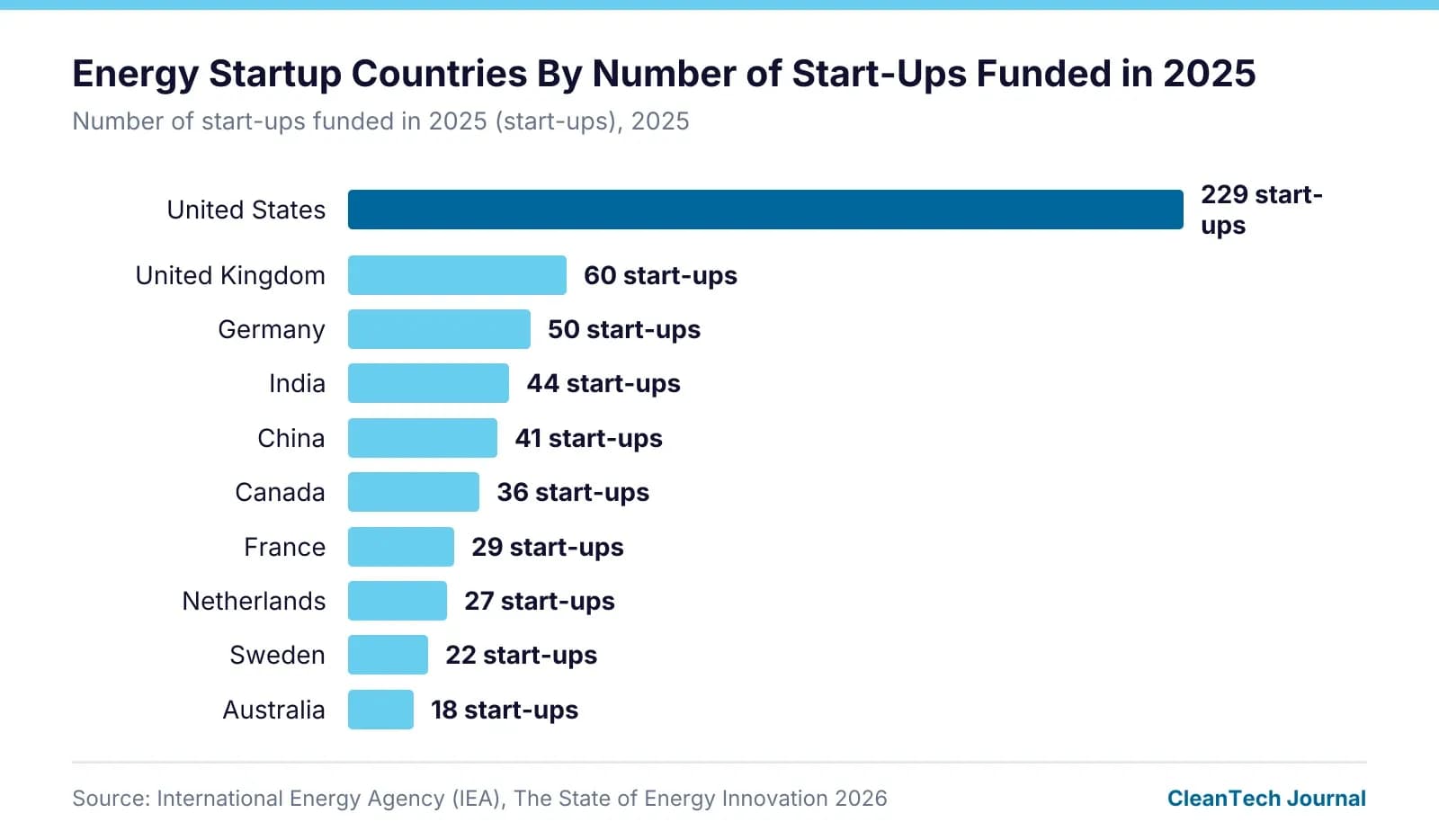
Energy startup countries ranked by funded start-ups in 2025: United States leads the IEA list in The State of Energy Innovation 2026 with 229.

Suraj Kadam
Published •19 min read

This ranking of energy startup countries compares them by the number of energy start-ups funded in 2025, using International Energy Agency data from The State of Energy Innovation 2026. The country figures are reported by location of start-up headquarters.
The United States stands well ahead at 229 start-ups, accounting for 41.2% of the list total. It is followed by the United Kingdom with 60 and Germany with 50, while the 10 ranked countries together account for 556 funded start-ups.
Energy Startup Countries Ranked By Number of Start-Ups Funded in 2025
Rank | Country | Number of start-ups funded in 2025 (start-ups) |
|---|---|---|
1 | United States | 229 |
2 | United Kingdom | 60 |
3 | Germany | 50 |
4 | India | 44 |
5 | China | 41 |
6 | Canada | 36 |
7 | France | 29 |
8 | Netherlands | 27 |
9 | Sweden | 22 |
10 | Australia | 18 |
How We Ranked These 10 Countries
- Ranked by: number of start-ups funded in 2025 (start-ups), 2025 data. This is the only measure used for the order.
- Data source: International Energy Agency (IEA), The State of Energy Innovation 2026, retrieved 2026-11-08.
- Included: Includes the count of energy start-ups that received venture capital funding in 2025, grouped by headquarters country.
- Excluded: Excludes unfunded start-ups, non-energy firms and countries not shown in the table.
- Ties: none in this list. If two entries had the same figure, energy venture capital fundraising in 2025 would decide.
- Figures: reported exactly as published by the source. CleanTech Journal does not estimate or adjust them; comparisons between entries are our own calculation from these figures.
1. United States: 229 start-ups
The United States leads the ranking with 229 funded start-ups in 2025, equal to 41.2% of the list total. It sits 169 start-ups ahead of the United Kingdom, which is the largest gap between neighbors in this top 10. In the IEA venture capital table, US-headquartered energy start-ups raised 13,921 in 2025. The country's top area in 2025 was nuclear, making that the main concentration of funded US energy start-ups in the source data.
2. United Kingdom: 60 start-ups
The United Kingdom ranks second with 60 funded start-ups in 2025, representing 10.8% of the list total. It trails the United States by 169 start-ups and stands 10 ahead of Germany. The IEA data also show 2,003 in 2025 energy venture capital fundraising for UK-headquartered start-ups. Its top area in 2025 was electricity grids, linking the UK's place in the ranking with strong activity in grid-related energy innovation.
3. Germany: 50 start-ups
Germany places third with 50 funded start-ups in 2025, or 9% of the list total. It is 10 start-ups behind the United Kingdom and 6 ahead of India, putting it in the middle of a relatively tight group behind the United States. The IEA table reports 1,448 in 2025 fundraising for Germany-based energy start-ups. Germany's top area in 2025 was end-use: transport, showing where the country's funded energy start-up activity was most concentrated.
4. India: 44 start-ups
India records 44 funded start-ups in 2025, giving it 7.9% of the list total and fourth place in the ranking. It is 6 start-ups behind Germany and 3 ahead of China, one of the narrower gaps in the top 10. The IEA source lists 867 in 2025 energy venture capital fundraising for Indian start-ups by headquarters location. India's top area in 2025 was end-use: transport, the same leading area reported for Germany, China and France.
5. China: 41 start-ups
China ranks fifth with 41 funded start-ups in 2025, equal to 7.4% of the list total. It follows India by 3 start-ups and remains 5 ahead of Canada, keeping the middle of the ranking close. In the IEA table, China records 1,890 in 2025 fundraising for energy start-ups headquartered there. Its top area in 2025 was end-use: transport, matching the main category shown for several other countries in this top 10.
6. Canada: 36 start-ups
Canada stands sixth with 36 funded start-ups in 2025, accounting for 6.5% of the list total. It is 5 start-ups behind China and 7 ahead of France. The IEA data show 781 in 2025 energy venture capital fundraising for Canadian start-ups by headquarters location. Canada's top area in 2025 was nuclear, the same leading area identified for the United States, which sets Canada apart from the transport- and grid-led countries around it in the ranking.
7. France: 29 start-ups
France is seventh with 29 funded start-ups in 2025, or 5.2% of the list total. It sits 7 start-ups behind Canada and just 2 ahead of the Netherlands, the smallest gap between neighbors in the ranking. The IEA source reports 1,453 in 2025 fundraising for France-based energy start-ups. France's top area in 2025 was end-use: transport, placing it alongside Germany, India and China in the transport-focused part of the list.
8. Netherlands: 27 start-ups
The Netherlands ranks eighth with 27 funded start-ups in 2025, representing 4.9% of the list total. It is only 2 start-ups behind France and 5 ahead of Sweden, so it sits in one of the tighter parts of the top 10. The IEA table shows 245 in 2025 fundraising for Dutch energy start-ups by headquarters location. Its top area in 2025 was electricity grids, the same category listed for the United Kingdom and Australia.
9. Sweden: 22 start-ups
Sweden places ninth with 22 funded start-ups in 2025, equal to 4% of the list total. It trails the Netherlands by 5 start-ups and remains 4 ahead of Australia. The IEA data list 491 in 2025 fundraising for Swedish energy start-ups headquartered in the country. Sweden's top area in 2025 was energy efficiency in buildings and industry, making it the only country in this top 10 with that category as its leading area.
10. Australia: 18 start-ups
Australia rounds out the ranking with 18 funded start-ups in 2025, accounting for 3.2% of the list total. It is 4 start-ups behind Sweden, and the spread from the United States at No. 1 to Australia at No. 10 is 211 start-ups. The IEA source shows 358 in 2025 fundraising for Australian energy start-ups by headquarters location. Australia's top area in 2025 was electricity grids, putting it in the same leading category as the United Kingdom and the Netherlands.
The Top Three Countries Account For 61% Of The List Total
Across these energy startup countries, the 10 entries combine for 556 funded start-ups in 2025. The top three countries - the United States, United Kingdom and Germany - account for 339 start-ups, or 61% of the list total. The United States alone represents 41.2%, while the United Kingdom accounts for 10.8% and Germany for 9%.
After the No. 1 position, the ranking becomes much tighter. The largest gap between neighbors is the 169-start-up lead from the United States to the United Kingdom, while the smallest is the 2-start-up difference between France and the Netherlands. The middle of the list is also close, with India on 44, China on 41 and Canada on 36.
SOURCES
Written by
Suraj Kadam
Suraj Kadam is a journalist and Chief Editor of CleanTech Journal, a knowledge and media platform covering clean technology, solar energy, and renewable energy. He reports on emerging technologies, industry developments, policy trends, and innovations shaping the global clean energy transition. Through his editorial work, Suraj aims to make complex clean technology topics accessible to industry professionals, researchers, policymakers, and readers interested in sustainable energy. His work focuses on delivering insightful, informative, and engaging coverage of the evolving renewable energy landscape.