Top 10 Public Energy R&D Countries Ranked By GDP Share
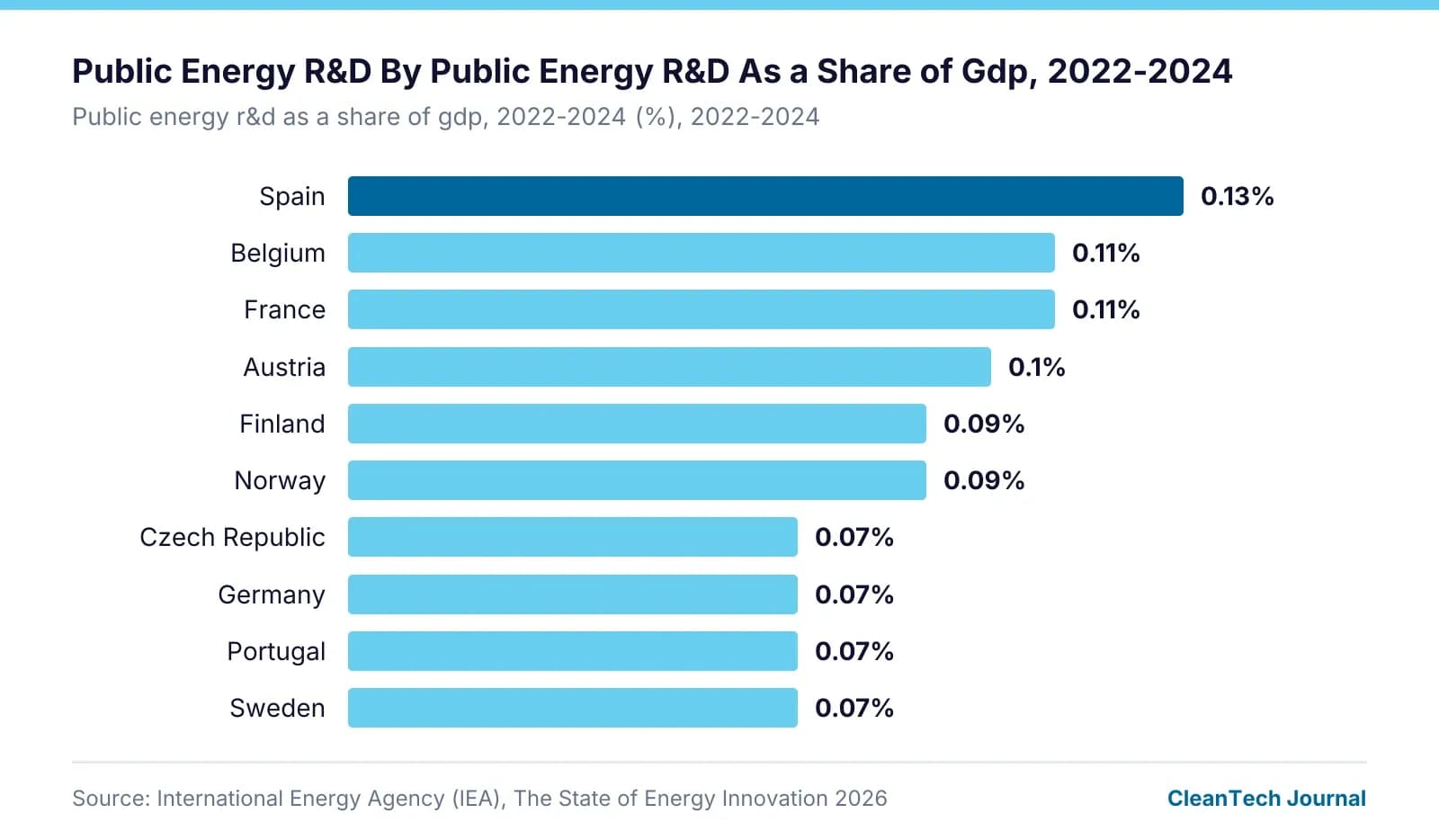
Public energy r&d countries ranked by GDP share from the IEA. Spain leads at 0.13% in 2022-2024 on a research-effort measure, ahead of Belgium and France.

Suraj Kadam
Published •20 min read
Countries are ranked here for public energy R&D by public energy R&D as a share of GDP in 2022-2024, using data from the International Energy Agency’s The State of Energy Innovation 2026.
Spain leads at 0.13%, with Belgium and France next at 0.11%. The IEA’s framing emphasizes research effort relative to economic size, so the ranking highlights commitment intensity rather than total public spending alone.
Public Energy R&D Ranked By Public Energy R&D As a Share of Gdp, 2022-2024
Rank | Country | Public energy r&d as a share of gdp, 2022-2024 (%) |
|---|---|---|
1 | Spain | 0.13 |
2 | Belgium | 0.11 |
3 | France | 0.11 |
4 | Austria | 0.1 |
5 | Finland | 0.09 |
6 | Norway | 0.09 |
7 | Czech Republic | 0.07 |
8 | Germany | 0.07 |
9 | Portugal | 0.07 |
10 | Sweden | 0.07 |
How We Ranked These 10 Countries
- Ranked by: public energy r&d as a share of gdp, 2022-2024 (%), 2022-2024 data. This is the only measure used for the order.
- Data source: International Energy Agency (IEA), The State of Energy Innovation 2026, retrieved 2026-11-08.
- Included: Includes the countries listed in the table ranked by public energy R&D spending relative to GDP over 2022-2024.
- Excluded: Excludes private-sector R&D, non-energy R&D and countries not listed in the table.
- Ties: entries with the same figure are listed in alphabetical order.
- Figures: reported exactly as published by the source. CleanTech Journal does not estimate or adjust them; comparisons between entries are our own calculation from these figures.
1. Spain: 0.13 %
Spain tops this public energy R&D ranking at 0.13% of GDP in 2022-2024. That puts it 0.02% ahead of Belgium, the largest gap between neighboring entries, and 0.02% above France as well, since Belgium and France are tied at 0.11%. Spain also accounted for 4% of global energy R&D spending in 2022-2024. The IEA says Spain is already at 0.1% of GDP when additional spending routed through the European Union budget is included. As with other EU member states in this list, the figure includes an estimate of Spain’s contribution to EU-level energy R&D spending.
2. Belgium: 0.11 %
Belgium is ranked second at 0.11% of GDP, 0.02% behind Spain and level with France. The gap from Belgium to France is 0%, the smallest gap between neighbors in the ranking, while Belgium stands 0.01% above Austria at 0.10%. Its share of global energy R&D spending in 2022-2024 was 1%. The IEA places Belgium among the European countries already at 0.1% of GDP for public energy R&D when spending routed via the EU budget is included. For EU member states, the table includes an estimate of each country’s contribution to EU-level energy R&D spending.
3. France: 0.11 %
France takes third place at 0.11% of GDP, tied with Belgium and 0.01% ahead of Austria. In the same 2022-2024 period, France’s share of global energy R&D spending was 7%, compared with Belgium’s 1% and Spain’s 4%. That underlines the article’s focus on research effort relative to economic size rather than total scale alone. The IEA says France is already at 0.1% of GDP for public energy R&D when additional spending routed through the EU budget is counted. As an EU member state, France’s figure includes an estimate of its contribution to EU-level energy R&D spending.
4. Austria: 0.1 %
Austria is fourth at 0.1% of GDP, sitting 0.01% below France and 0.01% above Finland. Its share of global energy R&D spending in 2022-2024 was 1%. Austria’s position also places it exactly at the 0.1% of GDP level that the IEA says governments have strong reasons to aim for again, given today’s overlapping energy policy challenges. Because Austria is an EU member state, the figure in the IEA table includes an estimate of the country’s contribution to EU-level energy R&D spending.
5. Finland: 0.09 %
Finland ranks fifth with public energy R&D at 0.09% of GDP in 2022-2024. That is 0.01% below Austria and level with Norway, while remaining 0.02% above the 0.07% entries for the Czech Republic, Germany, Portugal, and Sweden. Finland’s share of global energy R&D spending was listed as <1%. As an EU member state, Finland’s figure includes an estimate of its contribution to EU-level energy R&D spending. The IEA notes that public energy R&D data in this chapter mainly come from its Energy Technology RD&D Budgets database and mostly cover grant funding.
6. Norway: 0.09 %
Norway is sixth at 0.09% of GDP, matching Finland and sitting 0.02% above the next entry, the Czech Republic. Norway’s share of global energy R&D spending in 2022-2024 was 1%. The IEA specifically notes that Norway, which is not an EU member state, averaged 0.09% in 2021-2024. That places it just below the 0.1% mark highlighted in the report as a relevant benchmark for government energy R&D effort. Unlike the EU member states in the table, Norway’s figure is not described as including a national contribution routed through the EU budget.
7. Czech Republic: 0.07 %
The Czech Republic enters at 0.07% of GDP, 0.02% below Norway and level with Germany, Portugal, and Sweden. Its share of global energy R&D spending in 2022-2024 was listed as <1%. The ranking table’s note for EU member states applies here: the figure includes an estimate of the country’s contribution to EU-level energy R&D spending. In this list, the Czech Republic sits in the lower cluster of countries that share the same 0.07% reading, showing how compressed the ranking becomes after the 0.09% entries.
8. Germany: 0.07 %
Germany is eighth at 0.07% of GDP, tied with the Czech Republic, Portugal, and Sweden. The gap from the Czech Republic to Germany is 0%, and the gap from Germany to Portugal is also 0%, underscoring how tightly grouped this part of the ranking is. Germany’s share of global energy R&D spending in 2022-2024 was 6%, much higher than the <1% shares noted for the Czech Republic and Portugal and the 1% figure for Sweden. As with other EU member states in the table, Germany’s percentage includes an estimate of its contribution to EU-level energy R&D spending.
9. Portugal: 0.07 %
Portugal ranks ninth with public energy R&D at 0.07% of GDP, the same figure as Germany and Sweden. The gap from Germany to Portugal is 0%, and the gap from Portugal to Sweden is 0%, so the closing positions in the ranking are identical on this measure. Portugal’s share of global energy R&D spending in 2022-2024 was listed as <1%. Because Portugal is an EU member state, the IEA table includes an estimate of its contribution to EU-level energy R&D spending when reporting this figure.
10. Sweden: 0.07 %
Sweden rounds out the ranking at 0.07% of GDP in 2022-2024, matching Portugal, Germany, and the Czech Republic. Its share of global energy R&D spending was 1%. From Spain at 0.13% to Sweden at 0.07%, the spread across the full top 10 is 0.06%. Sweden’s figure shows how the lower end of the list remains close to the middle entries in percentage terms, even though countries differ in their share of global spending. As an EU member state, Sweden’s percentage includes an estimate of its contribution to EU-level energy R&D spending.
The Top Three Countries Make Up 38.5% Of The List Total
Across the 10 countries, the combined total is 0.9%. The top 3 — Spain, Belgium, and France — add up to 0.4%, equal to 38.5% of the list total. Spain alone accounts for 14.3% of the total, while Belgium and France each account for 12.1%.
The ranking is tightly packed. The spread from #1 Spain at 0.13% to #10 Sweden at 0.07% is 0.06%, and the largest gap between neighbors is Spain to Belgium at 0.02%. Belgium and France are tied at 0.11%, Finland and Norway are tied at 0.09%, and the Czech Republic, Germany, Portugal, and Sweden are all at 0.07%.
SOURCES
Written by
Suraj Kadam
Suraj Kadam is a journalist and Chief Editor of CleanTech Journal, a knowledge and media platform covering clean technology, solar energy, and renewable energy. He reports on emerging technologies, industry developments, policy trends, and innovations shaping the global clean energy transition. Through his editorial work, Suraj aims to make complex clean technology topics accessible to industry professionals, researchers, policymakers, and readers interested in sustainable energy. His work focuses on delivering insightful, informative, and engaging coverage of the evolving renewable energy landscape.