EV Battery Warranty by Brand: Top 10 Longest in the US
Compare the EV battery warranty of 10 brands in the US, from Mercedes-Benz's 10 years or 155,000 miles to the standard 8 years and 100,000 miles.

Suraj Kadam
Published •28 min read
Most electric cars sold in the US come with an EV battery warranty of 8 years or 100,000 miles, whichever comes first. A handful of brands go further, either by adding years, by covering more miles, or by spelling out exactly how much battery capacity they guarantee.
That last point matters more than the headline numbers. Some carmakers promise the battery will keep at least 70% of its original capacity during the warranty, while others only cover outright defects. We compared the official US warranty terms published by each brand and ranked them by length, then by mileage, then by how clearly they protect against capacity loss.
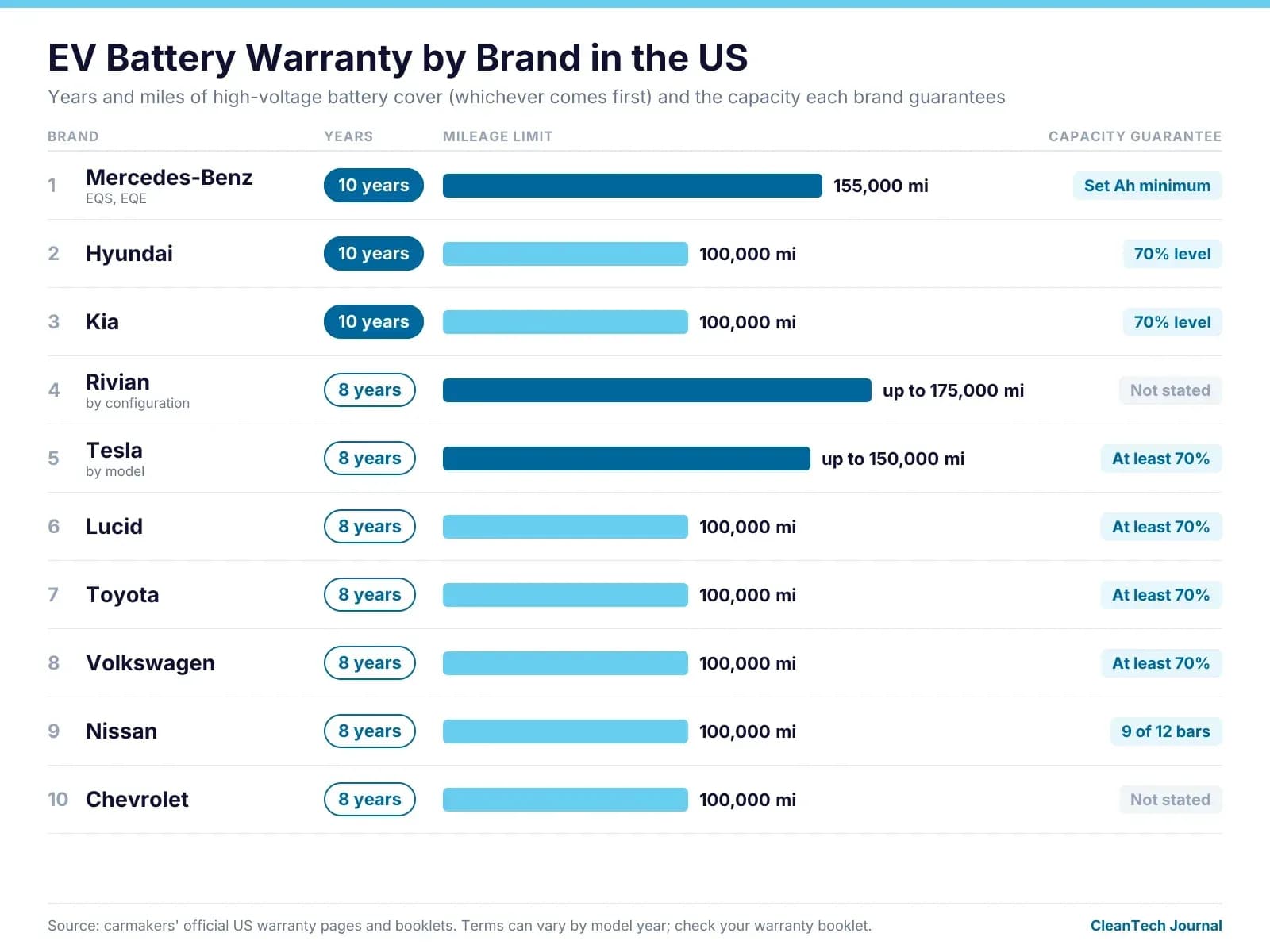
EV Battery Warranty by Brand at a Glance
Rank | Brand | Years | Miles | Capacity guarantee |
|---|---|---|---|---|
1 | Mercedes-Benz (EQS, EQE) | 10 | 155,000 | Minimum amp-hour level per model |
2 | Hyundai | 10 | 100,000 | 70% capacity level |
3 | Kia | 10 | 100,000 | Covered below 70% |
4 | Rivian | 8 | Up to 175,000 | Not stated on the support page |
5 | Tesla | 8 | Up to 150,000 | At least 70% |
6 | Lucid | 8 | 100,000 | At least 70% |
7 | Toyota | 8 | 100,000 | At least 70% |
8 | Volkswagen | 8 | 100,000 | At least 70% |
9 | Nissan | 8 | 100,000 | 9 of 12 capacity gauge segments |
10 | Chevrolet | 8 | 100,000 | Not stated |
1. Mercedes-Benz EQS and EQE
10 years or 155,000 miles
Mercedes-Benz gives its large EQ models the longest battery cover of any brand in this list. According to the company's 2026 EQ warranty booklet, the EQS sedan, EQS SUV, EQE sedan and EQE SUV are all covered for 10 years or 155,000 miles.
Instead of a percentage, Mercedes sets a minimum capacity in amp-hours for each model: 192 Ah for the EQS sedan, 197 Ah for the EQS SUV and 204 Ah for both EQE body styles. Smaller electric models, including the EQB, the electric CLA and the G 580, get a shorter 8-year or 100,000-mile term.
2. Hyundai
Hyundai's US warranty covers the battery in its electric and hybrid models for 10 years or 100,000 miles. In its own words, the battery "will not degrade more than 70 percent of the original capacity" during the warranty period.
- Second owners: the same 10-year or 100,000-mile battery term applies to subsequent owners, not only the first buyer
- Also covered for the same term: the hybrid power control unit and the transmission, including the traction motor
3. Kia
Kia matches Hyundai on time and mileage. Its EV battery coverage protects against capacity falling below 70% of the original level for 10 years or 100,000 miles, and repairs restore the battery to at least 70%.
The wider Kia EV system warranty covers the electric motor, high-voltage battery, power control unit and on-board charger for the same 10 years or 100,000 miles, counted from the date of first service.
4. Rivian
Rivian ranks highest among the 8-year warranties because of its mileage. Vehicles with the Quad-Motor and Large battery pack are covered for 8 years or 175,000 miles, the highest mileage limit of any brand here.
Dual-Motor versions with the Large or Max pack get 8 years or 150,000 miles. On Rivian, one combined warranty covers both the battery pack and the drivetrain, and the limits depend on the configuration.
5. Tesla
Tesla's battery and drive unit warranty runs for 8 years in every case, with a guarantee that the battery keeps at least 70% of its capacity. The mileage limit depends on the model:
- 150,000 miles: Model S, Model X and Cybertruck
- 120,000 miles: Model 3 and Model Y Premium and Performance versions
- 100,000 miles: Model 3 RWD and Model Y RWD
The full list is on Tesla's vehicle warranty page, which notes that the warranty supplied with each car is the final word.
6. Lucid
8 years or 100,000 miles, with at least 70% capacity retained
Lucid covers the high-voltage battery on the standard industry term, but with a written capacity guarantee. The company notes that the exact terms depend on the purchase date and are set out in the warranty document for each vehicle.
7. Toyota
Toyota's battery electric vehicle warranty lasts 8 years or 100,000 miles, whichever comes first. It guarantees a minimum of 70% of the original battery capacity, which Toyota describes as protection against abnormal capacity loss.
8. Volkswagen
Volkswagen covers the high-voltage battery in the ID.4 for 8 years or 100,000 miles. The battery's net capacity must stay at or above 70% during that time.
If it falls below that level, the warranty pays for repairs that bring it back to 70%. Volkswagen points out that such a repair may not return the battery to as-new condition with 100% capacity.
9. Nissan
Nissan offers 8 years or 100,000 miles of lithium-ion battery coverage against defects in materials or workmanship. It also covers capacity loss over the same period, but measures it on the car's capacity gauge rather than as a percentage.
What counts as capacity loss: the battery is covered if it drops below 9 of the 12 segments on the gauge.
10. Chevrolet
Chevrolet covers certain electric propulsion parts, including the high-voltage battery, for 8 years or 100,000 miles under its Propulsion Battery Limited Warranty. Its EV ownership page does not give a capacity-loss threshold, so owners should check the warranty booklet or ask a dealer what level of range loss is covered.
Other EV Brands With the Standard Battery Warranty
Several other brands sold in the US use the same 8-year or 100,000-mile term. Cadillac offers an 8-year or 100,000-mile battery limited warranty on its electric models, and Honda covers the high-voltage battery in the Prologue for the same period.
In practice, this means the real differences between most EVs lie in the details: whether capacity loss is covered, how it is measured, and whether the full term passes to a second owner.
How to Compare EV Battery Warranties Before You Buy
Start with the capacity guarantee, not the headline years. A warranty that only covers defects may not help if the battery slowly loses range, while a 70% guarantee gives a clear point at which the carmaker must step in.
Then check the mileage limit against how much you drive. A driver covering 15,000 miles a year would reach 100,000 miles in under seven years, before an 8-year term ends, so higher mileage limits from Rivian, Tesla and Mercedes-Benz matter most for long-distance drivers.
Frequently Asked Questions
Does an EV battery warranty cover accident damage?
No. Battery warranties cover defects in materials and workmanship, and in many cases excessive capacity loss. Damage from a crash, flooding, fire or road debris is normally a matter for your car insurance rather than the manufacturer's warranty.
Is normal range loss covered by the warranty?
Only if it passes the threshold in the warranty. All lithium-ion batteries lose some capacity as they age, and carmakers treat gradual loss above their stated limit, such as 70%, as normal wear that is not repaired for free.
What can void an EV battery warranty?
Common exclusions include unauthorized repairs or modifications to the battery, using non-approved charging equipment that causes damage, ignoring required software updates or recalls, and misuse of the vehicle. The exact list is in each brand's warranty booklet.
Can I buy an extended warranty for an EV battery?
Many carmakers and dealers sell extended service contracts for electric vehicles, and some include high-voltage components. Coverage, cost and battery terms vary widely, so check whether the plan actually covers the battery and capacity loss before paying for it.
How can I check the health of my EV battery?
Many electric cars show battery health or usable capacity in the vehicle menu or companion app. A dealer can also run a battery capacity test, which is useful when buying a used EV or when you think a warranty claim may apply.
SOURCES
- Mercedes-Benz USA – 2026 EQ Warranty and Service Booklet
- Hyundai USA – Warranty
- Kia America – Warranty
- Rivian – What's the warranty like?
- Tesla – Vehicle Warranty
- Lucid – Lucid Limited Warranty
- Toyota – Electrified Vehicles Warranty
- Volkswagen of America – ID.4 Press Information
- Nissan USA – Electric Vehicle Service
- Chevrolet – EV Ownership FAQs
Written by
Suraj Kadam
Suraj Kadam is a journalist and Chief Editor of CleanTech Journal, a knowledge and media platform covering clean technology, solar energy, and renewable energy. He reports on emerging technologies, industry developments, policy trends, and innovations shaping the global clean energy transition. Through his editorial work, Suraj aims to make complex clean technology topics accessible to industry professionals, researchers, policymakers, and readers interested in sustainable energy. His work focuses on delivering insightful, informative, and engaging coverage of the evolving renewable energy landscape.