How Long Do EV Batteries Last? What Real-World Data Shows
How long do EV batteries last? Real-world data from 22,700 EVs shows 2.3% capacity loss a year, so most outlast their 8-year battery warranty.

Suraj Kadam
Published •9 min read
How long do EV batteries last? Longer than most drivers fear, according to the latest data. Modeling by the National Laboratory of the Rockies, formerly NREL, suggests today's batteries may last 12 to 15 years in moderate climates and 8 to 12 years in extreme ones.
Real-world fleet data points the same way. Telematics company Geotab analyzed more than 22,700 electric vehicles across 21 models and found an average capacity loss of 2.3% a year. That is slow enough for most batteries to outlast the rest of the car.
How Long Do EV Batteries Last in Real-World Driving?
Battery life is measured by state of health, the share of the original capacity a battery can still hold. A new battery starts at 100%, and range falls roughly in step with it.
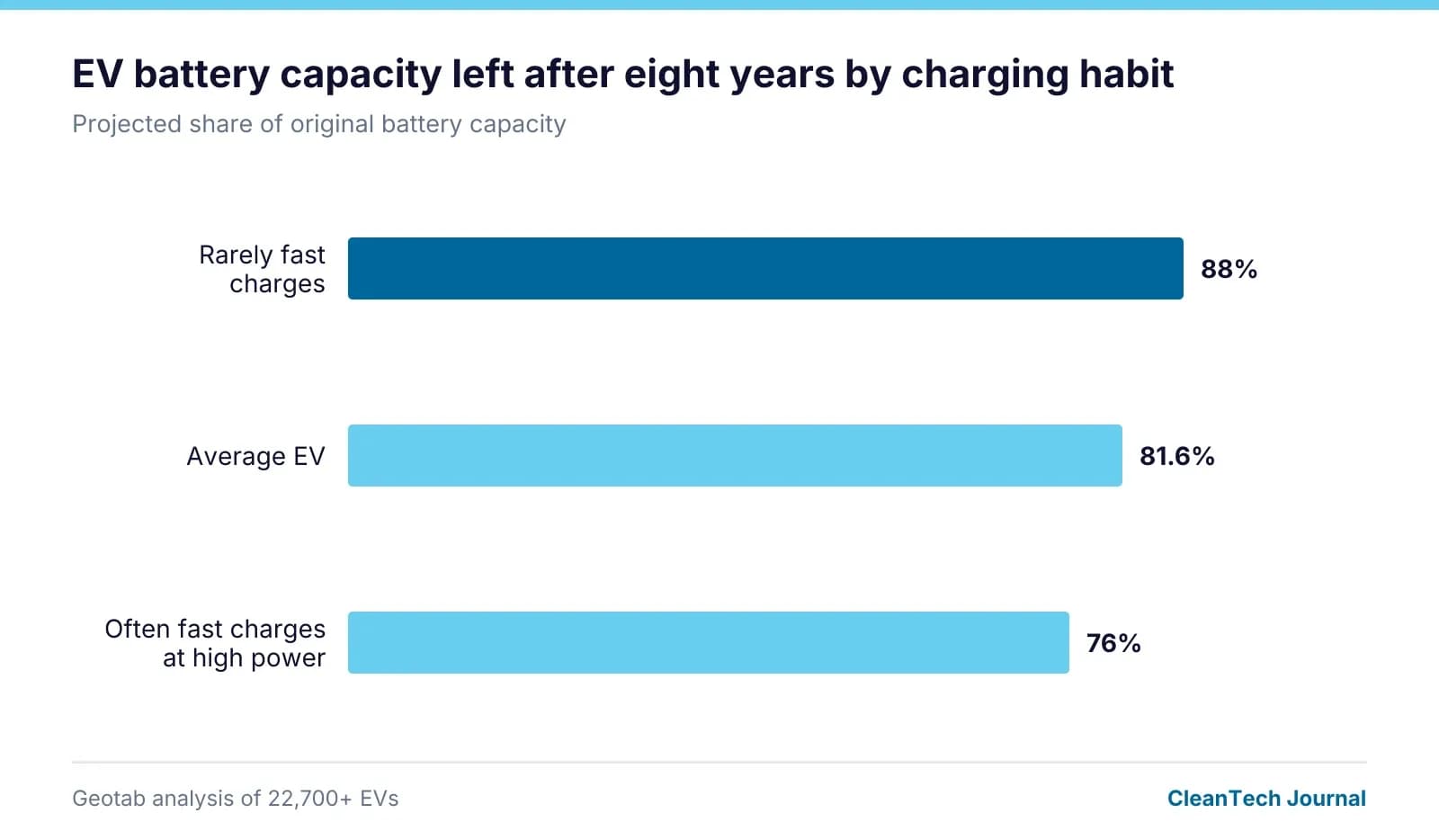
Based on its 2.3% average, Geotab projects that a typical EV battery will still have 81.6% of its original capacity after eight years. For a car that started with 300 miles of range, that works out to about 245 miles.
Batteries do not usually fail suddenly. They lose capacity gradually, which means an older EV normally has less range rather than no range.
What Wears an EV Battery Out Faster
Three factors stand out in the latest data.
- Frequent DC fast charging: Geotab found that vehicles using fast chargers for less than 12% of sessions lost about 1.5% of capacity a year. Vehicles that fast charged often, with many sessions above 100 kW, lost about 3.0% a year, twice as fast.
- Hot weather: vehicles in hot climates degraded 0.4 percentage points faster per year than those in mild climates. Geotab defined a hot climate as more than 35% of days above 25°C (77°F).
- Time and use: all lithium-ion batteries age, even when the car is parked, so a low-mileage EV still loses some capacity each year.
How Charging Habits Change Battery Life
The gap between careful and heavy fast charging adds up over time. Geotab projects that vehicles which rarely use high-power fast chargers will keep about 88% of their capacity after eight years, compared with about 76% for vehicles that use them heavily.
On a car with 300 miles of original range, that is roughly 264 miles versus 228 miles, a difference of 36 miles. Fast charging is still useful on road trips; the data simply suggests that charging at home or at work on most days is gentler on the battery.
How Long Do EV Batteries Last Compared With the Warranty?
Battery warranties give a useful floor. The US Department of Energy notes that several carmakers offer 8-year or 100,000-mile battery warranties. Many of those warranties also promise the battery will keep at least 70% of its capacity.
If the average battery holds about 82% after eight years, most will finish their warranty well above that 70% line. Our comparison of the EV battery warranty by brand shows which carmakers cover more years or miles.
What Happens When an EV Battery Gets Old
An older battery does not have to be replaced the moment its capacity falls. Many drivers can keep using a car with 70% or 75% of its original range if their daily trips are short.
When replacement is needed outside the warranty, the Department of Energy warns that it may be a significant expense. That makes battery health one of the most important things to check before buying a used EV.
Frequently Asked Questions
Is it bad to charge an EV to 100% every day?
Many carmakers recommend setting a lower daily charge limit, often around 80% to 90%, and charging to 100% only before long trips. Keeping a lithium-ion battery at a very high charge for long periods can speed up aging, so check your owner's manual for the limit your carmaker suggests.
Do EV batteries lose range in cold weather?
Yes, but most of that loss is temporary. Cold slows the chemical reactions inside the battery and heating the cabin uses energy, so winter range is often lower. The range usually returns in warmer weather and does not mean the battery has been permanently damaged.
Can an EV battery be repaired instead of replaced?
Often, yes. Many battery packs are built from modules, and a dealer or specialist can sometimes replace a faulty module or component rather than the whole pack, which is usually much cheaper.
What happens to old EV batteries?
Used EV batteries can be given a second life in stationary energy storage, where lower capacity matters less, or recycled to recover materials such as lithium, nickel and cobalt for new batteries.
Do plug-in hybrid batteries last as long as EV batteries?
Plug-in hybrid batteries are smaller and are often cycled more deeply each day, which can affect how they age. They are generally designed and warranted for similar periods, so check the specific warranty for the model you are considering.
SOURCES
- Geotab – How long do electric car batteries last? Real-world EV battery health
- US Department of Energy, Alternative Fuels Data Center – Benefits and Considerations of Electricity as a Vehicle Fuel
Written by
Suraj Kadam
Suraj Kadam is a journalist and Chief Editor of CleanTech Journal, a knowledge and media platform covering clean technology, solar energy, and renewable energy. He reports on emerging technologies, industry developments, policy trends, and innovations shaping the global clean energy transition. Through his editorial work, Suraj aims to make complex clean technology topics accessible to industry professionals, researchers, policymakers, and readers interested in sustainable energy. His work focuses on delivering insightful, informative, and engaging coverage of the evolving renewable energy landscape.