Are Solar Panels Worth It in Florida? 2026 Payback and Savings
Are solar panels worth it in Florida? A 7 kW system in Miami saves about $1,664 a year and pays off in 15.1 years. See net metering, costs and tax breaks.

Suraj Kadam
Published •22 min read

Are solar panels worth it in Florida? For most homeowners who plan to stay put, yes. A typical 7 kilowatt (kW) home system in Miami produces about 10,864 kilowatt-hours (kWh) a year, saves about $1,664 and pays for itself in about 15.1 years at 2026 power prices.
Florida has two big advantages: strong sunshine and a state net metering rule that credits the power you send to the grid. Its main drawback is cheap electricity, which keeps savings lower than in states such as California. Below, we work through the numbers using official data from the US Energy Information Administration (EIA), Lawrence Berkeley National Laboratory, the PVWatts calculator and the Florida Public Service Commission.
Are Solar Panels Worth It in Florida? The Numbers
Measure | Florida (Miami) |
|---|---|
Average home power price, Jan to Aug 2026 | 15.32 cents per kWh |
US average home power price | 18.19 cents per kWh |
Yearly output per 1 kW of panels | 1,552 kWh |
Example system | 7 kW, about 10,864 kWh a year |
Installed cost at $3.60 per watt | $25,200 |
Yearly savings at full retail value | About $1,664 |
Simple payback | About 15.1 years |
CleanTech Journal calculations. Output is from PVWatts for south-facing panels in Miami with a 20-degree tilt and 14% system losses. Cost is the 2025 US median for home solar from Berkeley Lab. Payback assumes no federal tax credit.
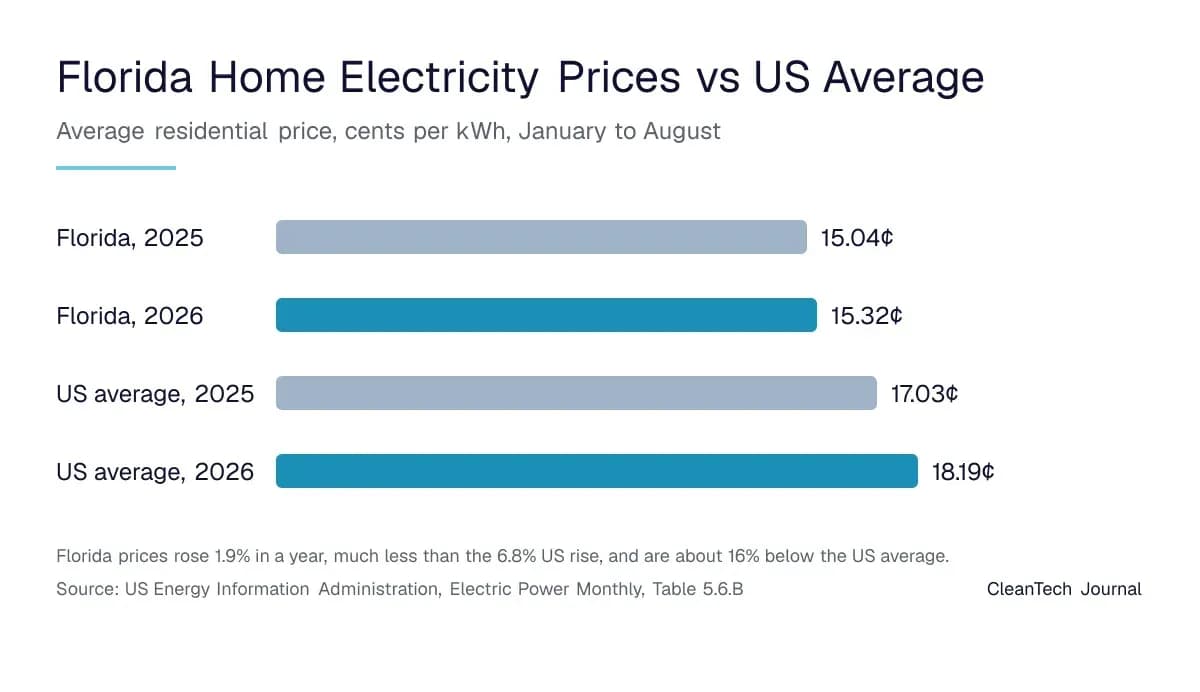
Florida home electricity averaged 15.32 cents per kWh in the first eight months of 2026, according to the EIA. That is about 16% below the US average of 18.19 cents. Florida prices also rose only 1.9% from the same period of 2025, against 6.8% for the US as a whole.
How Much Can Solar Panels Save in Florida?
Each 1 kW of south-facing panels in Miami produces about 1,552 kWh a year, more than most US cities we have analyzed. At the average Florida price, that is worth about $238 a year for every kW installed.
System size | Yearly output (Miami) | Yearly savings at 15.32 cents | Installed cost at $3.60 per watt |
|---|---|---|---|
5 kW | 7,760 kWh | About $1,189 | $18,000 |
7 kW | 10,864 kWh | About $1,664 | $25,200 |
10 kW | 15,520 kWh | About $2,378 | $36,000 |
Because cost and output both grow with system size, simple payback stays about 15.1 years whatever size you choose. Size your system to your yearly use, because power you export beyond that earns much less, as the next section explains.
Florida Net Metering: How Solar Credits Work
Unlike Texas, Florida has a statewide net metering rule. Under Florida Public Service Commission Rule 25-6.065, investor-owned utilities such as Florida Power & Light, Duke Energy Florida and Tampa Electric must offer net metering to customers with renewable systems:
- Monthly credits. Power you send to the grid is credited against your energy use in the next month's billing cycle.
- Credits last up to 12 months. Unused credits roll forward for up to a year.
- Year-end payout. At the end of each calendar year, the utility pays for any unused credits at an average rate based on its "as-available" energy tariff, which is lower than the retail price.
- System size. Home systems of 10 kW or less fall into the simplest tier, and the rule covers systems up to 2 megawatts (MW).
In practice, this means that as long as your panels do not produce more than you use over a year, nearly every kWh is worth close to the retail price. That makes our payback estimate realistic for most customers of the big utilities. City-owned utilities and electric cooperatives have their own net metering terms, so check with yours.
Florida homeowners have embraced it. The state had 292,284 customer-sited renewable systems with a combined 2.8 gigawatts (GW) of capacity at the end of 2024, according to the Florida Public Service Commission, and Florida Power & Light alone had 113,097.
Florida Solar Incentives
Florida offers no state rebate for home solar, but state law gives homeowners three useful protections:
- No sales tax. Florida law exempts solar energy systems and all their components from sales and use tax, according to the Florida Department of Revenue.
- No property tax increase. Under Florida Statute 193.624, the added value of a solar energy system on a home is not counted when the property is assessed for tax.
- HOA protection. Under Florida Statute 163.04, a homeowners association may not deny permission to install solar panels. It may choose where on the roof they go, but only within 45 degrees east or west of due south, and only if its choice does not impair the system's performance.
- No federal credit for new home systems. The 30% federal Residential Clean Energy Credit does not apply to home systems installed after December 31, 2025, according to the IRS.
When Solar Panels Are Worth It in Florida
Solar is most likely to pay off in Florida when:
- You plan to stay. With payback of about 15 years, owners who stay 20 years or longer are most likely to come out ahead. Most panels carry 25- to 30-year power warranties.
- Your system matches your use. Net metering credits are worth the most when your panels make roughly what you use in a year.
- Your roof faces south, east or west with little shade from trees or nearby buildings.
- Your roof is in good condition. Replace an aging roof before installing panels to avoid paying to remove and reinstall them.
- You want backup power. A grid-tied solar system shuts down during a power outage for safety unless it has a battery, so add storage if keeping the lights on during storms matters to you.
Solar in Florida Compared With Other States
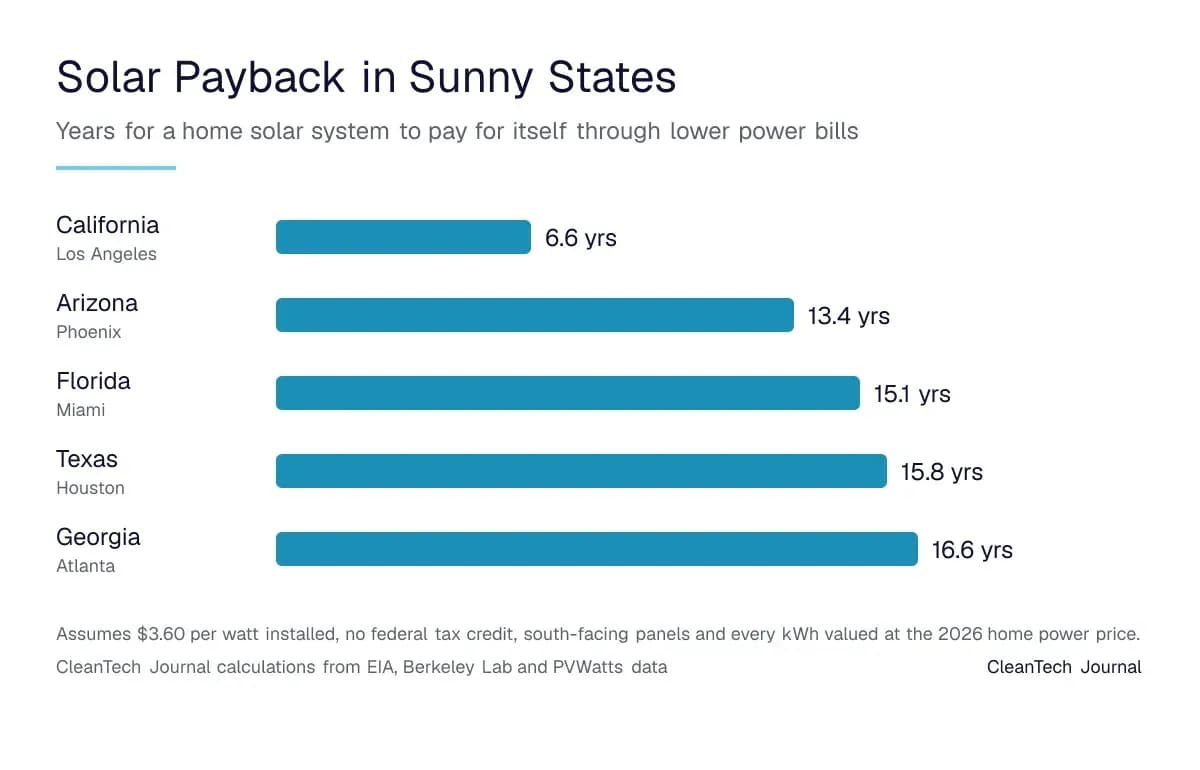
Florida's payback is similar to other sunny southern states with cheap power, such as Texas (about 15.8 years) and Georgia (about 16.6 years), and slower than Arizona (about 13.4 years). California pays off in about 6.6 years because its electricity costs more than twice as much.
Florida gets more sun than most of the country, but low power prices limit savings. If Florida prices rise faster in the coming years, payback will shorten. Read our guide to whether solar panels are worth it in Texas for a state without statewide net metering.
Frequently Asked Questions
Are solar panels worth it in Florida?
For most homeowners who plan to stay, yes. A typical system in Miami pays for itself in about 15.1 years at 2026 prices, and Florida's net metering rule credits exported power against future bills.
Does Florida have net metering?
Yes. Investor-owned utilities must offer net metering under Florida Public Service Commission Rule 25-6.065. Excess power is credited to the next month's bill, and unused credits are paid out at the end of the year at a lower rate.
How much do solar panels cost in Florida?
At the 2025 US median of $3.60 per watt, a 7 kW system costs about $25,200. Florida does not charge sales tax on solar energy systems.
Do solar panels raise property taxes in Florida?
No. Florida Statute 193.624 excludes the value of a home solar energy system from property tax assessments.
Can my HOA stop me from installing solar panels in Florida?
No. Florida Statute 163.04 bars associations from denying permission, though they can choose the roof location within limits that do not impair the system's performance.
SOURCES
- US EIA: Electric Power Monthly, Table 5.6.B (average price of electricity by state, year-to-date)
- Florida Administrative Code Rule 25-6.065: Interconnection and Metering of Customer-Owned Renewable Generation
- Florida Public Service Commission: 2024 Net Metering Report
- Florida Department of Revenue: Tax Information Publication on solar energy systems
- Florida Statute 193.624: Assessment of renewable energy source devices
- UCF Florida Solar Energy Center: Florida Solar Rights Law (Statute 163.04)
- Lawrence Berkeley National Laboratory: Distributed Solar and Storage Data, 2026 Update
- National Laboratory of the Rockies, PVWatts Calculator (version 8)
- IRS: FAQs on modification of sections 25C, 25D and other credits
Written by
Suraj Kadam
Suraj Kadam is a journalist and Chief Editor of CleanTech Journal, a knowledge and media platform covering clean technology, solar energy, and renewable energy. He reports on emerging technologies, industry developments, policy trends, and innovations shaping the global clean energy transition. Through his editorial work, Suraj aims to make complex clean technology topics accessible to industry professionals, researchers, policymakers, and readers interested in sustainable energy. His work focuses on delivering insightful, informative, and engaging coverage of the evolving renewable energy landscape.