Are Solar Panels Worth It in Ohio? 2026 Payback and Savings
Are solar panels worth it in Ohio? A 7 kW system in Columbus saves about $1,725 a year and pays off in 14.6 years as power prices rise. See the numbers.

Suraj Kadam
Published •22 min read
Are solar panels worth it in Ohio? Increasingly, yes. A typical 7 kilowatt (kW) home system in Columbus saves about $1,725 a year and pays for itself in about 14.6 years at 2026 power prices, and a sharp rise in Ohio electricity prices is making solar more attractive.
Ohio gets less sun than southern states, but its home electricity now costs more than the US average. Its net metering rules, however, credit exported power at less than the full retail price, so how much of your solar power you use yourself matters. Below, we work through the numbers using official data from the US Energy Information Administration (EIA), Lawrence Berkeley National Laboratory, the PVWatts calculator and the Public Utilities Commission of Ohio (PUCO).
Are Solar Panels Worth It in Ohio? The Numbers
Measure | Ohio (Columbus) |
|---|---|
Average home power price, Jan to Aug 2026 | 18.81 cents per kWh |
US average home power price | 18.19 cents per kWh |
Yearly output per 1 kW of panels | 1,310 kWh |
Example system | 7 kW, about 9,170 kWh a year |
Installed cost at $3.60 per watt | $25,200 |
Yearly savings at full retail value | About $1,725 |
Simple payback | About 14.6 years |
CleanTech Journal calculations. Output is from PVWatts for south-facing panels in Columbus with a 20-degree tilt and 14% system losses. Cost is the 2025 US median for home solar from Berkeley Lab. Payback assumes no federal tax credit.
Ohio Electricity Prices Are Rising Fast
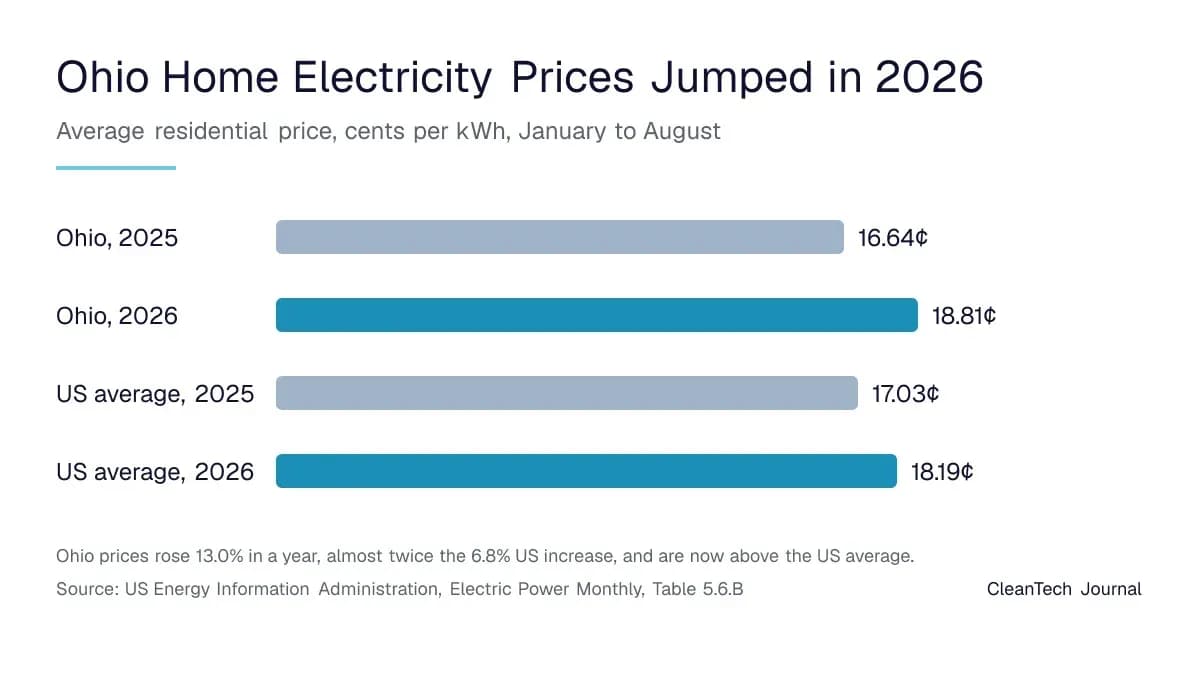
Ohio home electricity averaged 18.81 cents per kilowatt-hour (kWh) in the first eight months of 2026, according to the EIA. That is up 13.0% from 16.64 cents in the same period of 2025, almost twice the 6.8% rise for the US as a whole.
The increase pushed Ohio above the US average of 18.19 cents and directly improves the case for solar. At 2025 prices, the same Columbus system would have taken about 16.5 years to pay off, nearly two years longer than today. If prices keep climbing, every kWh your panels make becomes more valuable.
How Much Can Solar Panels Save in Ohio?
Each 1 kW of south-facing panels in Columbus produces about 1,310 kWh a year. At the average Ohio price, that is worth about $246 a year for every kW installed.
System size | Yearly output (Columbus) | Yearly savings at 18.81 cents | Installed cost at $3.60 per watt |
|---|---|---|---|
5 kW | 6,550 kWh | About $1,232 | $18,000 |
7 kW | 9,170 kWh | About $1,725 | $25,200 |
10 kW | 13,100 kWh | About $2,464 | $36,000 |
Because cost and output both grow with system size, simple payback stays about 14.6 years whatever size you choose. These savings assume each kWh is worth the full retail price, which is closest to reality for power you use at home, as the next section explains.
Ohio Net Metering Rules
Under PUCO Rule 4901:1-10-28, every electric utility regulated by PUCO, such as AEP Ohio, must offer a standard net metering tariff. The key terms are:
- Credits are in dollars, not kWh. Excess power you send to the grid is converted to a monetary credit at the "energy component" of your utility's standard service offer, which is less than the full retail price you pay.
- Credits carry forward. The credit is applied to future bills.
- No cash payout. The utility is not required to pay out unused credits, and the rule says credits "may be lost" if they go unused.
- Size limit. Your system must not be sized to produce more than 120% of your electricity needs at the time it is connected.
- Competitive suppliers. Ohio customers can buy power from competitive suppliers, which may offer their own net metering contracts but are not required to.
In practice, solar pays off best in Ohio when you size your system to your own use and use as much of the power as you can at home, where each kWh saves you the full retail price. Oversizing a system to export power earns much less. City-owned utilities and electric cooperatives set their own rules, so check with yours.
Ohio Solar Incentives
Incentives for Ohio homeowners are limited:
- No federal credit for new home systems. The 30% federal Residential Clean Energy Credit does not apply to home systems installed after December 31, 2025, according to the IRS.
- Local and utility programs. Ask your utility and local government whether they offer any solar programs or financing before you buy.
- Compare offers. Get several quotes, and compare cash purchase, loans and leases on total cost over 20 years or more.
When Solar Panels Are Worth It in Ohio
Solar is most likely to pay off in Ohio when:
- You use most of the power at home. Daytime use for air conditioning, an electric vehicle or a heat pump makes more of your output worth the full retail price.
- You size the system to your needs. Ohio's rules cap systems at 120% of your use and credit exports at a lower rate.
- You plan to stay. With payback around 15 years, owners who stay 20 years or longer are most likely to come out ahead. Most panels carry 25- to 30-year power warranties.
- Your roof faces south, east or west with little shade, and is in good condition.
- You expect prices to keep rising. Ohio's 13.0% jump in one year shows how quickly the value of solar can change.
Solar in Ohio Compared With Other States
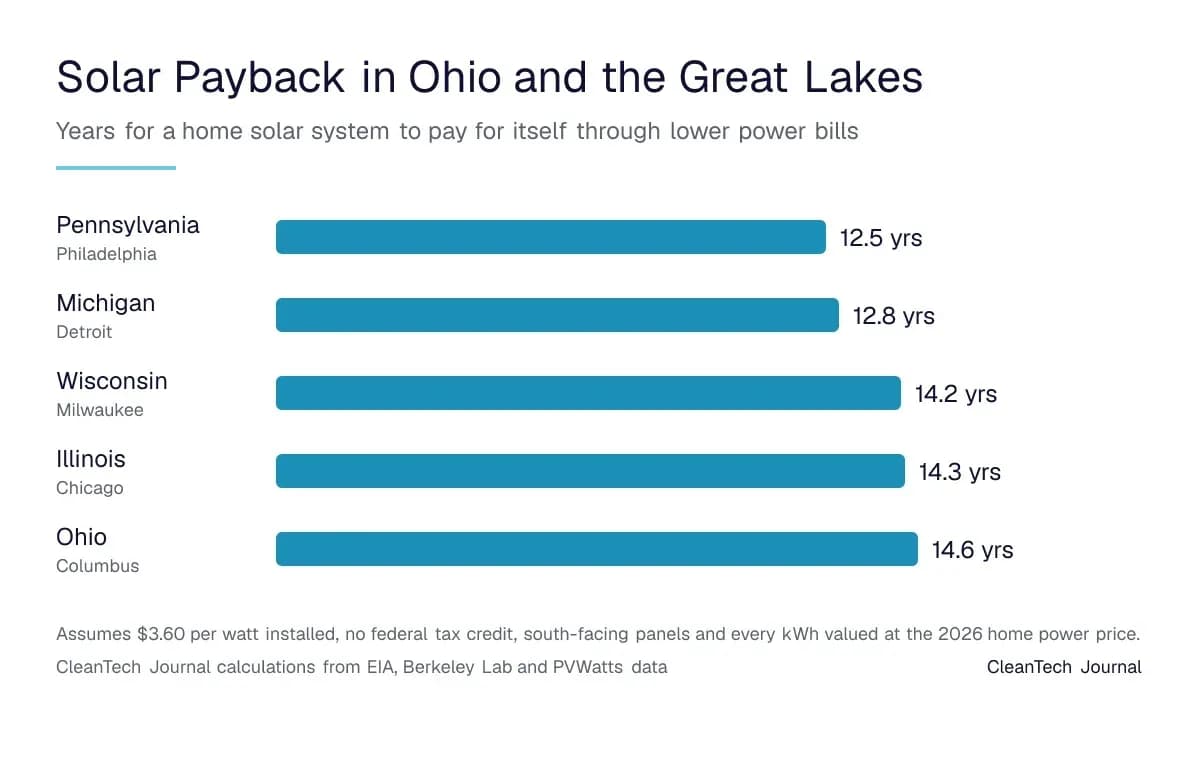
Ohio's payback of about 14.6 years is close to its Great Lakes neighbors Illinois (about 14.3 years) and Wisconsin (about 14.2 years). Pennsylvania (about 12.5 years) and Michigan (about 12.8 years) pay off faster because their power prices are higher.
Ohio also compares well with sunnier states. Solar pays off sooner in Ohio than in Florida (about 15.1 years) or Texas (about 15.8 years), because higher Ohio power prices outweigh the extra sunshine in the South. Read our guides to whether solar panels are worth it in Florida and in Texas.
Frequently Asked Questions
Are solar panels worth it in Ohio?
For many homeowners, yes. A typical system in Columbus pays for itself in about 14.6 years at 2026 prices, and rising electricity prices are shortening payback.
Does Ohio have net metering?
Yes. Under PUCO Rule 4901:1-10-28, every PUCO-regulated electric utility must offer a net metering tariff. Excess power earns a dollar credit at the energy part of the utility's rate, which carries forward to future bills but is not paid out in cash.
How much do solar panels cost in Ohio?
At the 2025 US median of $3.60 per watt, a 7 kW system costs about $25,200 before any incentives. Prices vary by installer, so get several quotes.
Do solar panels work in Ohio's climate?
Yes. Each 1 kW of panels in Columbus produces about 1,310 kWh a year. Output is lower in winter, but solar panels work in cold and cloudy weather.
How long do solar panels take to pay off in Ohio?
About 14.6 years in Columbus at 2026 prices, down from about 16.5 years at 2025 prices. Exporting a lot of power at Ohio's lower credit rate makes payback longer.
SOURCES
- US EIA: Electric Power Monthly, Table 5.6.B (average price of electricity by state, year-to-date)
- Ohio Administrative Code Rule 4901:1-10-28: Net metering
- Lawrence Berkeley National Laboratory: Distributed Solar and Storage Data, 2026 Update
- National Laboratory of the Rockies, PVWatts Calculator (version 8)
- IRS: FAQs on modification of sections 25C, 25D and other credits
Written by
Suraj Kadam
Suraj Kadam is a journalist and Chief Editor of CleanTech Journal, a knowledge and media platform covering clean technology, solar energy, and renewable energy. He reports on emerging technologies, industry developments, policy trends, and innovations shaping the global clean energy transition. Through his editorial work, Suraj aims to make complex clean technology topics accessible to industry professionals, researchers, policymakers, and readers interested in sustainable energy. His work focuses on delivering insightful, informative, and engaging coverage of the evolving renewable energy landscape.