Top Rated Solar Panels in the US: 2026 Reliability Test Results
Top rated solar panels in the US for home and office, ranked by 2026 independent reliability tests: Trina, Qcells, Jinko, LONGi, Aiko and more.

Suraj Kadam
Published •28 min read
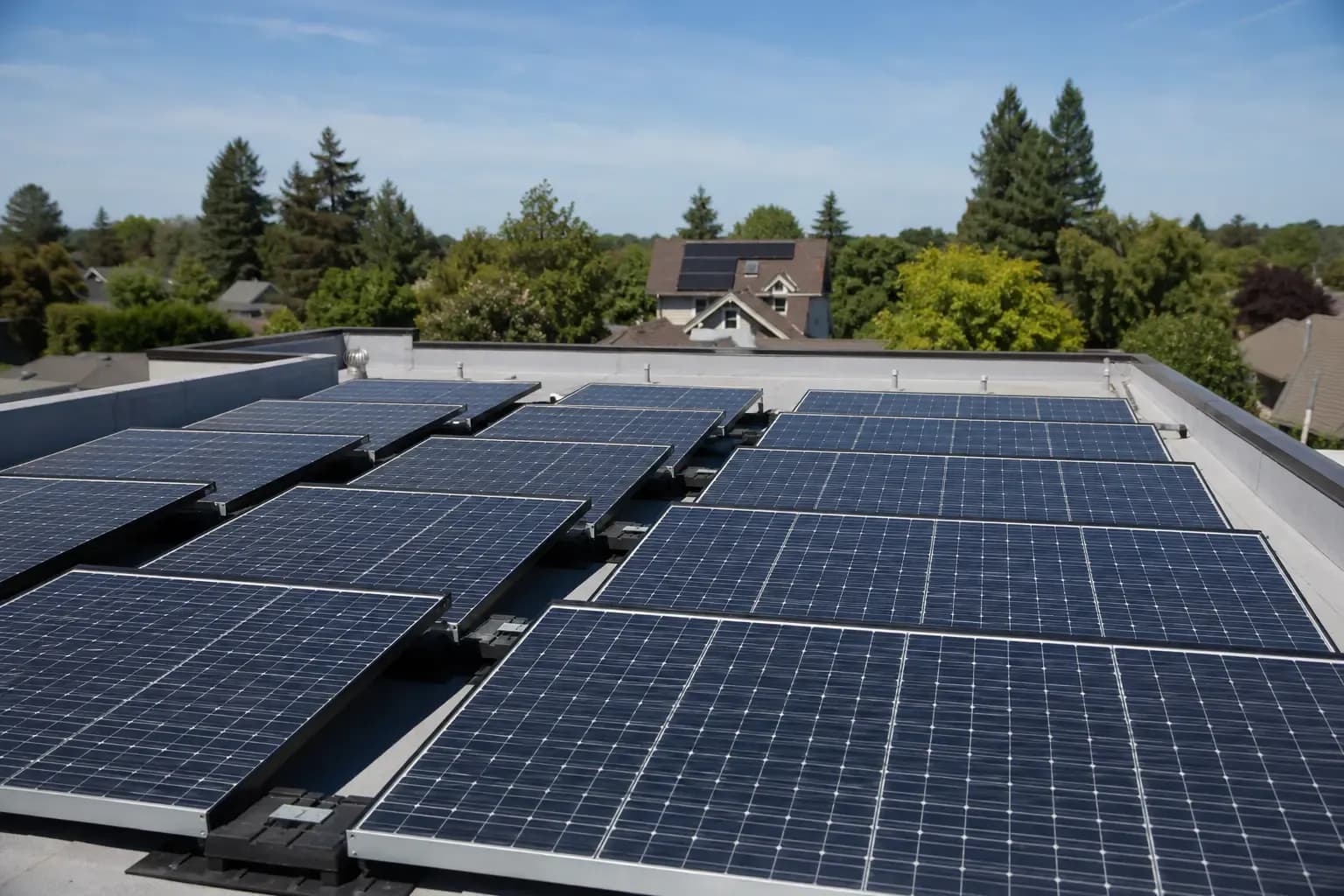
The top rated solar panels in the US are the ones that survive the toughest independent lab testing. Each year, Kiwa PVEL, an independent US testing lab, puts panels through months of heat, humidity, hail and stress tests, and names the brands whose models come through with almost no loss as "Top Performers."
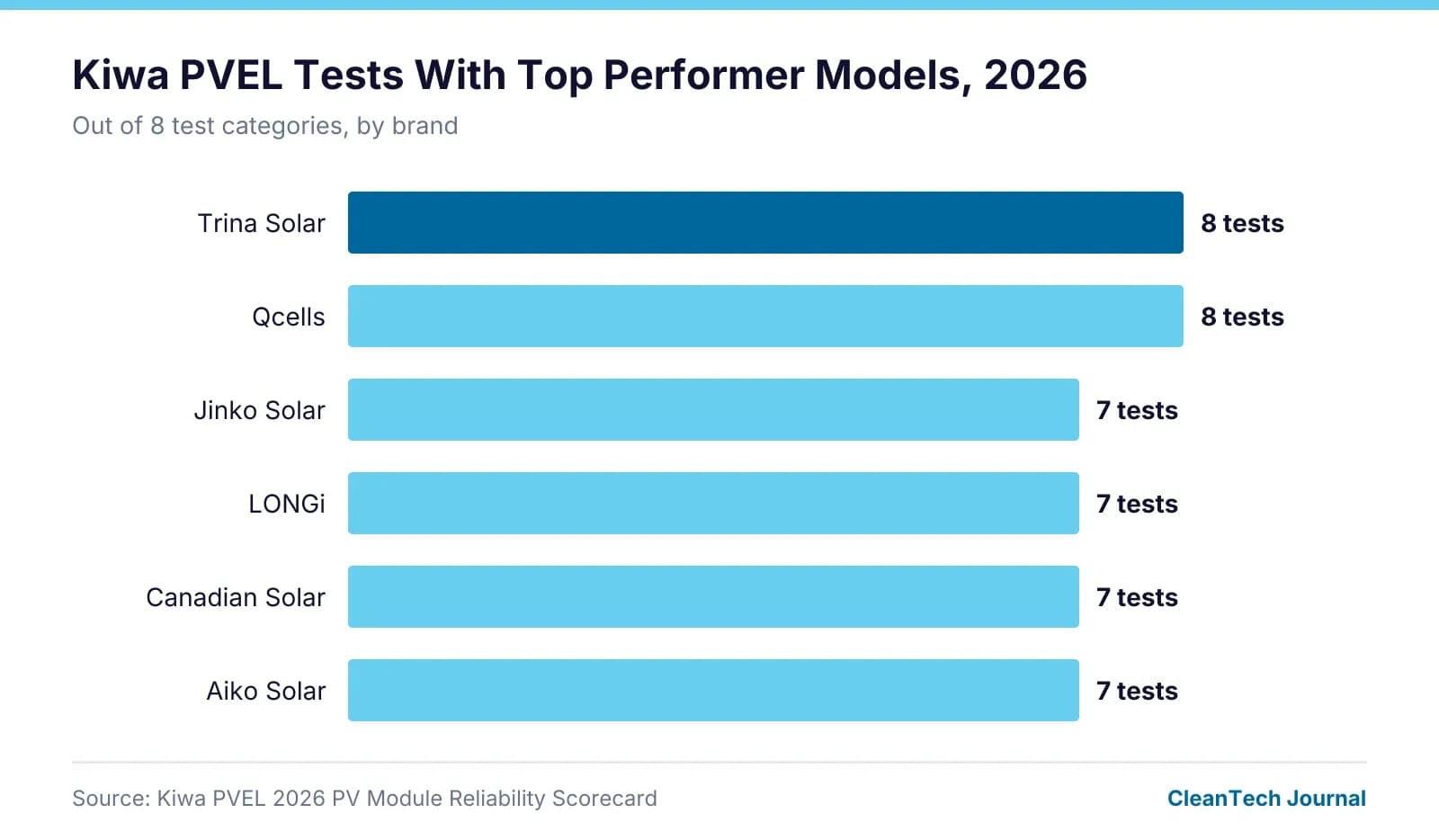
In its 2026 PV Module Reliability Scorecard, only seven manufacturers earned Top Performer results in all eight test categories, and two of them, Trina Solar and Qcells, are well-known names in US home solar. Below, we rank six leading brands by their test results, look at each brand's flagship home panel, and explain how to pick top rated solar panels for a home or an office.
Top Rated Solar Panels in the US at a Glance
Brand | Tests with Top Performer models (out of 8) | Example home panel | Max efficiency | Temperature coefficient |
|---|---|---|---|---|
Trina Solar | 8 | Vertex S+ G3 | 24.7% | -0.26%/°C |
Qcells | 8 | Q.TRON BLK M-G2+ | 22.2% | -0.30%/°C |
Jinko Solar | 7 | Tiger Neo 3.0 | 24.5% | Not published |
LONGi | 7 | Hi-MO X10 | 24.5% | -0.26%/°C |
Canadian Solar | 7 | TOPBiHiKu6 | 22.8% | -0.29%/°C |
Aiko Solar | 7 | Neostar 3P54 | 25.0% | -0.26%/°C |
Test results are from the Kiwa PVEL 2026 Scorecard Top Performers list. Top Performer status applies to specific tested bills of materials (BOMs), not automatically to every panel a brand sells. Panel figures come from each manufacturer's datasheet or product page. A lower temperature coefficient means a panel loses less output on hot days.
How Solar Panels Are Rated in Independent Tests
Kiwa PVEL's Product Qualification Program pushes panels well beyond the basic certification every panel needs to be sold. A model earns Top Performer status in a test only if it loses less than 2% of its power and shows no major defect, wet leakage failure or diode failure.
The eight test categories are:
- Thermal cycling: repeated swings between extreme heat and cold.
- Damp heat: long exposure to high heat and humidity.
- Mechanical stress: heavy loads like snow and wind.
- Hail stress: impacts from hailstones 40 mm or larger, with no glass breakage allowed.
- Potential-induced degradation (PID): electrical stress that can sap output.
- UV-induced degradation: long exposure to ultraviolet light.
- Light-induced degradation (LID and LETID): combined loss must stay under 1%.
- Energy yield (PAN performance): top quarter for simulated energy output.
Why These Ratings Matter in 2026
Failures are rising. In 2026, 87% of manufacturers and 61% of tested BOMs had at least one test failure, up from 66% and 41% in 2024, according to PV Tech. Broken glass in the mechanical and hail tests was the most common problem, and 45% of manufacturers had at least one major delamination defect.
That makes independent results a useful check before you buy. Two panels with the same wattage and warranty can behave very differently after 20 years on a roof.
1. Trina Solar
Trina Solar was one of only seven manufacturers worldwide with Top Performer models in all eight of Kiwa PVEL's 2026 test categories, from hail and mechanical stress to energy yield. That breadth of results is what puts it at the top of this list.
Its flagship home panel, the Vertex S+ G3, entered mass production in July 2026. It uses n-type i-TOPCon Ultra cells and reaches up to 515 W and 24.7% efficiency in a standard 1,842 by 1,134 mm rooftop size. Its temperature coefficient of -0.26% per °C is among the lowest in this comparison, which helps it hold output on hot roofs.
The Vertex S+ G3 is rated for snow loads up to 5,400 Pa and wind loads up to 4,000 Pa, and is backed by a 25-year product warranty and a 30-year power warranty. Trina's announcement does not list the yearly degradation rates behind that power warranty, so we have not charted it here.
2. Qcells
Qcells also earned Top Performer results in all eight categories in 2026, matching Trina for the broadest set of test results among the brands in this list.
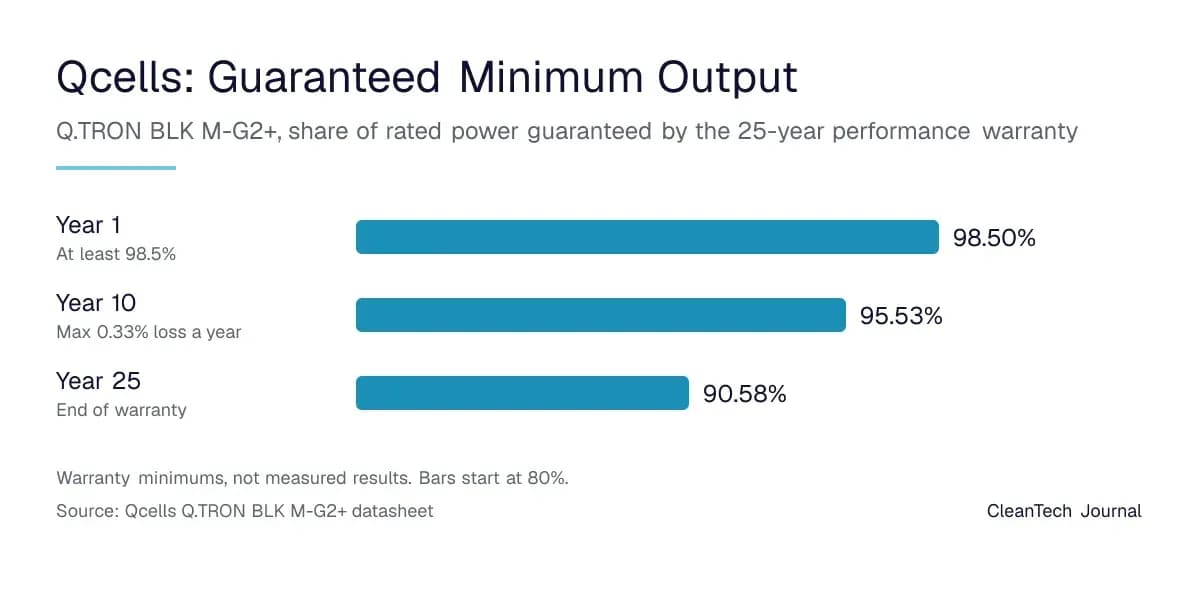
Its all-black Q.TRON BLK M-G2+ is a residential panel of up to 425 W and 22.2% efficiency, using n-type TOPCon cells. It is less efficient than the newest panels here, but it comes with one of the clearest performance warranties: at least 98.5% of rated power in the first year, then no more than 0.33% loss a year. That guarantees at least 95.53% after 10 years and 90.58% after 25 years.
The panel is covered by a 25-year product and performance warranty, and its temperature coefficient is -0.30% per °C.
3. Jinko Solar
Jinko Solar had Top Performer models in seven of the eight test categories in 2026, placing it among the most consistently tested large manufacturers.
Its residential Tiger Neo 3.0 is rated at up to 24.52% efficiency, with the 48-cell version producing up to 490 W in a compact 1,762 by 1,134 mm frame. It uses n-type TOPCon cells, and Jinko says the panel offers very low degradation over time.
Jinko's residential product page does not publish the panel's yearly degradation rates or temperature coefficient, and warranty terms vary by market. Ask your installer for the US datasheet and warranty document before you buy, and check that the exact model appears in Kiwa PVEL's Top Performer database.
4. LONGi
LONGi earned Top Performer results in seven categories in 2026. Its Hi-MO X10 home panel uses the company's second-generation HPBC 2.0 back-contact cells, which move all the wiring to the back of the cell so none blocks sunlight on the front.
The residential Hi-MO X10 reaches up to 24.5% efficiency and about 500 W, and includes built-in shading optimization, which LONGi says keeps performance steadier in partial shade and helps avoid hot spots. Its temperature coefficient is -0.26% per °C.
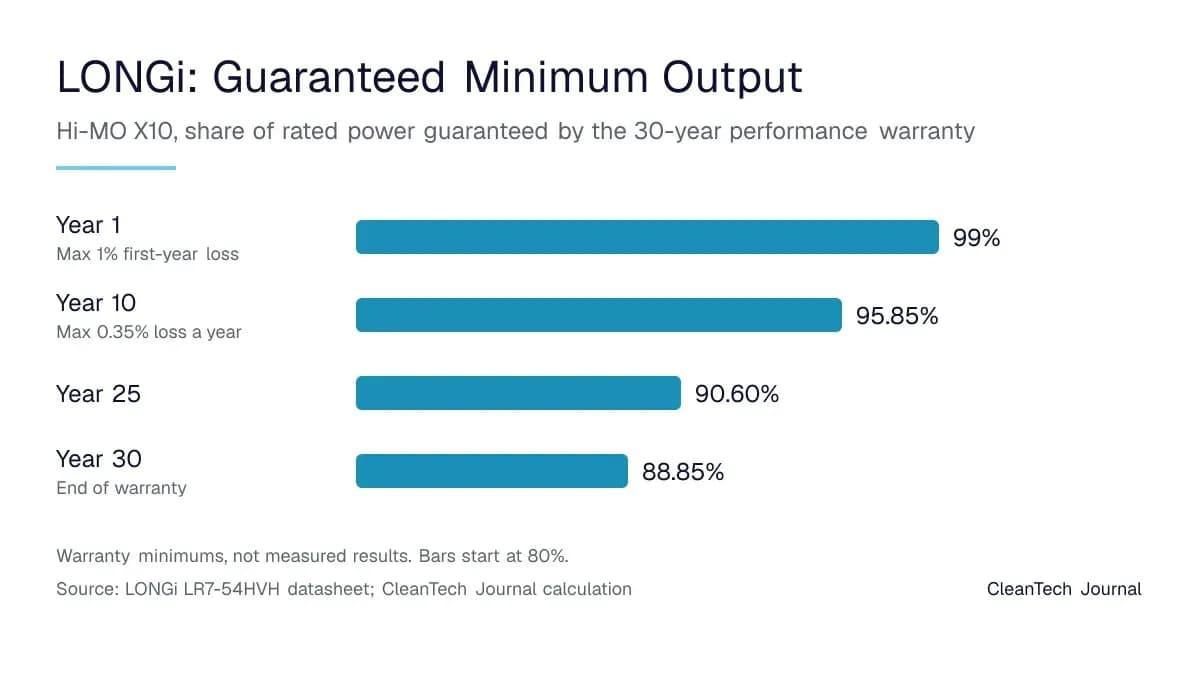
LONGi's datasheet guarantees no more than 1% loss in the first year and 0.35% a year after that, over a 30-year performance warranty. That works out to at least 88.85% of rated output in year 30. The panel has a 15-year product warranty.
5. Canadian Solar
Canadian Solar also scored in seven of eight categories. Its TOPBiHiKu6 residential panel uses n-type TOPCon cells and reaches 420 to 445 W and up to 22.8% efficiency, according to its datasheet.
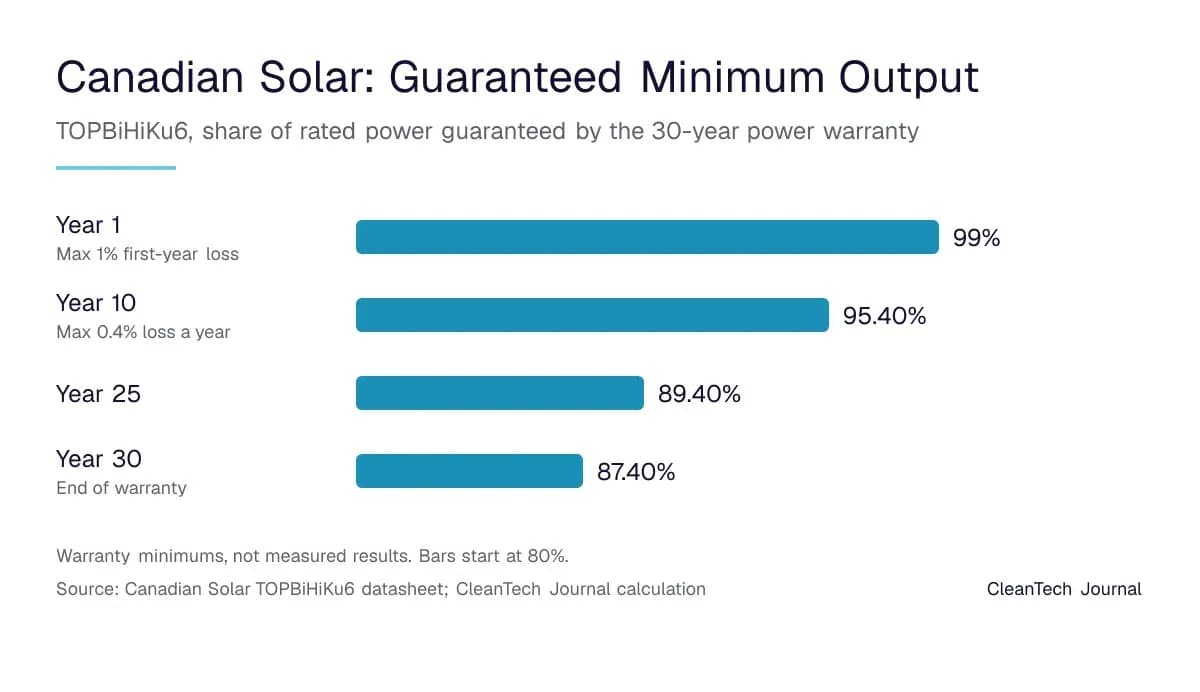
The panel is rated for snow loads up to 5,400 Pa and wind loads up to 2,400 Pa, with a temperature coefficient of -0.29% per °C. Canadian Solar guarantees no more than 1% loss in the first year and 0.4% a year after that, over a 30-year power warranty, or at least 87.4% of rated output in year 30.
Its product warranty is 12 years, shorter than several rivals here, so compare warranty terms closely if you are choosing between brands with similar test results.
6. Aiko Solar
Aiko Solar had Top Performer models in seven categories in 2026. Its Neostar 3P54 is the most efficient home panel in our comparison of the most efficient solar panels, at up to 25.0% and 470 to 500 W.
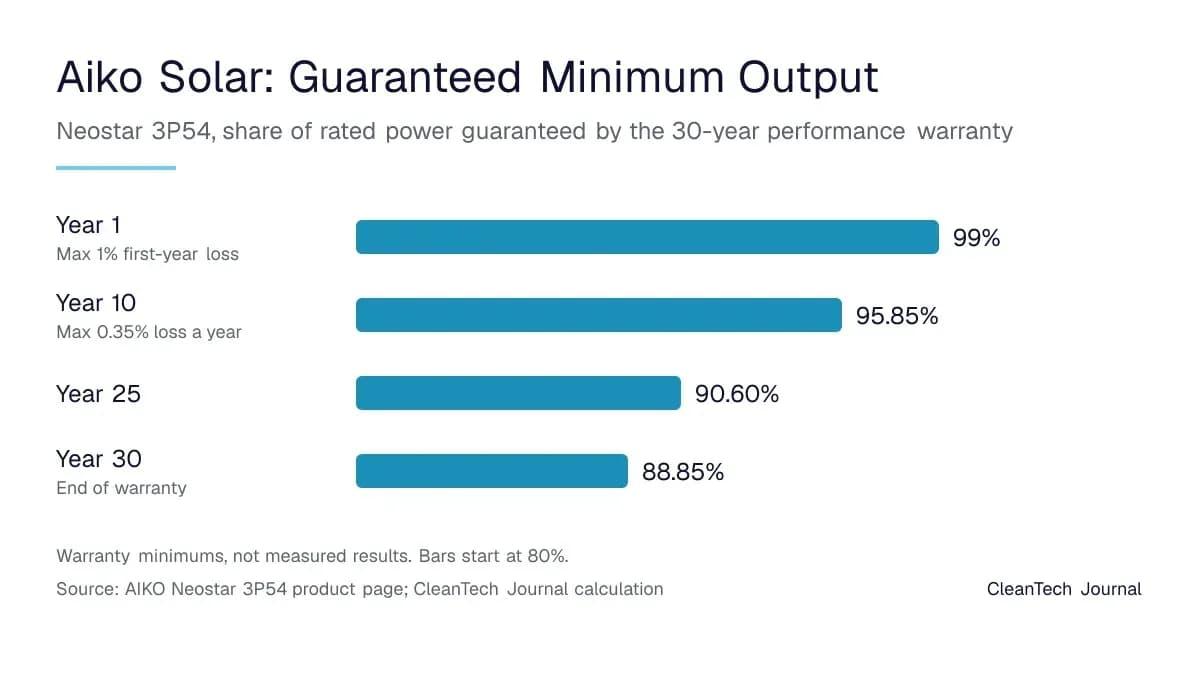
The panel uses all-back-contact (ABC) cells with no metal lines on the front, and has a temperature coefficient of -0.26% per °C. Aiko guarantees no more than 1% loss in the first year and 0.35% a year after that, under a 30-year performance warranty, or at least 88.85% in year 30. The product warranty is 15 years, extendable to 25 years.
Other well-known brands, including REC and Maxeon, did not appear on the 2026 Top Performer list. That does not mean their panels failed: manufacturers choose whether and which products to submit for testing.
Top Rated Solar Panels for Home
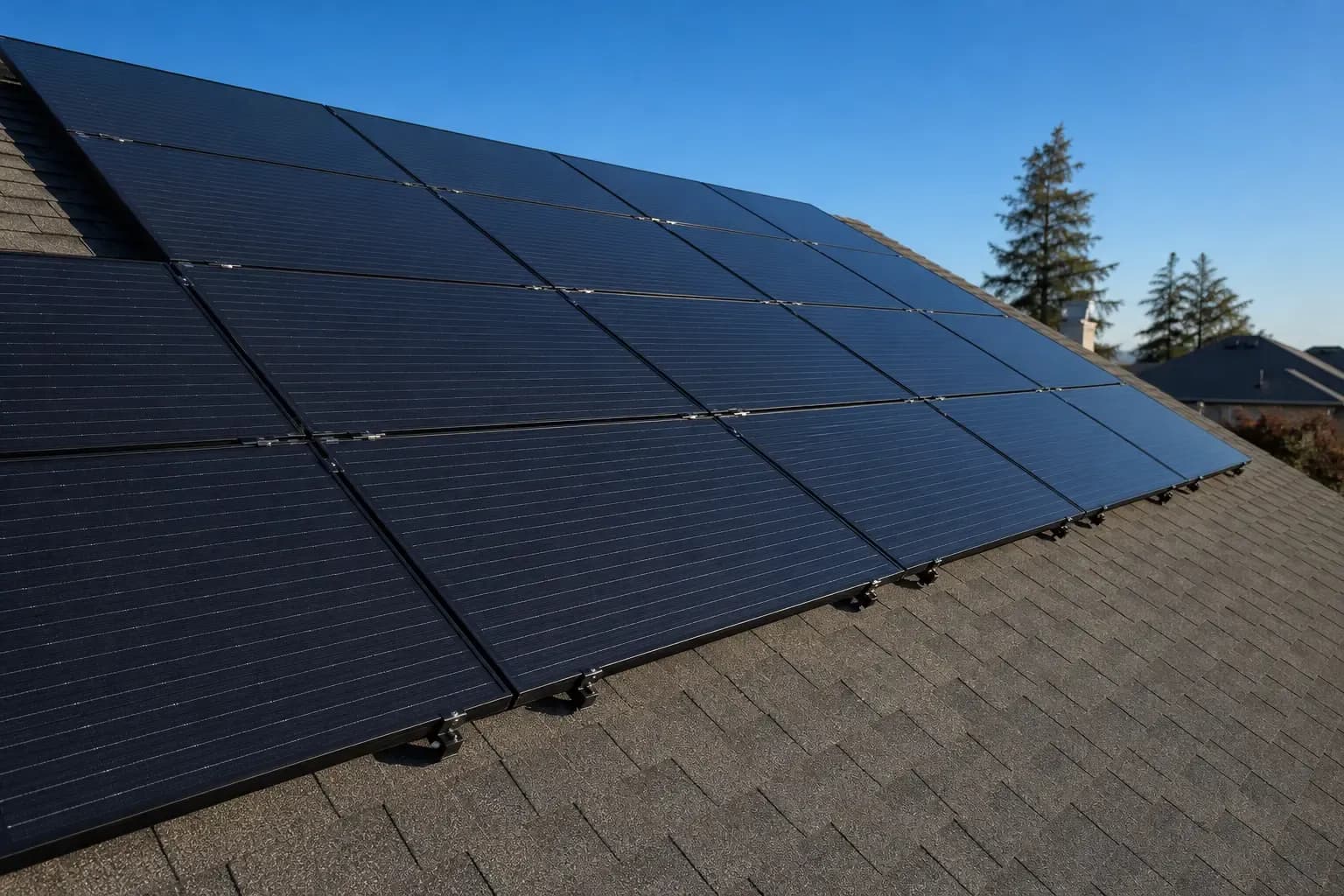
For a house, roof space is usually the main limit, so look for panels that combine high efficiency with strong test results.
- Choose residential-size panels, typically about 420 to 515 W, that fit standard roofs.
- Favor brands with Top Performer results in hail and mechanical stress if you live where hail, heavy snow or high winds are common.
- Compare warranties: a 25-year product warranty and a 25- to 30-year power warranty are now common among leading brands.
- Check the temperature coefficient if you live in a hot climate. Panels at -0.26% per °C lose less output in summer heat than panels at -0.30%.
- Ask the installer for the exact model, then check it in Kiwa PVEL's searchable Top Performer database.
Among the brands above, the Trina Vertex S+ G3 and Qcells Q.TRON stand out for pairing all-eight-test brand results with proven home panels.
Top Rated Solar Panels for Office
For an office or commercial building, the priorities shift toward cost per watt, energy yield and long-term reliability across a larger array.
- Larger-format panels with more power per panel can cut mounting and labor costs on big, flat roofs.
- Energy yield (PAN performance) and PID results matter more, because small losses add up across hundreds of panels.
- Request independent test reports for the exact bill of materials, and ask that the delivered panels match the tested version.
- Check the roof's load capacity, since commercial roofs may limit panel weight and racking.
Most of the top rated brands also make larger commercial-size panels, so the Scorecard is just as useful for office buyers.
Frequently Asked Questions
What are the top rated solar panels in the US?
Based on independent reliability testing, Trina Solar and Qcells were the best-known brands with Top Performer models in all eight of Kiwa PVEL's 2026 test categories. Jinko, LONGi, Canadian Solar and Aiko scored in seven.
What does Top Performer mean for solar panels?
It means a tested panel version lost less than 2% of its power in a test, with no major defects, in Kiwa PVEL's independent lab program. It applies to the tested bill of materials, not every product a brand makes.
Are the most efficient solar panels also the top rated?
Not always. Efficiency measures how much sunlight a panel converts, while reliability tests measure how well it holds up. The best choices score well on both.
What should offices look for in solar panels?
Large-format panels with low cost per watt, strong energy-yield and PID test results, and independent test reports for the exact panels delivered.
How long do top rated solar panels last?
Most are designed for 25 to 30 years or more. Among the panels here, power warranties guarantee roughly 87% to 91% of rated output after 25 to 30 years.
SOURCES
- Kiwa PVEL: 2026 Scorecard Top Performers
- Kiwa PVEL: Scorecard methodology
- PV Tech: Module test failures increase in Kiwa PVEL's 2026 Scorecard
- Trinasolar: Mass production of Vertex S+ G3 515W module
- Qcells Q.TRON BLK M-G2+ datasheet
- JinkoSolar: Tiger Neo 3.0 residential
- LONGi Hi-MO X10 LR7-54HVH datasheet
- Canadian Solar TOPBiHiKu6 CS6R datasheet
- AIKO: NEOSTAR 3P54 Mono-Glass
Written by
Suraj Kadam
Suraj Kadam is a journalist and Chief Editor of CleanTech Journal, a knowledge and media platform covering clean technology, solar energy, and renewable energy. He reports on emerging technologies, industry developments, policy trends, and innovations shaping the global clean energy transition. Through his editorial work, Suraj aims to make complex clean technology topics accessible to industry professionals, researchers, policymakers, and readers interested in sustainable energy. His work focuses on delivering insightful, informative, and engaging coverage of the evolving renewable energy landscape.