Most Efficient Solar Panels 2026: 7 Top Models Compared
The most efficient solar panels 2026 buyers can get reach 25%. We compare 7 top models from AIKO, Trina, LONGi, Jinko, Maxeon, REC and Qcells.

Suraj Kadam
Published •24 min read
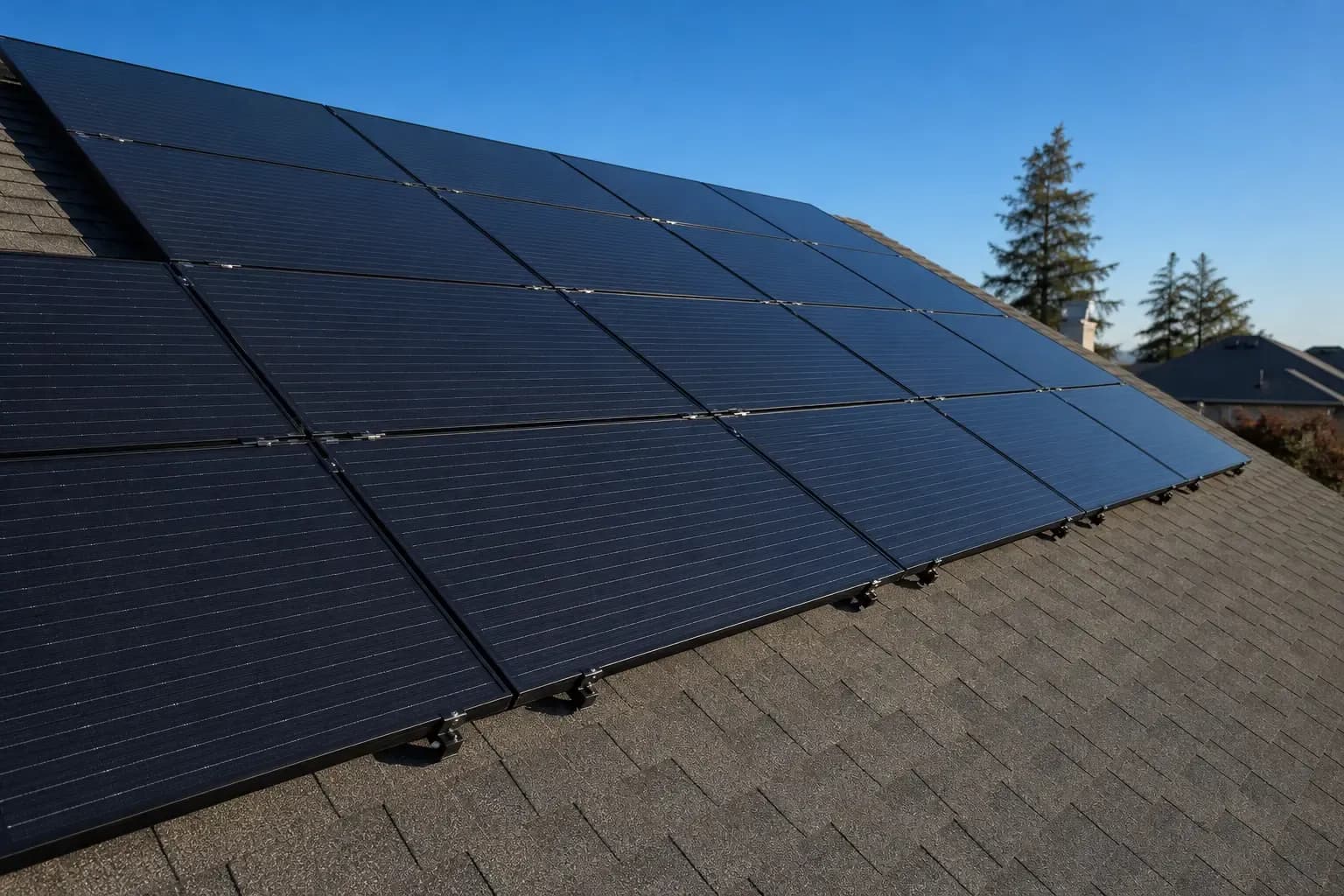
The most efficient solar panels in 2026 turn up to 25% of the sunlight that hits them into electricity. That top figure belongs to AIKO's Neostar 3P54, and three more rooftop models now reach 24.5% or higher.
Efficiency matters most when roof space is tight. A more efficient panel makes more power from the same area, so you can fit a bigger system on a small roof. To rank the most efficient solar panels 2026 has to offer, we compared seven leading rooftop panels using figures from each manufacturer's own datasheet or product page.
The Most Efficient Solar Panels in 2026 at a Glance
Rank | Panel | Max power | Max efficiency | Cell technology | Power warranty |
|---|---|---|---|---|---|
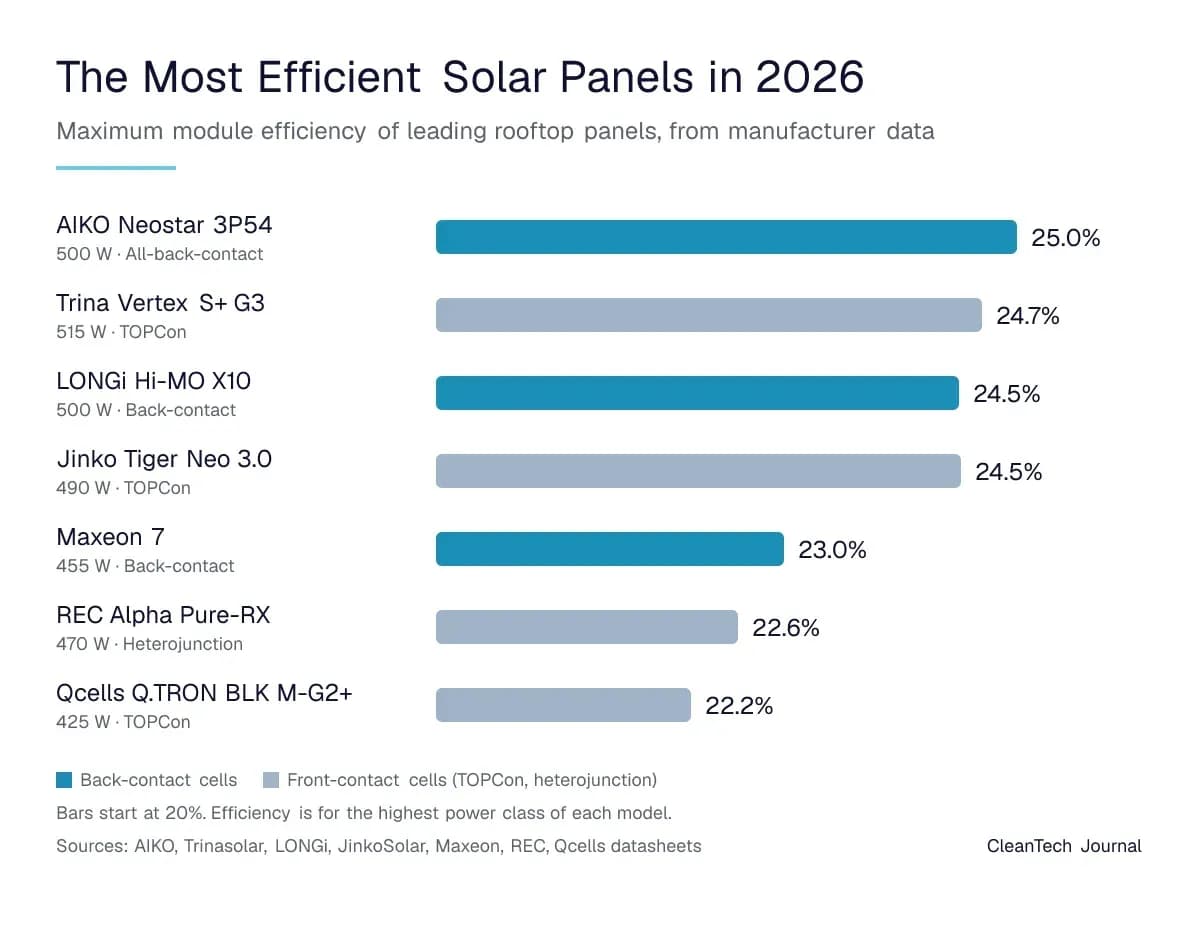
1 | AIKO Neostar 3P54 | 500 W | 25.0% | All-back-contact (ABC) | 30 years |
2 | Trina Vertex S+ G3 | 515 W | 24.7% | n-type i-TOPCon Ultra | 30 years |
3 | LONGi Hi-MO X10 (54-cell) | 500 W | 24.5% | HPBC 2.0 back-contact | 30 years |
4 | Jinko Tiger Neo 3.0 (48-cell) | 490 W | 24.5% | n-type TOPCon | See datasheet |
5 | Maxeon 7 | 455 W | 23.0% | IBC back-contact | 40 years |
6 | REC Alpha Pure-RX | 470 W | 22.6% | Heterojunction | 25 years |
7 | Qcells Q.TRON BLK M-G2+ | 425 W | 22.2% | n-type TOPCon | 25 years |
Efficiency is for each model's highest power class. Jinko's figure is the company's stated 24.52%, which matches a 490 W panel measuring 1,762 by 1,134 mm. Availability and power classes vary by country.
What Panel Efficiency Means for Your Roof
Panel efficiency is the share of incoming sunlight a panel converts into electricity under standard test conditions. In practice, it tells you how many watts you can fit per square foot.
Our calculation shows that 100 square feet of AIKO's 25% panels is rated at about 2,320 watts. The same area of 22.2% panels is rated at about 2,060 watts. That is roughly 12.6% more capacity from the same roof.
For a typical 300 square feet of panel area, that means about 7.0 kW with the most efficient panel, against about 6.2 kW with the 22.2% option. These are CleanTech Journal calculations based on each panel's rated efficiency.
The Top 7 Panels Ranked
1. AIKO Neostar 3P54
The AIKO Neostar 3P54 leads with up to 25.0% efficiency and 470 to 500 W of output. It uses all-back-contact cells, which move the wiring to the back of each cell so no metal lines block sunlight on the front. AIKO offers a 15-year product warranty, extendable to 25 years, and a 30-year power warranty with no more than 0.35% loss a year after the first year.
2. Trina Vertex S+ G3
Trinasolar's Vertex S+ G3 reaches 24.7% and up to 515 W in a 1,842 by 1,134 mm frame, according to Trinasolar. It began mass production in July 2026 and uses n-type i-TOPCon Ultra cells. It comes with a 25-year product warranty and a 30-year power warranty.
3. LONGi Hi-MO X10 (54-cell)
LONGi's residential Hi-MO X10 reaches 24.5% and up to 500 W, using the company's second-generation HPBC 2.0 back-contact cells. LONGi lists a 25-year product warranty and a 30-year power warranty. The cell design also includes shading optimization, which limits losses when part of the panel is shaded.
4. Jinko Tiger Neo 3.0 (48-cell)
JinkoSolar's residential Tiger Neo 3.0 is rated at up to 24.52% efficiency, with the 48-cell version producing up to 490 W in a compact frame. It uses n-type TOPCon cells. Check the local datasheet for warranty terms, which vary by market.
5. Maxeon 7
Maxeon 7 reaches 23.0% and 455 W from 120 IBC back-contact cells. Its standout feature is the warranty: Maxeon covers product, power and service for 40 years, with no more than 0.25% loss a year.
6. REC Alpha Pure-RX
REC's Alpha Pure-RX reaches 22.6% at 470 W using heterojunction cells. REC guarantees at least 92% of output after 25 years, a loss of just 0.25% a year. The product warranty is 20 years, or 25 years when installed by an REC Certified Solar Professional.
7. Qcells Q.TRON BLK M-G2+
The all-black Q.TRON BLK M-G2+ reaches 22.2% at 425 W with n-type TOPCon cells. Qcells guarantees at least 90.58% of output after 25 years and backs the panel with a 25-year product and performance warranty.
Back-Contact vs TOPCon: Which Cell Technology Leads
Back-contact panels hold three of the top five spots. Putting all the electrical contacts on the back of the cell frees the whole front surface to collect light, which raises efficiency and gives the panel a clean, all-black look.
TOPCon panels are close behind. Trina's Vertex S+ G3 and Jinko's Tiger Neo 3.0 show that the most widely produced cell type can now reach 24.5% or more. Heterojunction panels, such as REC's, trade a little peak efficiency for strong long-term output.
How to Choose Among the Most Efficient Solar Panels
- Start with your roof. If space is limited, choose a panel at 24% or higher. If you have plenty of room, a slightly less efficient panel may cost less per watt.
- Compare warranties, not just efficiency. A 30- or 40-year power warranty can matter more over the system's life than a fraction of a percent of efficiency.
- Check the yearly loss. Lower degradation, such as 0.25% a year, keeps more of the output you paid for.
- Confirm local availability. Not every model or power class is sold in every country, so ask installers what they can source.
- Get several quotes. Installation quality affects performance as much as the panel itself.
Frequently Asked Questions
What is the most efficient solar panel in 2026?
Among rooftop panels with published datasheets, the AIKO Neostar 3P54 leads at up to 25.0% efficiency. Trina's Vertex S+ G3 follows at 24.7%.
Are high-efficiency solar panels worth the extra cost?
They are most worth it on small or shaded roofs, where every square foot counts. On a large, open roof, a cheaper panel with slightly lower efficiency can deliver the same system size at a lower cost.
What is a good efficiency for a solar panel?
The seven leading rooftop panels in our comparison range from 22.2% to 25.0%. The most efficient solar panels 2026 buyers can choose sit at the top of that range, at 24.5% or more.
Does panel efficiency drop over time?
Yes, slowly. The panels in our list guarantee yearly losses of about 0.25% to 0.35% after the first year, so most keep around 90% or more of their original output after 25 years.
Do more efficient panels produce more electricity?
Per panel and per square foot, yes. But the total electricity a system produces depends on its overall size, your location, roof angle and shading, so a larger system of less efficient panels can produce just as much.
SOURCES
- AIKO: NEOSTAR 3P54 Mono-Glass
- Trinasolar: Mass production of Vertex S+ G3 515W module
- LONGi: Explorer and Hi-MO X10 series
- JinkoSolar: Tiger Neo 3.0 residential
- Maxeon 7 455 W datasheet
- REC Alpha Pure-RX datasheet
- Qcells Q.TRON BLK M-G2+ datasheet
Written by
Suraj Kadam
Suraj Kadam is a journalist and Chief Editor of CleanTech Journal, a knowledge and media platform covering clean technology, solar energy, and renewable energy. He reports on emerging technologies, industry developments, policy trends, and innovations shaping the global clean energy transition. Through his editorial work, Suraj aims to make complex clean technology topics accessible to industry professionals, researchers, policymakers, and readers interested in sustainable energy. His work focuses on delivering insightful, informative, and engaging coverage of the evolving renewable energy landscape.