Top 10 Largest Battery Storage Projects in the US by Capacity
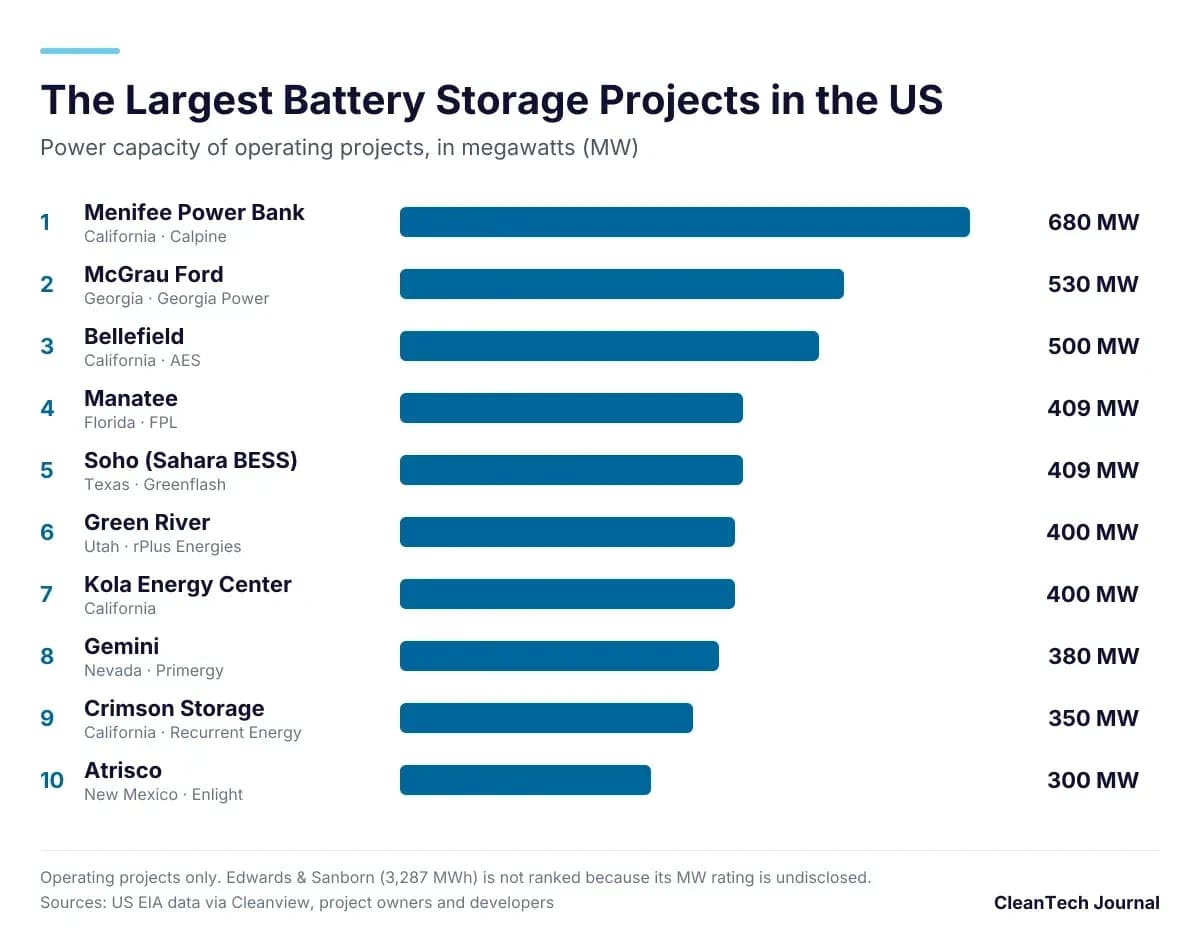
The largest battery storage projects in the US ranked by power capacity, led by California's 680 MW Menifee Power Bank and Georgia Power's McGrau Ford.

Suraj Kadam
Published •28 min read
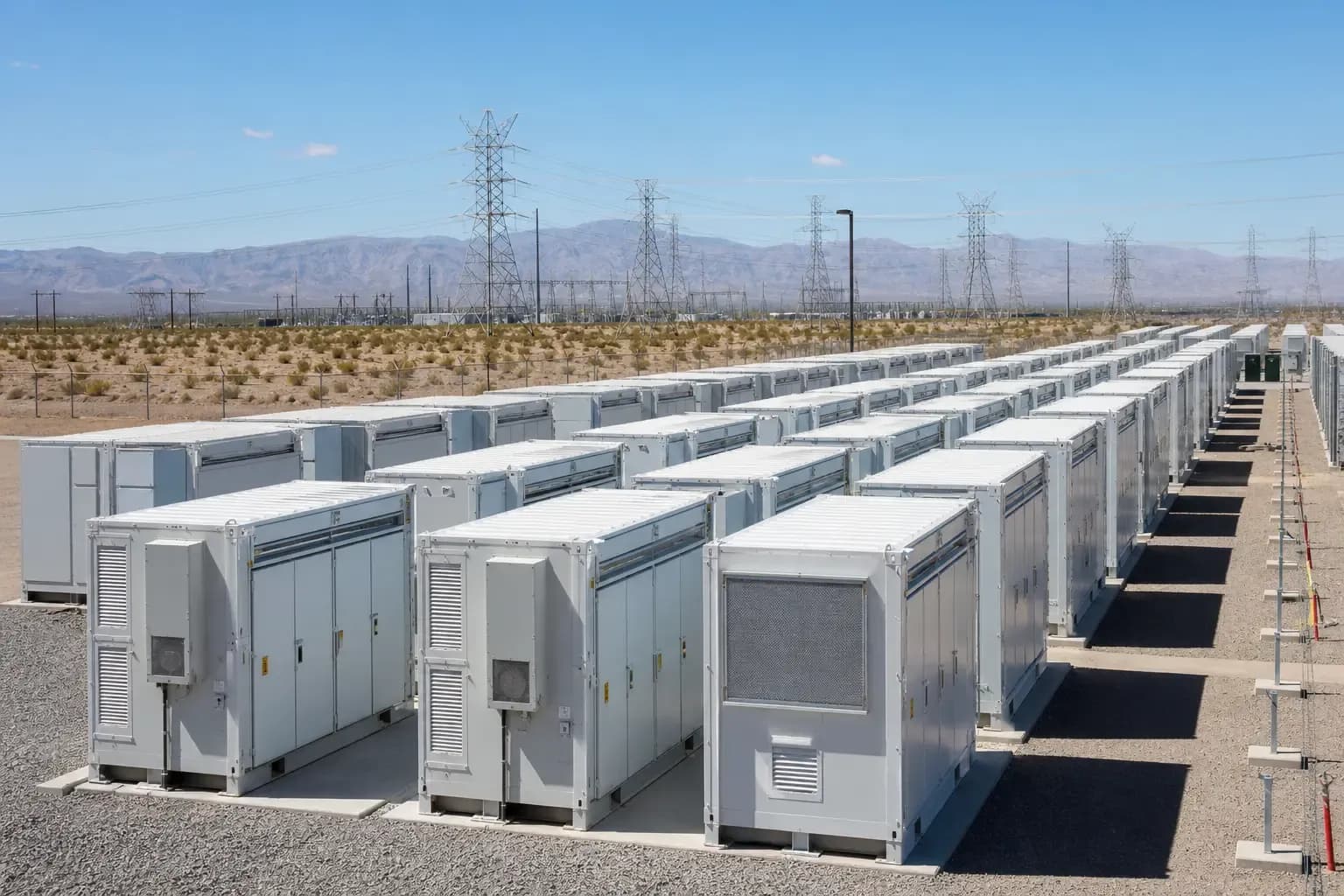
US battery storage is growing at a pace few other energy technologies can match. The country had nearly 52 GW of battery capacity by June 2026, according to US Energy Information Administration data reported by ESS News, after growing an average of 70% a year for three years.
We ranked the largest battery storage projects in the US by power capacity in megawatts (MW), which measures how much electricity a battery can deliver at once. We used EIA plant data as compiled by the project tracker Cleanview, checked against operator announcements, and included only projects that are operating.
Largest Battery Storage Projects in the US at a Glance
Rank | Project | State | Owner or developer | Power | Energy |
|---|---|---|---|---|---|
1 | Menifee Power Bank (Nova) | California | Calpine | 680 MW | 2,720 MWh |
2 | McGrau Ford | Georgia | Georgia Power | 530 MW | Not disclosed |
3 | Bellefield | California | AES | 500 MW | Not disclosed |
4 | Manatee Energy Storage Center | Florida | FPL | 409 MW | 900 MWh |
5 | Soho (Sahara BESS) | Texas | Greenflash Infrastructure | 409 MW | About 800 MWh |
6 | Green River Energy Center | Utah | rPlus Energies | 400 MW | 1,600 MWh |
7 | Kola Energy Center | California | Not disclosed | 400 MW | Not disclosed |
8 | Gemini | Nevada | Primergy | 380 MW | About 1,400 MWh |
9 | Crimson Storage | California | Recurrent Energy | 350 MW | 1,400 MWh |
10 | Atrisco | New Mexico | Enlight | 300 MW | 1,200 MWh |
Power (MW) is how fast a battery can discharge, while energy (MWh) is how much it can store. A 400 MW battery with 1,600 MWh can run at full power for about four hours.
1. Menifee Power Bank (Nova), California
The largest operating battery storage project in the US
Calpine built the Nova Power Bank on a brownfield site in Menifee, in Riverside County, in five phases. With 680 MW and 2,720 MWh, it can deliver four hours of power and helps supply about 680,000 homes, according to Calpine.
EIA data list the project, now known as Menifee Power Bank, as entering commercial operation in 2025.
2. McGrau Ford, Georgia
Georgia Power's McGrau Ford battery in Cherokee County, north of Atlanta, has 530 MW of capacity. It is part of 765 MW of new utility-owned battery storage that Georgia Power scheduled to enter service in 2026.
It is one of the largest battery projects outside the Western and Texas power markets, where most US battery storage has been built so far.
3. Bellefield, California
AES's Bellefield Solar and Energy Storage Farm in Kern County pairs 500 MW of solar with 500 MW of battery storage. It was placed in service in December 2025.
AES plans a second phase that would double the battery capacity, which would make Bellefield one of the largest battery storage projects in the US once complete.
4. Manatee Energy Storage Center, Florida
Florida's solar-charged giant
Florida Power & Light's Manatee Energy Storage Center has 409 MW and 900 MWh of capacity. It came online in 2021, charged by FPL's neighboring Manatee solar plant, and was among the largest batteries in the world at the time.
5. Soho (Sahara BESS), Texas
Greenflash Infrastructure's Soho project in Brazoria County, south of Houston, is a standalone battery with about 400 MW and 800 MWh, according to Energy-Storage.news. EIA data record it at 409 MW, with commercial operation in 2026.
Greenflash described it as the largest standalone battery under construction in Texas, where the ERCOT grid had about 15 GW of batteries in 2025.
6. Green River Energy Center, Utah
rPlus Energies' Green River Energy Center in Emery County combines 400 MW of solar with a 400 MW, 1,600 MWh battery. It began commercial operation in June 2026 and sells its power to PacifiCorp.
It is Utah's largest solar-plus-storage facility.
7. Kola Energy Center, California
Kola Energy Center in San Joaquin County, in California's Central Valley, has 400 MW of battery capacity. It entered commercial operation in August 2025, according to EIA data compiled by Cleanview.
8. Gemini, Nevada
Primergy's Gemini project in Clark County, outside Las Vegas, combines up to 690 MW of solar with 380 MW of four-hour battery storage. It reached commercial operation in 2024.
Primergy describes Gemini as the largest co-located solar-plus-storage project in the US. It can supply about 10% of Nevada's peak power demand.
9. Crimson Storage, California
Recurrent Energy's Crimson Storage in Riverside County has 350 MW and 1,400 MWh of capacity. When it came online in October 2022, it was described as the world's largest battery storage project built in a single phase.
The project is on federal land managed by the Bureau of Land Management.
10. Atrisco, New Mexico
Enlight Renewable Energy's Atrisco project, near Albuquerque, pairs about 364 MW of solar with 300 MW and 1,200 MWh of storage. It entered commercial operation in November 2024 and supplies New Mexico's largest utility, PNM.
Other Large Battery Storage Projects
Edwards & Sanborn, California: Terra-Gen's solar-plus-storage project in Kern County holds 3,287 MWh of battery storage, more energy than any project on this list. Its total power rating has not been disclosed, so it is not ranked by MW here.
Moss Landing, California: Vistra's Moss Landing battery site in Monterey County was once the largest in the world. A fire in January 2025 destroyed its original 300 MW building, and we have left the site out of this ranking because of the uncertainty over its operating status.
Why Battery Storage Is Booming in the US
Batteries soak up cheap solar power during the day and release it in the evening, when demand peaks and solar output falls. That makes them especially valuable in sunny states like California, Arizona and Nevada, and in Texas, where large swings in wind and solar output create price spikes.
Developers plan about 54 GW of additional battery capacity through 2028, according to the same EIA data. That means the list of the largest battery storage projects in the US is likely to change quickly, with several projects of 500 MW or more under construction.
Frequently Asked Questions
What is a battery energy storage system?
A battery energy storage system, or BESS, is a set of large batteries, usually lithium-ion, connected to the grid. It charges when power is cheap or plentiful and discharges when it is needed.
How long can grid batteries supply power?
Most large US battery projects are designed to discharge at full power for two to four hours. Longer-duration technologies, such as iron-air batteries, are being developed to supply power for days.
Are large battery storage sites safe?
Modern sites use fire detection, suppression and spacing between battery units to reduce risk. Fires are rare but can be hard to put out, which is why safety standards and local permitting rules have tightened since the Moss Landing fire.
Why are so many batteries paired with solar farms?
Sharing a site and grid connection lowers costs, and the battery can store solar power for use after sunset. Co-located projects also make it easier for utilities to buy round-the-clock clean power.
Can home batteries help the grid like these big projects?
Yes, on a smaller scale. Through virtual power plant programs, thousands of home batteries can be coordinated to supply power to the grid during peak demand.
SOURCES
- ESS News: US battery storage capacity grows 70% annually
- Calpine: Nova Power Bank
- Cleanview: Operating US battery storage projects
- Georgia Power: The essential role of battery energy storage systems
- Energy-Storage.news: Greenflash secures financing for Texas's largest standalone BESS
- Energy-Storage.news: rPlus Energies' Utah project begins commercial operation
- Business Wire: Gemini solar + storage reaches commercial operations
- Energy-Storage.news: Crimson Energy Storage comes online
- Energy-Storage.news: Enlight commissions solar-plus-storage project in New Mexico
- Energy-Storage.news: Edwards & Sanborn fully online
Written by
Suraj Kadam
Suraj Kadam is a journalist and Chief Editor of CleanTech Journal, a knowledge and media platform covering clean technology, solar energy, and renewable energy. He reports on emerging technologies, industry developments, policy trends, and innovations shaping the global clean energy transition. Through his editorial work, Suraj aims to make complex clean technology topics accessible to industry professionals, researchers, policymakers, and readers interested in sustainable energy. His work focuses on delivering insightful, informative, and engaging coverage of the evolving renewable energy landscape.