Top 10 Hydrogen Fuel Cell Vehicles, From Cars to Trucks
Top hydrogen fuel cell vehicles ranked by range, from the Mercedes NextGenH2 truck and Hyundai Nexo to the Toyota Mirai and Honda CR-V e:FCEV.

Suraj Kadam
Published •26 min read
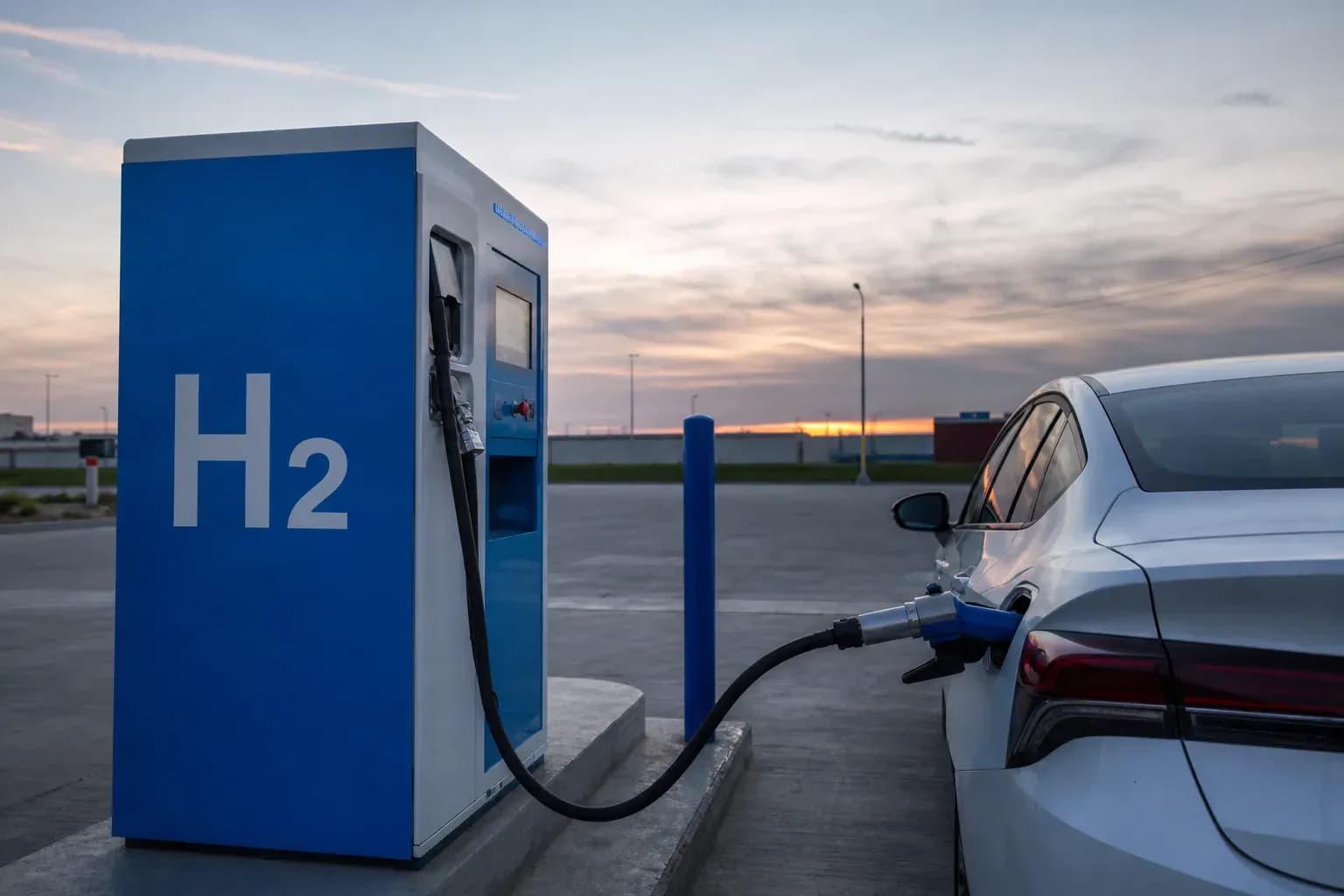
Hydrogen fuel cell vehicles promise something battery cars still struggle with: hundreds of miles of range and a refill that takes minutes. The question is which models actually deliver, and the answer now spans family SUVs, city buses and 40-ton trucks.
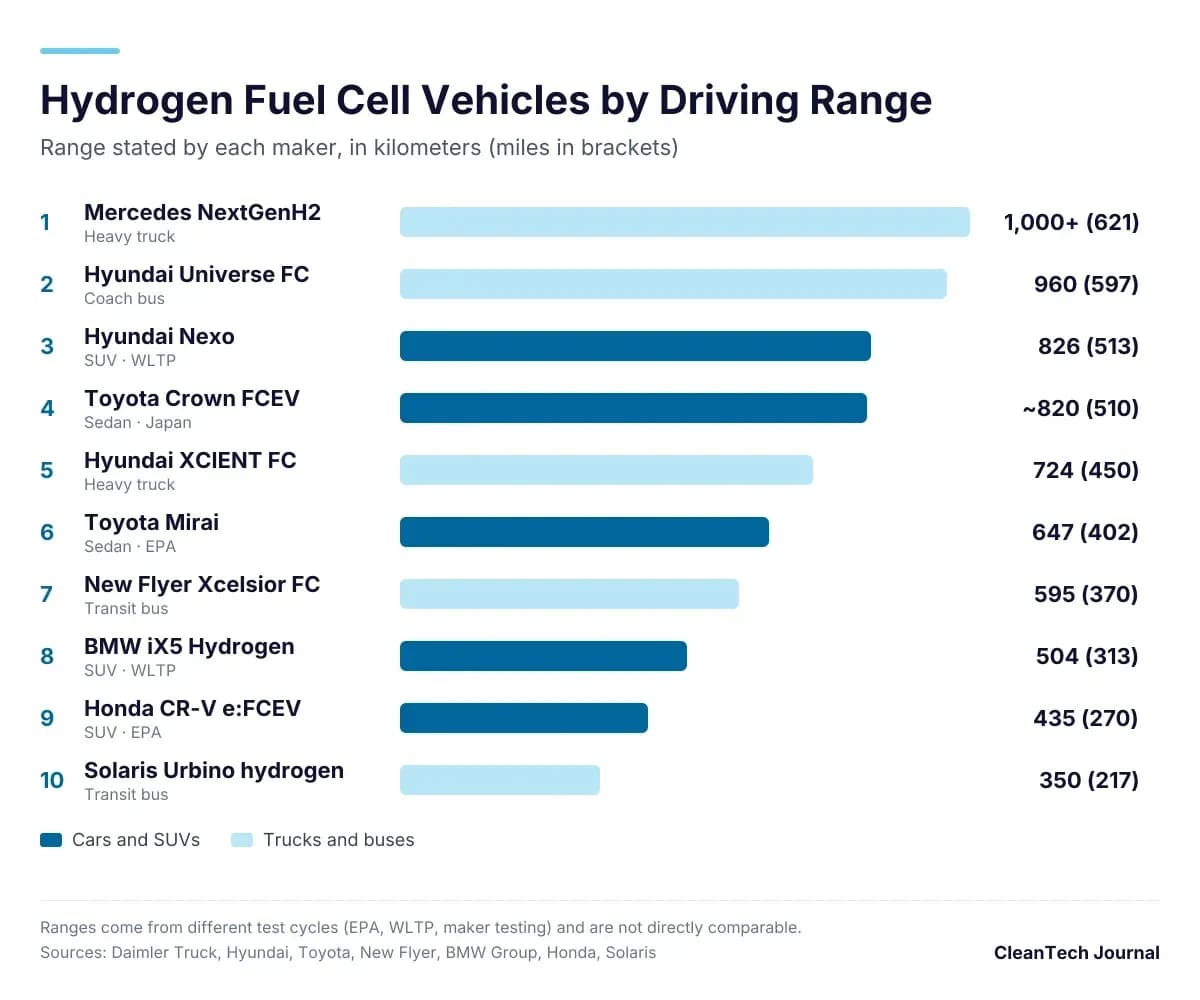
We ranked 10 hydrogen fuel cell vehicles by the driving range their makers state, from passenger cars to heavy trucks. Ranges come from different test cycles, including the US EPA, Europe's WLTP and manufacturer testing, so they are a guide rather than a like-for-like comparison.
Hydrogen Fuel Cell Vehicles at a Glance
Rank | Vehicle | Type | Stated range | Status |
|---|---|---|---|---|
1 | Mercedes-Benz NextGenH2 | Heavy truck | More than 1,000 km (621 mi) | Customer trucks from late 2026 |
2 | Hyundai Universe Fuel Cell | Coach bus | Up to 960 km (597 mi) | On sale in South Korea |
3 | Hyundai Nexo (second generation) | SUV | 826 km (513 mi), WLTP | Global launch in 2026 |
4 | Toyota Crown FCEV | Sedan | About 820 km (510 mi) | On sale in Japan |
5 | Hyundai XCIENT Fuel Cell | Heavy truck | Up to 450 mi (724 km) | In service in the US and Europe |
6 | Toyota Mirai | Sedan | 402 mi (647 km), EPA | On sale in California |
7 | New Flyer Xcelsior CHARGE FC | Transit bus | Up to 370 mi (595 km) | In service in North America |
8 | BMW iX5 Hydrogen | SUV | 504 km (313 mi), WLTP | Pilot fleet, production planned for 2028 |
9 | Honda CR-V e:FCEV | SUV | 270 mi (435 km), EPA | Leased in California |
10 | Solaris Urbino hydrogen | Transit bus | Up to 350 km (217 mi) | In service in Europe |
Conversions between miles and kilometers are CleanTech Journal calculations.
1. Mercedes-Benz NextGenH2 Truck
The longest-range fuel cell vehicle on this list
Daimler Truck's NextGenH2 runs on liquid hydrogen stored in two tanks holding 85 kg in total, which gives it a range of more than 1,000 km on one fill. Two 150 kW fuel cell units power the truck, and refueling takes about 10 to 15 minutes.
Daimler plans to put 100 of these trucks into customer operation from the end of 2026, after earlier GenH2 trials with companies including Amazon and Air Products.
2. Hyundai Universe Fuel Cell
Hyundai's upgraded Universe intercity coach can travel up to 960 km on a single fill, according to the company. Its fuel cell system produces up to 180 kW and works alongside a 48.2 kWh battery.
Hyundai launched the updated coach in South Korea in August 2025, adding a new 12-meter version.
3. Hyundai Nexo (Second Generation)
The all-new Nexo SUV has a projected range of 826 km under the WLTP cycle, and Hyundai says a refill takes about five minutes. Total system output has risen to 190 kW, up from 135 kW in the first-generation model.
Hyundai set the second-generation Nexo's global launch for early 2026, making it the newest hydrogen fuel cell car on the market.
4. Toyota Crown FCEV
Toyota's second hydrogen car after the Mirai is a fuel cell version of the Crown sedan, sold in Japan. Toyota says it can travel around 820 km on a refill that takes about three minutes.
It launched at a price of 8.3 million yen, and Toyota has since introduced taxi and police versions in Japan.
5. Hyundai XCIENT Fuel Cell
A Class 8 hydrogen truck already working in the US
The latest version of Hyundai's XCIENT Fuel Cell tractor has a maximum range of 450 miles, powered by two 90 kW fuel cell stacks. At Hyundai Motor Group's Metaplant in Georgia, 21 of these trucks handle about 40% of the plant's logistics, running on hydrogen produced on site.
Hyundai Translead expects to bring 50 to 100 more units to the US in 2026.
6. Toyota Mirai
The Toyota Mirai has an EPA-estimated range of 402 miles, one of the longest of any car sold in the US. The 2026 model starts at $51,795 and comes with up to $15,000 of complimentary hydrogen fuel.
Its fuel cell stack delivers 182 horsepower to a rear-wheel-drive electric motor.
7. New Flyer Xcelsior CHARGE FC
New Flyer's fuel cell transit bus can travel up to 370 miles per refueling, combining power from a 100 kW fuel cell with battery-only driving. The 40-foot version stores 37.5 kg of hydrogen, and the 60-foot articulated version stores 56 kg.
An extended-range option adds about 50% more fuel capacity and up to 120 more miles, aimed at rural and long-distance routes.
8. BMW iX5 Hydrogen
BMW's iX5 Hydrogen pilot fleet has a WLTP range of 504 km and a peak output of 295 kW, or 401 hp. Filling its hydrogen tanks takes three to four minutes.
BMW has said a production fuel cell model will follow in 2028.
9. Honda CR-V e:FCEV
The Honda CR-V e:FCEV is the first plug-in fuel cell vehicle sold in the US. It has a total EPA range of 270 miles, including 29 miles on battery power alone, which can be recharged from a plug.
It is built in Marysville, Ohio, and is available only through lease at approved dealers in California, with up to $30,000 in hydrogen fuel credits depending on the lease term.
10. Solaris Urbino Hydrogen
Poland's Solaris builds the Urbino hydrogen in 12-meter and 18-meter articulated versions. The company says the buses can cover up to about 350 km on one refill in various weather conditions.
Solaris is one of Europe's largest suppliers of hydrogen buses, with fleets running in Germany, Italy and the Netherlands.
Where You Can Drive Hydrogen Fuel Cell Vehicles
For US drivers, the biggest limit on fuel cell cars is not the vehicles but the fuel. Nearly all public hydrogen stations in the country are in California, which is why the Mirai and the CR-V e:FCEV are sold or leased only there.
Heavy vehicles are a different story. Trucks and buses return to the same depots each day, so operators can build their own hydrogen supply, which is why many new hydrogen fuel cell vehicles are commercial rather than passenger models.
Frequently Asked Questions
How does a hydrogen fuel cell vehicle work?
A fuel cell combines hydrogen from the tank with oxygen from the air to make electricity, which drives an electric motor. The only tailpipe emission is water vapor.
How long does it take to refuel a hydrogen car?
Most hydrogen cars refuel in about three to five minutes, similar to filling a gasoline car. Heavy trucks with larger tanks take longer, around 10 to 15 minutes for liquid hydrogen.
Is hydrogen fuel clean?
The vehicle itself produces no carbon dioxide, but the overall impact depends on how the hydrogen is made. Hydrogen made with renewable electricity is low-carbon, while most hydrogen today is still produced from natural gas.
Are fuel cell cars safer or riskier than gasoline cars?
Hydrogen tanks in fuel cell cars are built from carbon-fiber composites and tested for crashes and fire. Hydrogen also disperses quickly if it leaks, because it is much lighter than air.
What is the difference between a fuel cell car and a battery electric car?
Both use electric motors. A battery electric car stores electricity in a battery that is charged from the grid, while a fuel cell car makes its electricity on board from hydrogen.
SOURCES
- Toyota: The 2026 Toyota Mirai
- Hyundai: All-new NEXO sets new standards
- Honda: 2025 CR-V Fuel Cell Electric Vehicle lease pricing
- BMW Group: BMW iX5 Hydrogen pilot fleet launches
- New Mobility: Mercedes-Benz NextGen hydrogen truck enters small-series production
- Transport Topics: Hyundai to ship up to 100 XCIENT tractors to US in 2026
- New Flyer: Xcelsior CHARGE FC specification sheet
- Solaris: Hydrogen buses
- Truck & Bus Builder: Hyundai unveils improved Universe hydrogen bus
- H2 View: Toyota unveils Crown Sedan FCEV in Japan
Written by
Suraj Kadam
Suraj Kadam is a journalist and Chief Editor of CleanTech Journal, a knowledge and media platform covering clean technology, solar energy, and renewable energy. He reports on emerging technologies, industry developments, policy trends, and innovations shaping the global clean energy transition. Through his editorial work, Suraj aims to make complex clean technology topics accessible to industry professionals, researchers, policymakers, and readers interested in sustainable energy. His work focuses on delivering insightful, informative, and engaging coverage of the evolving renewable energy landscape.