Top 10 Largest Nuclear Power Plants in the World by Capacity
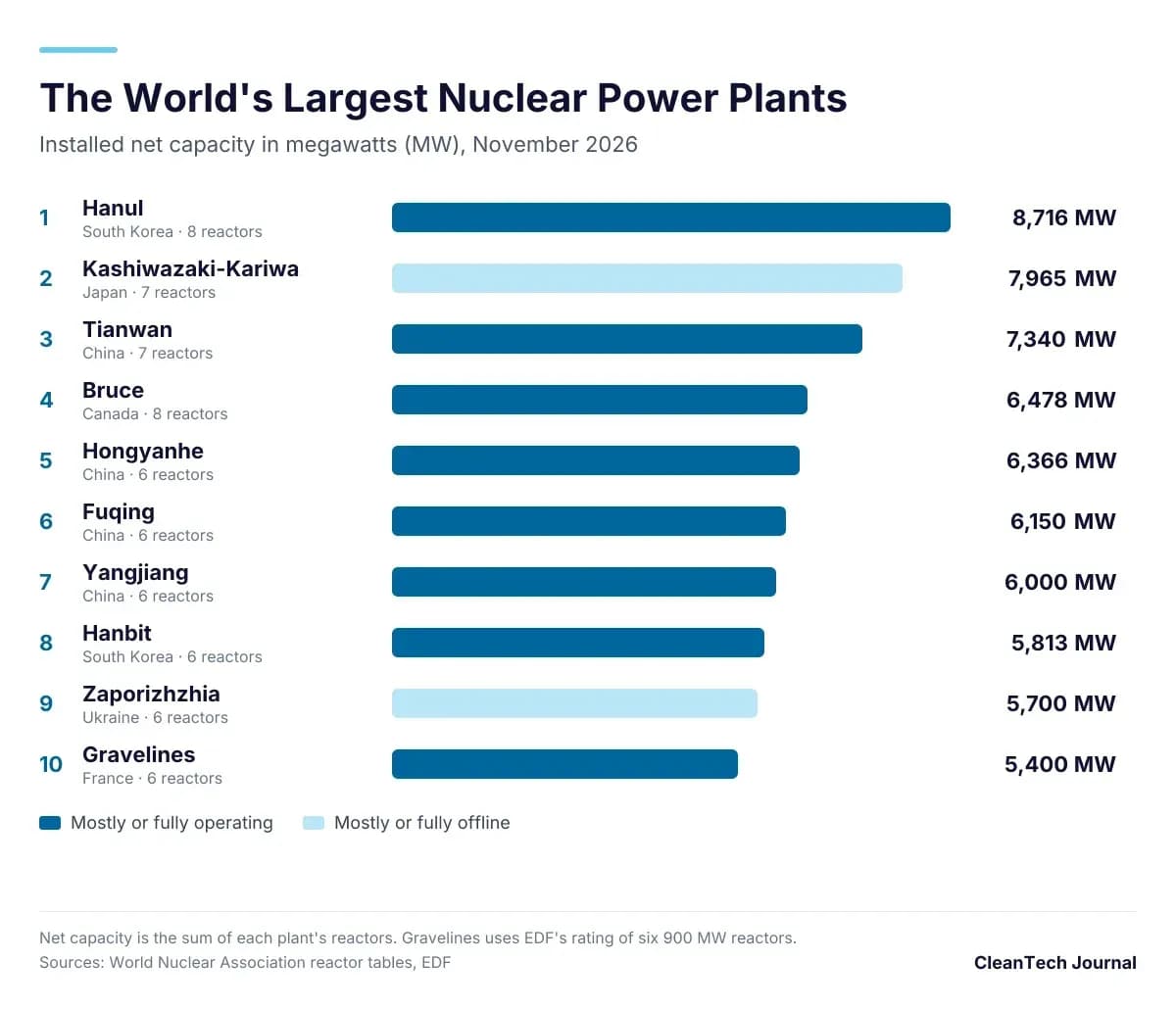
The largest nuclear power plants in the world ranked by net capacity, from South Korea's 8,716 MW Hanul to Japan's mostly idle Kashiwazaki-Kariwa.

Suraj Kadam
Published •30 min read
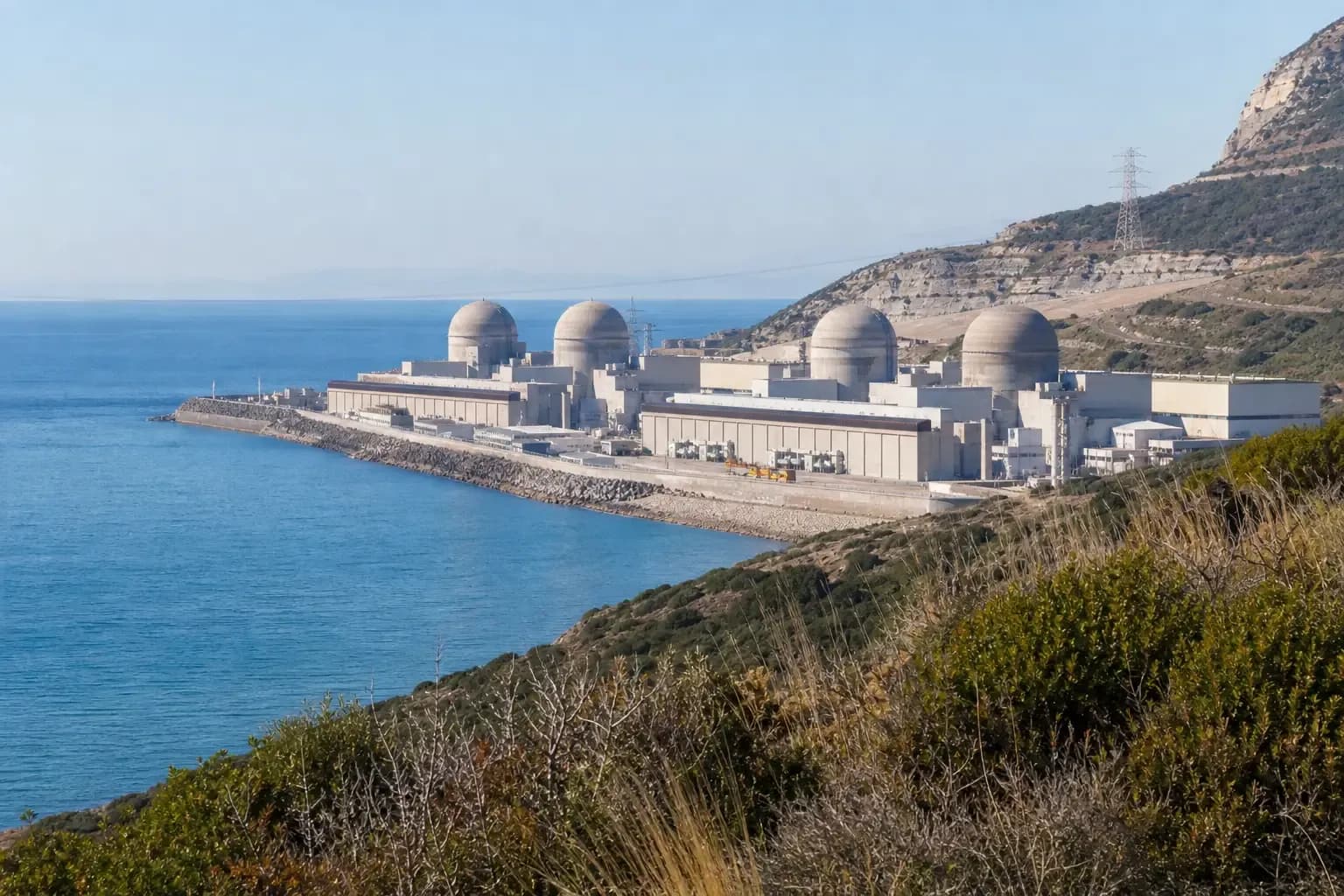
For years, Japan's Kashiwazaki-Kariwa held the title among the largest nuclear power plants in the world. On installed net capacity, that title now belongs to Hanul in South Korea, which passed 8,700 MW after its eighth reactor entered commercial operation.
We ranked the 10 largest plants by adding up the net capacity of every reactor at each site, using the reactor tables published by the World Nuclear Association. Plants count whether their reactors are running or idle, so we note where much of the capacity is offline.
Largest Nuclear Power Plants in the World at a Glance
Rank | Plant | Country | Reactors | Net capacity | Status |
|---|---|---|---|---|---|
1 | Hanul | South Korea | 8 | 8,716 MW | Operating |
2 | Kashiwazaki-Kariwa | Japan | 7 | 7,965 MW | One reactor operating |
3 | Tianwan | China | 7 | 7,340 MW | Operating |
4 | Bruce | Canada | 8 | 6,478 MW | Operating |
5 | Hongyanhe | China | 6 | 6,366 MW | Operating |
6 | Fuqing | China | 6 | 6,150 MW | Operating |
7 | Yangjiang | China | 6 | 6,000 MW | Operating |
8 | Hanbit | South Korea | 6 | 5,813 MW | Four reactors operating |
9 | Zaporizhzhia | Ukraine | 6 | 5,700 MW | Cold shutdown |
10 | Gravelines | France | 6 | 5,400 MW | Operating |
Capacity totals are CleanTech Journal calculations from per-reactor figures. Gravelines uses operator EDF's rating of six 900 MW reactors.
1. Hanul, South Korea
Hanul, on South Korea's east coast in Uljin, combines six older units with two newer APR-1400 reactors at Shin Hanul. The second of those began commercial operation in 2024, lifting the site to 8,716 MW across eight reactors.
The site is still growing. Construction of Shin Hanul 3 began in May 2025 and unit 4 followed in 2026, with completion expected in 2032 and 2033. Hanul 1 and 2 are awaiting approval to keep operating beyond their original licences.
2. Kashiwazaki-Kariwa, Japan
Run by Tokyo Electric Power Company (TEPCO) in Niigata Prefecture, Kashiwazaki-Kariwa has seven boiling water reactors with a combined net capacity of 7,965 MW. It stood idle for years after the 2011 Fukushima accident.
Unit 6 restarted in January 2026 and, according to NucNet, returned to commercial operation in April after more than 14 years offline. That puts 1,315 MW, or about 17% of the site, back in service. Unit 7 cannot restart until a required safety facility is finished, scheduled for August 2029.
3. Tianwan, China
Seven reactors, two reactor families, one coastal site in Jiangsu Province
Tianwan's first two units are Russian-designed VVER reactors, and its newest, unit 7, is a larger VVER-1200 design that was connected to the grid in October 2026. That addition took the plant to 7,340 MW, making it China's largest nuclear plant by net capacity.
4. Bruce, Canada
Bruce Power operates eight CANDU reactors on the shore of Lake Huron in Ontario. Their combined net capacity is 6,478 MW, while Bruce Power gives the site's total capability as 6,550 MW.
Unlike most plants on this list, every reactor at Bruce uses Canada's own heavy-water reactor technology. That makes it the largest operating nuclear plant outside Asia.
5. Hongyanhe, China
Located in Liaoning Province in northeast China, Hongyanhe has six reactors rated at 1,061 MW net each, for a total of 6,366 MW. Units 5 and 6 use the upgraded ACPR-1000 design, while the first four are CPR-1000 reactors.
6. Fuqing, China
Fuqing, in Fujian Province, reaches 6,150 MW with four CPR-1000 reactors and two Hualong One units. The Hualong One is China's homegrown large reactor design, and Fuqing 5 was the first to enter commercial operation.
7. Yangjiang, China
Yangjiang in Guangdong Province has six reactors of 1,000 MW each, for a total of 6,000 MW. Four are CPR-1000 units, and the last two use the ACPR-1000 design.
8. Hanbit, South Korea
Second South Korean site in the top 10, with two reactors paused
Hanbit, in Yeonggwang on the southwest coast, has six reactors totaling 5,813 MW. Units 1 and 2 were suspended after their operating licences expired in December 2025 and September 2026, leaving about 3,900 MW running.
South Korea's nuclear regulator approved related plans and licence changes for both units in October 2026, but no restart date has been set.
9. Zaporizhzhia, Ukraine
Zaporizhzhia is Europe's largest nuclear plant, with six VVER reactors of 950 MW each, or 5,700 MW in total. It has been under Russian occupation since March 2022.
All six reactors have been in cold shutdown since September 2022, so the plant currently produces no electricity for the grid. Its installed capacity alone keeps it among the largest nuclear power plants in the world.
10. Gravelines, France
EDF's Gravelines plant on France's northern coast near Dunkirk operates six pressurized water reactors of 900 MW each, for about 5,400 MW. It is the largest plant in France's nuclear fleet by number of reactors.
Other Large Nuclear Plants Worth Knowing
Kori and Saeul, South Korea: these neighboring plants near Busan share one coastline but are run as separate plants by Korea Hydro & Nuclear Power. Counted together, their seven reactors total 7,389 MW, which would place them third. Saeul 3 is in commissioning, which will add about 1,400 MW once it enters commercial operation.
Barakah, United Arab Emirates: its four APR-1400 reactors total about 5,348 MW net. The plant's operator rates it at 5,600 MW and says it can meet about 25% of the UAE's electricity demand.
Vogtle, United States: Vogtle in Georgia became the largest nuclear power plant in the US when its fourth reactor started commercial operation in 2024. The US Energy Information Administration puts its total capacity at nearly 5 GW, ahead of the 4,210 MW Palo Verde plant in Arizona.
How Nuclear Power Plant Capacity Is Counted
Most of the biggest nuclear power plants in the world are not single giant reactors but clusters of six to eight units sharing one site. Adding reactors to an existing site lets operators reuse cooling water access, grid connections and security infrastructure.
Net capacity is the electricity a plant can send to the grid after powering its own equipment. Because reactors are added, retired and paused at different times, the ranking of the largest nuclear power plants in the world can shift within a single year.
Frequently Asked Questions
What is the difference between net and gross nuclear capacity?
Gross capacity is the total electricity a plant's generators produce. Net capacity subtracts the power the plant uses to run its own pumps, cooling and safety systems, so it reflects what actually reaches the grid.
What is a CANDU reactor?
CANDU is a Canadian reactor design that uses heavy water to slow neutrons, which allows it to run on natural, unenriched uranium. It can also be refueled while operating, rather than shutting down for refueling.
How long can a nuclear reactor operate?
Licence terms vary by country. In South Korea, reactors start with a 40-year licence and can apply for continued operation, as Kori 2, 3 and 4 have done, with approvals running into the 2030s.
Which nuclear plants are being built that could join this list?
Hanul will grow further when Shin Hanul 3 and 4 are completed. In China, four reactors are under construction at Xudabao in Liaoning Province, a site that currently has no operating units.
Does the largest plant always generate the most electricity?
No. Annual output depends on how many reactors run and for how long, so a plant with idle reactors can produce far less than a smaller plant running at full capacity.
SOURCES
- World Nuclear Association: Nuclear Power in South Korea
- World Nuclear Association: Nuclear Power in China
- World Nuclear Association: Nuclear Power in Japan
- World Nuclear Association: Nuclear Power in Canada
- World Nuclear Association: Nuclear Power in Ukraine
- World Nuclear Association: Nuclear Power in the United Arab Emirates
- EDF: The nuclear fleet in France
- NucNet: Kashiwazaki-Kariwa 6 resumes commercial operation
- US Energy Information Administration: Plant Vogtle Unit 4 begins commercial operation
- Abu Dhabi Media Office: Barakah Unit 4 start-up
Written by
Suraj Kadam
Suraj Kadam is a journalist and Chief Editor of CleanTech Journal, a knowledge and media platform covering clean technology, solar energy, and renewable energy. He reports on emerging technologies, industry developments, policy trends, and innovations shaping the global clean energy transition. Through his editorial work, Suraj aims to make complex clean technology topics accessible to industry professionals, researchers, policymakers, and readers interested in sustainable energy. His work focuses on delivering insightful, informative, and engaging coverage of the evolving renewable energy landscape.