How Much Energy Does a Solar Panel Produce? Per Day, Month, Year
How much energy does a solar panel produce? See daily, monthly and yearly kWh for 100W, 300W, 400W panels and 1kW and 5kW systems in 10 US cities.

Suraj Kadam
Published •42 min read
How much energy does a solar panel produce? In the US, each 1 kilowatt (kW) of solar panels produces about 1,100 to 1,750 kilowatt-hours (kWh) of electricity a year, depending on where you live. That works out to roughly 3 to 4.8 kWh a day for every 1,000 watts of panels.
A single 400-watt panel, the size now common on home roofs, makes about 1.2 to 1.9 kWh on an average day. We worked out the figures below with the free PVWatts calculator from the National Laboratory of the Rockies (formerly the National Renewable Energy Laboratory), for south-facing rooftop panels with a 20-degree tilt and standard 14% system losses.
How Much Energy Does a Solar Panel Produce?
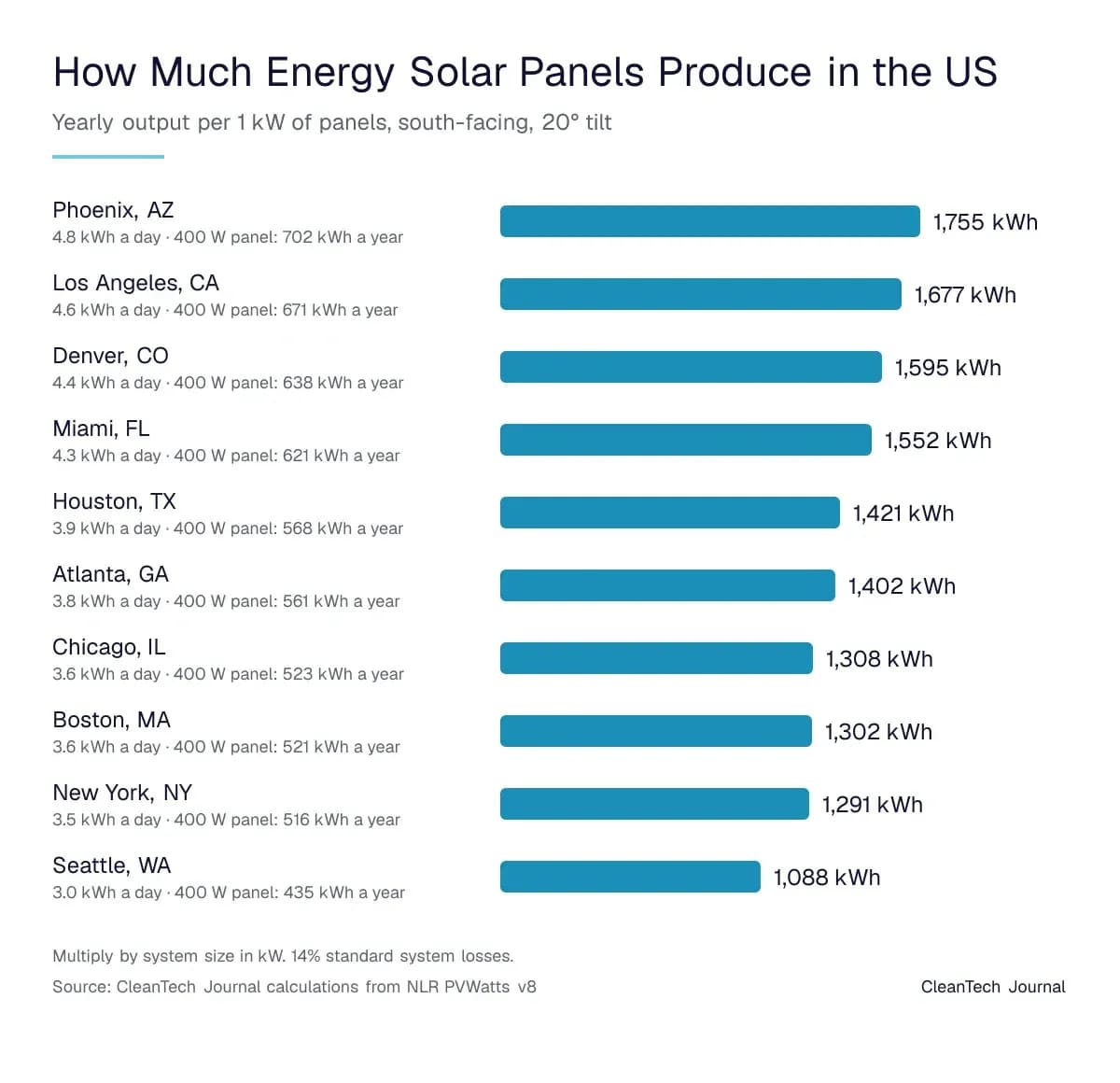
The table shows yearly and daily output for each 1 kW of panels in 10 US cities. To estimate any system, multiply these figures by its size in kW: a 400 W panel is 0.4 kW, and a 5 kW system is 5 kW.
City | Yearly output per 1 kW | Daily output per 1 kW |
|---|---|---|
Phoenix, AZ | 1,755 kWh | 4.8 kWh |
Los Angeles, CA | 1,677 kWh | 4.6 kWh |
Denver, CO | 1,595 kWh | 4.4 kWh |
Miami, FL | 1,552 kWh | 4.3 kWh |
Houston, TX | 1,421 kWh | 3.9 kWh |
Atlanta, GA | 1,402 kWh | 3.8 kWh |
Chicago, IL | 1,308 kWh | 3.6 kWh |
Boston, MA | 1,302 kWh | 3.6 kWh |
New York, NY | 1,291 kWh | 3.5 kWh |
Seattle, WA | 1,088 kWh | 3.0 kWh |
CleanTech Journal calculations from PVWatts version 8 results. Daily figures are yearly output divided by 365. Below, we use Phoenix as a sunny city, Atlanta as a mid-range city close to the middle of this list, and Seattle as a cloudy city.
How Much Energy Does a Solar Panel Produce per Day
Each 1 kW of panels produces about 3.0 kWh a day in Seattle, 3.8 kWh in Atlanta and 4.8 kWh in Phoenix, averaged over the year. Solar professionals often call this figure "peak sun hours," because it equals the number of hours the panels would need to run at full rated power to make the same energy.
Daily output swings with the seasons and the weather. A clear summer day can produce well above the average, while a cloudy winter day may produce only a fraction of it.
How Much Energy Does a Solar Panel Produce per Hour
In one hour of strong midday sun, a solar panel produces close to, but usually below, its rated power. After the typical 14% losses from wiring, inverters, dirt and heat assumed in PVWatts, a 400 W panel delivers roughly 0.34 kWh in an ideal hour.
Most hours produce much less, because the sun is lower in the morning and evening, and output falls to zero at night. That is why daily totals are a better guide than hourly figures: a 400 W panel's 1.5 kWh or so on an average Atlanta day is spread unevenly across the daylight hours.
How Much Energy Does a Solar Panel Produce per Month
On average, each 1 kW of panels produces about 91 kWh a month in Seattle, 117 kWh in Atlanta and 146 kWh in Phoenix. These are yearly totals divided by 12.
Actual monthly output varies a lot by season. In our earlier PVWatts analysis, a 1 kW system in Phoenix produced about 117 kWh in December and 156 kWh in July, while in Seattle it produced only 33 kWh in December but 143 kWh in July.
How Much Energy Does a Solar Panel Produce per Year
Each 1 kW of panels produces about 1,088 kWh a year in Seattle, 1,402 kWh in Atlanta and 1,755 kWh in Phoenix. Across our 10 cities, the middle value is about 1,410 kWh.
For context, the average US home used about 10,400 kWh of electricity a year, according to the US Energy Information Administration. Yearly output also falls slowly as panels age, typically by around 0.5% a year.
How Much Energy Does a 100 Watt Solar Panel Produce
A 100 W panel, common for RVs, boats and small off-grid setups, produces about:
Location | Per day | Per month | Per year |
|---|---|---|---|
Phoenix (sunny) | 0.48 kWh | 14.6 kWh | 176 kWh |
Atlanta (mid-range) | 0.38 kWh | 11.7 kWh | 140 kWh |
Seattle (cloudy) | 0.30 kWh | 9.1 kWh | 109 kWh |
That is enough to charge phones, run LED lights or keep a small battery topped up, but not to power large appliances.
How Much Energy Does a 300W Solar Panel Produce
A 300 W panel produces about:
Location | Per day | Per month | Per year |
|---|---|---|---|
Phoenix (sunny) | 1.44 kWh | 43.9 kWh | 526 kWh |
Atlanta (mid-range) | 1.15 kWh | 35.1 kWh | 421 kWh |
Seattle (cloudy) | 0.89 kWh | 27.2 kWh | 326 kWh |
How Much Energy Does a 400 Watt Solar Panel Produce
A 400 W panel, now a common size for new home installations, produces about:
Location | Per day | Per month | Per year |
|---|---|---|---|
Phoenix (sunny) | 1.92 kWh | 58.5 kWh | 702 kWh |
Atlanta (mid-range) | 1.54 kWh | 46.7 kWh | 561 kWh |
Seattle (cloudy) | 1.19 kWh | 36.3 kWh | 435 kWh |
Higher-wattage panels make more energy mainly because they are larger or more efficient, not because the sun is used differently. Each watt of rated capacity produces about the same amount in the same place.
How Much Energy Does a 1kW Solar Panel Produce
A 1 kW system is usually two or three panels rather than a single panel. It produces about:
Location | Per day | Per month | Per year |
|---|---|---|---|
Phoenix (sunny) | 4.81 kWh | 146 kWh | 1,755 kWh |
Atlanta (mid-range) | 3.84 kWh | 117 kWh | 1,402 kWh |
Seattle (cloudy) | 2.98 kWh | 91 kWh | 1,088 kWh |
These are the building-block figures in the first table: any system's output is roughly its size in kW multiplied by these numbers.
How Much Energy Does a 5kW Solar Panel Produce
A 5 kW system, about 12 to 13 panels of 400 W, produces about:
Location | Per day | Per month | Per year | Share of an average home's use |
|---|---|---|---|---|
Phoenix (sunny) | 24.0 kWh | 731 kWh | 8,775 kWh | 84% |
Atlanta (mid-range) | 19.2 kWh | 584 kWh | 7,010 kWh | 67% |
Seattle (cloudy) | 14.9 kWh | 453 kWh | 5,440 kWh | 52% |
The last column compares yearly output with the average US home's use of about 10,400 kWh. To see how big a system your own home needs, read our guide to how many solar panels you need to power your home.
What Changes How Much Energy Your Panels Produce
- Location and sunshine. Sunny Southwest cities produce over 60% more per kW than Seattle.
- Direction and tilt. South-facing panels produce the most in the US. East or west faces produce less, and north faces much less.
- Shade. Even partial shade from trees, chimneys or nearby buildings can cut output noticeably.
- Heat. Panels lose efficiency when hot, so a cool, sunny day is ideal.
- Panel age. Output declines slowly over time, typically around 0.5% a year.
You can check your own address with the free PVWatts calculator, which uses local weather data.
Frequently Asked Questions
How many kWh does a solar panel produce a day?
A typical 400 W home panel produces about 1.2 to 1.9 kWh a day in the US, depending on location, according to our PVWatts calculations.
How much energy does a solar panel produce in winter?
Much less than in summer in northern cities. A 1 kW system in Seattle produced about 33 kWh in December against 143 kWh in July in PVWatts, while in Phoenix the difference was far smaller.
Do solar panels produce energy on cloudy days?
Yes, but less. Panels still capture diffuse light through clouds, but output can fall to a fraction of what they produce in full sun.
How much energy does a solar panel produce in its lifetime?
A 400 W panel in Atlanta producing about 561 kWh a year would make about 13,200 kWh over 25 years, assuming its output falls by 0.5% a year.
Is a bigger solar panel always better?
Not always. Higher-wattage panels produce more per panel, but output per watt is similar. What matters most is the total capacity that fits on your roof and how well the roof faces the sun.
SOURCES
Written by
Suraj Kadam
Suraj Kadam is a journalist and Chief Editor of CleanTech Journal, a knowledge and media platform covering clean technology, solar energy, and renewable energy. He reports on emerging technologies, industry developments, policy trends, and innovations shaping the global clean energy transition. Through his editorial work, Suraj aims to make complex clean technology topics accessible to industry professionals, researchers, policymakers, and readers interested in sustainable energy. His work focuses on delivering insightful, informative, and engaging coverage of the evolving renewable energy landscape.