Balcony Solar Kit Cost and Savings: Is It Worth It?
A balcony solar kit costs $500 to $1,500 and can save $100 to $400 a year. We modeled savings and payback in 5 US cities to see if it is worth it.

Suraj Kadam
Published •22 min read
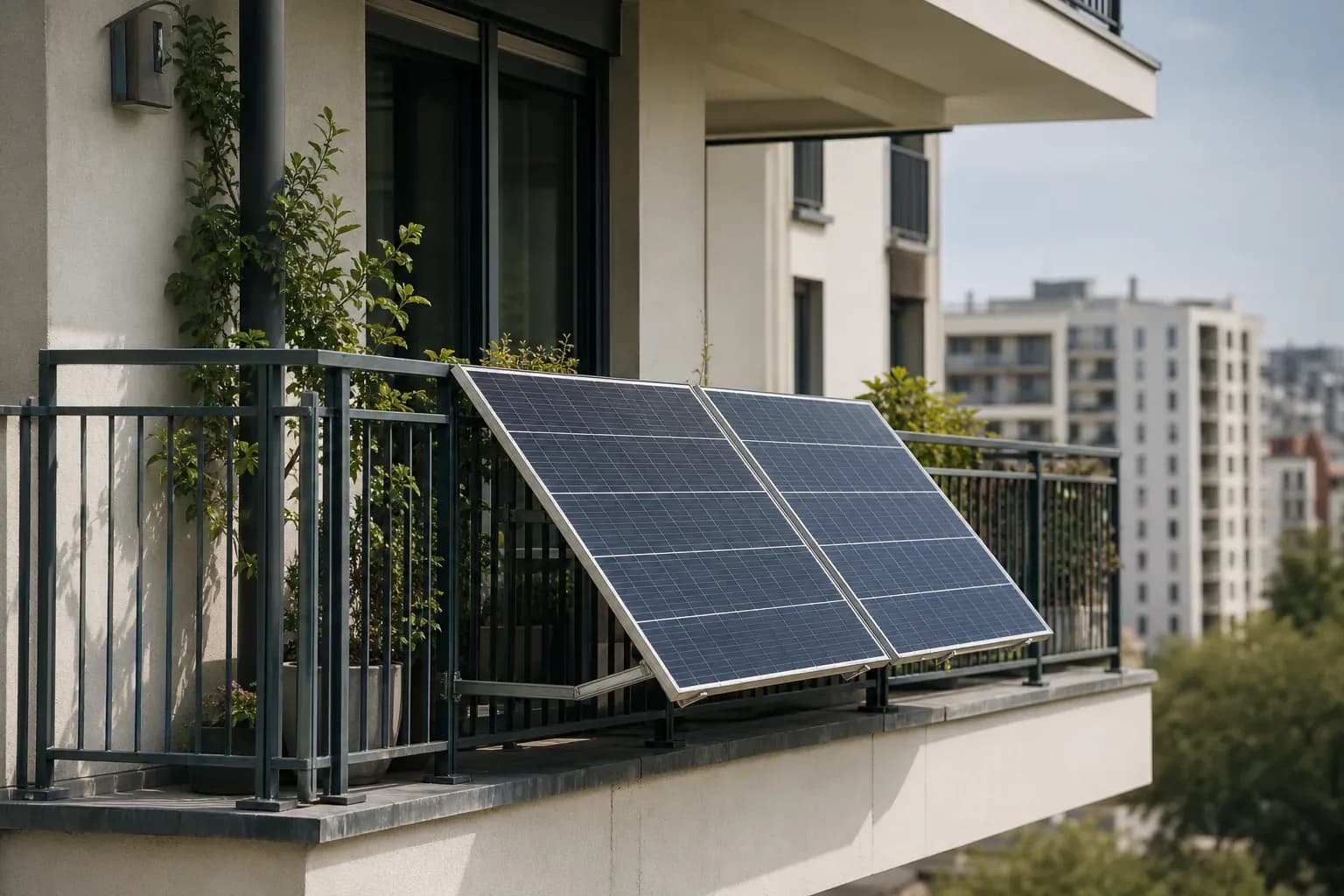
A balcony solar kit costs about $500 to $1,500 and can cut a household's power bill by roughly $100 to $400 a year, depending on where you live and how the panels are mounted. That puts payback anywhere from about two and a half years to more than nine.
These plug-in systems, usually one or two panels with a small inverter, plug straight into a standard outlet. They have been popular in Germany for years and are now legal in a growing number of US states. To see whether one pays off, we modeled an 800-watt kit in five US cities using federal solar and electricity price data.
Balcony Solar Kit Savings by City
City | Railing mount: yearly output | Railing mount: yearly savings | Railing mount: payback | Angled mount: yearly output | Angled mount: yearly savings | Angled mount: payback |
|---|---|---|---|---|---|---|
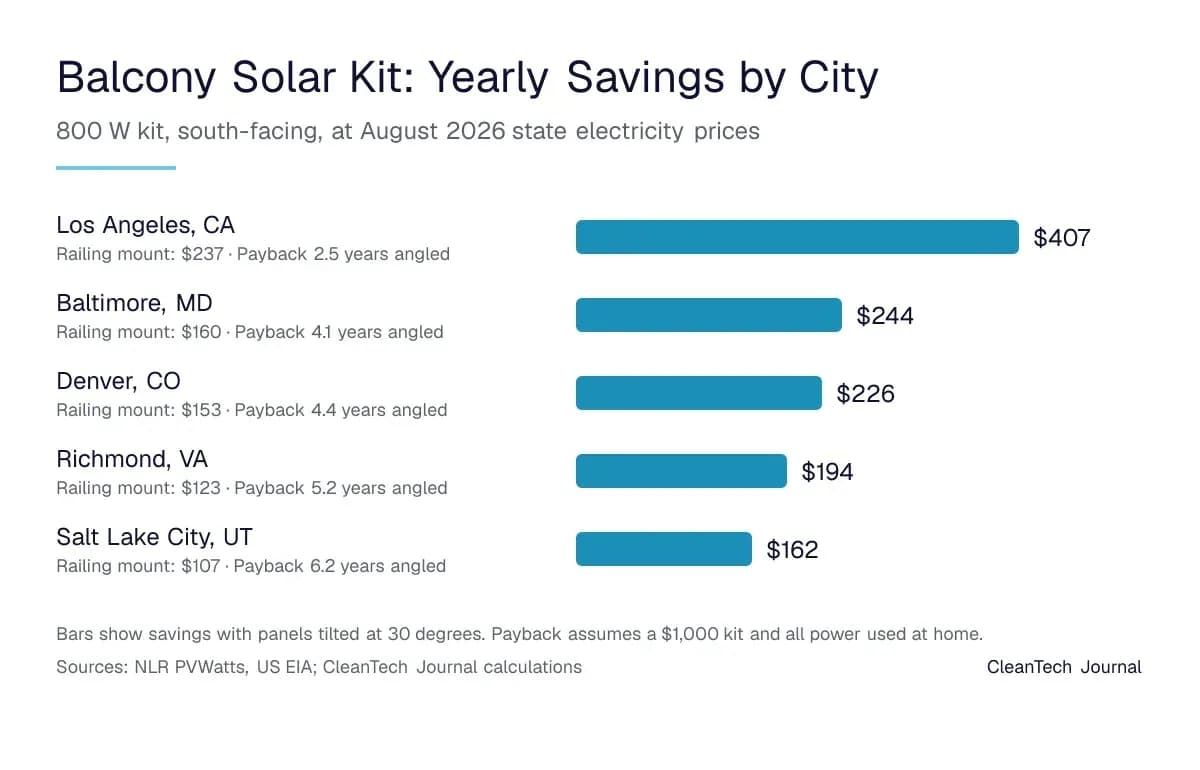
Los Angeles, CA | 796 kWh | $237 | 4.2 years | 1,368 kWh | $407 | 2.5 years |
Baltimore, MD | 746 kWh | $160 | 6.3 years | 1,139 kWh | $244 | 4.1 years |
Denver, CO | 889 kWh | $153 | 6.6 years | 1,316 kWh | $226 | 4.4 years |
Richmond, VA | 699 kWh | $123 | 8.1 years | 1,100 kWh | $194 | 5.2 years |
Salt Lake City, UT | 800 kWh | $107 | 9.4 years | 1,221 kWh | $162 | 6.2 years |
CleanTech Journal calculations for an 800 W kit facing south, using the PVWatts calculator from the National Laboratory of the Rockies (formerly NREL) with standard 14% system losses. "Railing mount" means panels hung upright on a balcony railing; "angled mount" means panels tilted at 30 degrees. Savings use each state's average residential electricity price for August 2026 from the US Energy Information Administration. Payback assumes a $1,000 kit and that all the power is used at home.
What a Plug-In Solar Kit Is and What It Costs
A plug-in kit is a small, self-contained solar system. It typically includes one or two panels, a microinverter that turns the panels' direct current into household alternating current, mounting hardware and a cable that plugs into a wall outlet. Power flows into your home's circuits and is used first by appliances running at that moment, such as the fridge, router or TV.
Most kits sold for homes range from about 400 to 800 watts and cost roughly $500 to $1,500, according to EnergySage, with batteries adding to the price. Some nonprofit sellers go lower: Bright Saver, a group backing plug-in solar laws, sells 180-watt panels for $285 and 360-watt panels for $414.
Because there is no roofer, permit or electrician in the typical setup, the kit price is close to the full cost. That is the main reason the payback can be so short compared with a rooftop system.
Why Mounting Angle Matters So Much
The biggest factor in our results, after your electricity price, is how the panels face the sun. Panels hung straight up on a railing produced 32% to 42% less power over a year than the same panels tilted at 30 degrees in our five cities.
Upright panels catch the low winter sun well but miss much of the high summer sun. In Los Angeles, a railing-mounted kit produced about 97 kWh in November but only about 28 kWh in June. If your balcony or patio allows it, an angled stand pays off noticeably faster.
Where Balcony Solar Is Legal in the US
Utah became the first state to legalize plug-in solar in 2025, capping systems at 1,200 watts. Since then, Virginia, Colorado, Connecticut, Maine, Maryland, New Hampshire, New Jersey and Vermont have passed their own laws. In September 2026, California became the 10th state, allowing systems of up to 1,200 watts that are certified by UL or an equivalent lab and shut off automatically if the grid goes down, as reported by Solar Power World.
Rules differ by state, and safety certification is still catching up. UL issued its certification program for plug-in solar devices in January 2026, but the full standard is still moving through committee. Check your state's law, your utility's rules and, if you rent, your lease before buying.
What Europe's Experience Shows
Germany shows how big the market can get. The Bundesnetzagentur, the country's grid regulator, registered about 430,000 plug-in solar systems in 2025 alone, totaling about 0.5 gigawatts.
German rules cap the inverter at 800 VA and require owners to register the system in a national online register within a month.
Is a Balcony Solar Kit Worth It?
For many renters and apartment owners, yes. Plug-in solar is one of the few ways to use solar power without a roof of your own, and in high-price states like California, a well-placed kit can pay for itself in a few years.
The value drops when:
- Electricity is cheap. In Utah, where power costs about half of California's rate, payback stretches to six to nine years in our model.
- The balcony is shaded or faces north. Our figures assume a clear south-facing spot. East or west faces produce less, and north faces much less.
- Your home uses little power during the day. Kits mostly offset what you use as the sun shines. Check whether your utility credits power sent back to the grid; if it does not, unused output earns nothing.
- You might move soon. The kit moves with you, but mounting may need adjusting at a new home.
How to Get the Most From Plug-In Solar
- Buy a kit certified for your market, with a microinverter that shuts off when the grid goes down.
- Tilt the panels if you can, rather than hanging them flat against a railing.
- Plug into a dedicated outlet, not an extension cord or power strip.
- Run dishwashers, laundry and other flexible loads during sunny hours.
- Keep the panels clear of shade from plants, awnings and neighboring buildings.
Frequently Asked Questions
How much does a balcony solar kit cost?
Most balcony solar kits cost between about $500 and $1,500 for 400 to 800 watts of panels. Kits with batteries cost more.
How much electricity does an 800-watt kit produce?
In our model, an 800 W kit produced about 700 to 890 kWh a year when hung upright on a railing, and about 1,100 to 1,370 kWh a year when tilted at 30 degrees, depending on the city.
Can I install a plug-in solar kit myself?
Yes, that is the point of a plug-in kit. In states that allow them, most kits mount with clamps or stands and plug into an outdoor outlet. Follow the maker's instructions and your state's rules.
Do balcony solar kits work for renters?
They can. Kits need no roof work and can move with you, but you will need permission to mount anything on a balcony and access to an outdoor outlet.
Will plug-in solar power my whole home?
No. An 800 W kit covers a slice of a typical home's use, mainly appliances that run during the day. It lowers your bill but does not replace grid power.
SOURCES
- US EIA: Average price of electricity by state (Table 5.6.A)
- Solar Power World: California is 10th state to legalize balcony solar
- CT Mirror: Balcony solar state regulations
- EnergySage: Plug-in and balcony solar panels
- Bundesnetzagentur: Ausbau Erneuerbarer Energien 2025
- VDE FNN: PV systems with energy feed-in plug
Written by
Suraj Kadam
Suraj Kadam is a journalist and Chief Editor of CleanTech Journal, a knowledge and media platform covering clean technology, solar energy, and renewable energy. He reports on emerging technologies, industry developments, policy trends, and innovations shaping the global clean energy transition. Through his editorial work, Suraj aims to make complex clean technology topics accessible to industry professionals, researchers, policymakers, and readers interested in sustainable energy. His work focuses on delivering insightful, informative, and engaging coverage of the evolving renewable energy landscape.