Top 10 Energy Certifications for Clean Energy Careers in 2026
Compare the top 10 energy certifications in the US: who each one suits, eligibility, exam format, official 2026 fees and renewal rules, from CEM to NABCEP.

Suraj Kadam
Published •35 min read

Energy certifications are a direct way to prove you can audit a building, install a solar array or verify energy savings, and the right one can help you get hired. This guide covers the top 10 energy certifications for US clean energy careers in 2026. For each one it lists who runs it, who it suits, how to qualify, what the exam looks like, what it costs and how you keep it. Every fee and requirement comes from the certifying body's own pages, checked in November 2026.
The jobs behind these credentials are growing. The US Bureau of Labor Statistics projects employment of solar photovoltaic installers to grow 37% from 2025 to 2035. It projects 30% growth for wind turbine technicians over the same period. Both rates are much faster than the average for all occupations.
How We Picked These Energy Certifications
We chose credentials that meet three tests:
- Run by an established body. Each one comes from a recognized professional organization or industry standard-setter, not a training company selling its own certificate.
- Tied to real work. Each covers a job employers and programs ask for by name: energy management, auditing, solar and storage installation, home energy rating, green building or wind safety.
- Clear public rules. Each body publishes its eligibility, exam and renewal requirements.
The list mixes credentials for engineers and facility managers with credentials for field technicians. The order is not a ranking of quality. Pick the one that matches the work you want to do.
Certified Energy Manager (CEM)
The Certified Energy Manager credential from the Association of Energy Engineers (AEE) is a core credential for people who run energy programs in buildings, campuses and plants. AEE was founded in 1977 and says it has more than 32,000 active certifications worldwide across all its programs. CEM is accredited by the ANSI National Accreditation Board (ANAB). It is also recognized under the US Department of Energy's Better Buildings Workforce Guidelines.
Who it suits: energy managers, facility managers, energy engineers and efficiency consultants.
Eligibility: you need one of these combinations of education and energy engineering or energy management experience:
Education | Experience |
|---|---|
4-year engineering or architecture degree, PE or RA | 3+ years |
4-year degree in technology, environmental science, physics or earth science | 4+ years |
4-year business or related degree | 5+ years |
2-year energy management associate degree | 6+ years |
2-year associate degree | 8+ years |
No degree | 10+ years |
If you don't meet these yet, you can take the exam as an Energy Manager In-Training (EMIT). That status is valid for six years while you build experience.
Exam: taken at the end of an in-person training program or as a remote proctored exam. The content follows the CEM Body of Knowledge.
Cost and renewal: $500 for the application and exam in the US, nonrefundable, and $250 for a retest. Renewal costs $300 every three years.
NABCEP PV Installation Professional (PVIP)
The North American Board of Certified Energy Practitioners (NABCEP) PV Installation Professional board certification is aimed at the people who lead solar PV installations. It covers system design, installation, commissioning and maintenance. BLS notes that some states require certification for solar projects to qualify for state subsidies. CTJ's guide to home solar panel costs explains what those projects cost.
Who it suits: installation contractors, foremen, crew leads and solar designers.
Eligibility: six project credits in a decision-making role, OSHA 10-hour safety training and 58 hours of PV training. Under NABCEP's Board Eligible pathway, you can take the exam before you finish the project experience. You become board certified once all the requirements are met.
Cost and renewal: a $125 application fee plus a $375 exam fee. A re-exam costs $275. You recertify every three years for $390, and certificants complete 30 hours of continuing education in each three-year cycle. Exams taken outside the US and Canada carry an extra $75 fee.
The work is growing. BLS puts the median pay for solar photovoltaic installers at $53,140 a year as of May 2025, with about 31,100 jobs in 2025.
LEED AP With Specialty
LEED AP with specialty is administered by the Green Business Certification Inc. (GBCI) for the US Green Building Council. It shows you can guide a building through LEED certification. Building Design + Construction (BD+C) is the specialty for new construction and major renovations. The others cover Operations + Maintenance, Interior Design + Construction, Homes and Neighborhood Development.
Who it suits: architects, engineers, contractors, sustainability consultants and building owners' representatives.
Eligibility: you must be 18 or older and hold an active LEED Green Associate credential. You can also take a combined exam that covers Green Associate and the specialty in one sitting. USGBC strongly recommends prior LEED project experience but doesn't require it.
Exam: each specialty exam has 100 multiple-choice questions in two hours. The BD+C, O+M and ID+C exams are moving to the new LEED v5 rating system. The Homes and Neighborhood Development exams stay on LEED v4.
Cost and renewal: USGBC posts exam prices on its exam page, and members pay less than non-members. You maintain the credential through continuing education every two years.
Certified Energy Auditor (CEA)
AEE's Certified Energy Auditor credential focuses on the audit itself: walking a facility, finding savings and putting numbers on them. Like CEM, it is ANAB accredited and recognized under DOE's Better Buildings Workforce Guidelines. DOE's Energy Skilled finder also lists it as a credential for single-family home energy audits.
Who it suits: energy auditors, efficiency program staff and engineers who run building assessments.
Eligibility: one of the following, with experience in energy auditing or energy assessment teams:
Education | Experience |
|---|---|
4-year engineering or architecture degree, PE or RA | 3+ years |
4-year degree in another field | 4+ years |
2-year associate degree | 5+ years |
Current CEM | 3+ years |
No degree | 10+ years |
You can also start as a CEA In-Training (CEA-IT), which is valid for six years.
Cost and renewal: $500 for the application and exam in the US, and $250 for a retest. Renewal costs $300 every three years.
Certified Measurement and Verification Professional (CMVP)
The CMVP proves you can measure and verify energy savings. That skill matters most in energy savings performance contracts, where the contractor gets paid based on verified results. AEE runs the program together with the Efficiency Valuation Organization.
Who it suits: energy service company (ESCO) staff, M&V engineers, utility program evaluators and consultants.
Eligibility: M&V project experience plus one of these: a bachelor's degree in science, engineering, architecture, business, law or finance with 3 years of experience. A PE or RA with 3 years also qualifies. Other paths: a bachelor's degree in another field with 5 years, a two-year technical degree with 5 years, or no degree with 10 years. A current CEM or CEA needs only 1 year of experience. An in-training status, CMVP-IT, is valid for six years.
Cost and renewal: $400 for the application and exam in the US, whether you test after a live seminar or remotely. A retest costs $200 and renewal costs $300 every three years. Outside the US, CMVP is required under the United Arab Emirates ESCO accreditation scheme, and the Saudi Energy Efficiency Center recognizes it.
ASHRAE Building Energy Assessment Professional (BEAP)
ASHRAE's BEAP certification covers commercial building energy assessment: surveying systems and site conditions, analyzing energy use and recommending improvements. It is accredited by ANSI under the ISO/IEC 17024 standard for personnel certification. DOE's Energy Skilled finder also lists it for home energy audits.
Who it suits: commercial energy auditors, HVAC and building systems engineers, and consultants.
Eligibility: you need to meet education and experience requirements and to have completed five commercial energy audits. You also need two hours of continuing education in safety training and must agree to ASHRAE's code of ethics.
Exam: computer-based, at more than 300 testing locations.
Cost and renewal: the application fee is $395 for ASHRAE members and $595 for non-members. To recertify, you need five more commercial audits, two hours of safety training and 50 professional development hours, up to 25 of which can come from work experience. Recertification costs $195 for members and $295 for non-members.
BPI Building Analyst Professional (BA-P)
The Building Performance Institute (BPI) Building Analyst Professional is the advanced home performance credential. A BA-P uses energy modeling and diagnostic data to write a prioritized list of upgrades for comfort, efficiency and indoor air quality.
Who it suits: home energy auditors, weatherization staff and home performance contractors. CTJ's ranking of energy-efficient technologies for US homes shows the kind of upgrades these reports recommend.
Eligibility: an active Building Analyst Technician (BA-T) certification.
Exam: online, with 60 multiple-choice questions, a 2.5-hour time limit and a passing score of 70%.
Cost and renewal: fees are set by each BPI Test Center, not by BPI. You recertify every three years, either by retaking the exam or by submitting continuing education credits.
DOE recognizes the BA-P, and BPI says it is approved for the State Energy Office Contractor Training Grant Program. It was also approved for audits under the federal Energy Efficient Home Improvement Credit (Section 25C). However, the IRS says that credit is not allowed for property placed in service after December 31, 2025.
RESNET HERS Rater
A HERS Rater scores a home on the Home Energy Rating System (HERS) Index, a scale used to rate the energy performance of US homes. Raters are certified through the Residential Energy Services Network (RESNET) system and work under an accredited Rating Provider that checks their ratings.
Who it suits: people who rate new homes for builders, energy code compliance and efficiency programs.
How to qualify:
- Complete training with a RESNET-accredited training provider.
- Pass three tests: the National Rater Exam (40 of 55 questions), the Combustion Appliance Simulation Test (85%) and the Rater Simulation Practical Test (73%).
- Sign a Rater Agreement with an accredited Rating Provider and complete at least five probationary ratings.
- Finish all exams and probationary ratings within 15 months.
Quality checks and renewal: providers must review at least 10% of each rater's ratings on file and at least 1% in the field. To recertify every three years, raters complete 18 hours of RESNET-approved professional development.
NABCEP Energy Storage Installation Professional (ESIP)
As more homes pair solar with batteries, NABCEP's Energy Storage Installation Professional credential covers the people who design and install battery systems. CTJ explains one way those batteries earn money in how a home battery works in a virtual power plant.
Who it suits: solar and electrical contractors who install battery storage.
Eligibility: six project credits in a decision-making role, OSHA 30-hour safety training and 58 hours of training. The safety requirement is stricter than the OSHA 10 needed for the PV Installation Professional.
Cost and renewal: a $125 application fee plus a $375 exam fee, with a $275 re-exam fee. Recertification costs $390.
GWO Basic Safety Training
Global Wind Organisation (GWO) Basic Safety Training isn't a professional exam like the others on this list. It is the industry's common safety training standard, and GWO's member companies recognize people who hold a current record as trained in basic wind safety. GWO is a non-profit founded by turbine manufacturers and owners. It published the first Basic Safety Training standard in 2012.
Who it suits: anyone starting work as a wind turbine technician, onshore or offshore. CTJ's guide to small wind turbines for the home covers the smaller end of the industry.
What it covers: five modules: First Aid, Manual Handling, Fire Awareness, Working at Height and Sea Survival. Sea Survival is for offshore work. Training is delivered by GWO-certified providers, and each completed course is recorded in GWO's WINDA database.
Validity: 24 months. Technicians take refresher training to keep the record valid. Course prices are set by the training providers.
BLS says wind turbine technicians earned a median $64,120 a year as of May 2025, with about 11,800 jobs in 2025. BLS also notes that certification isn't required, and employers often tell workers which training they need.
How Much These Credentials Cost
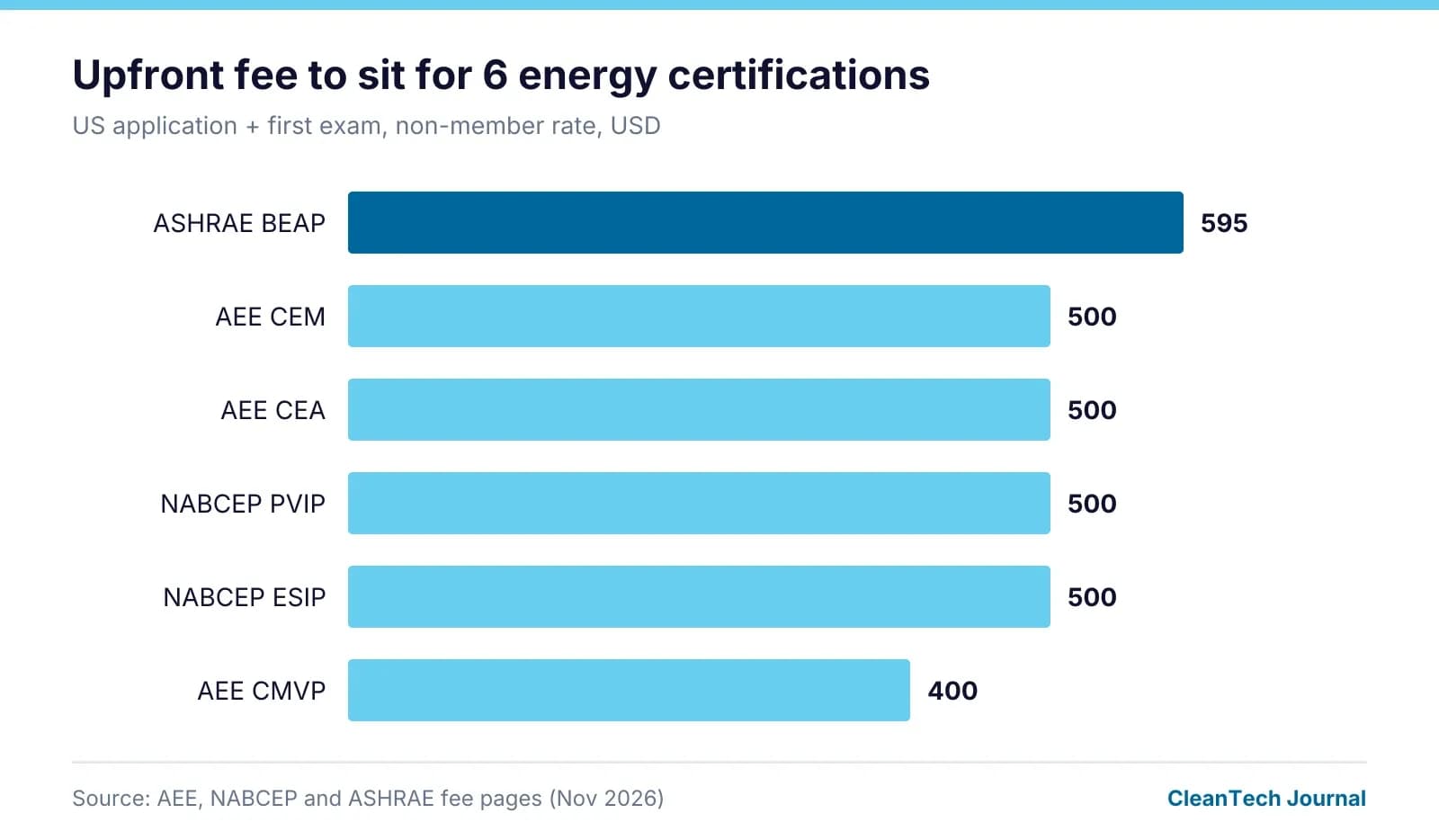
For the six credentials with a single published US price, the upfront cost to apply and sit the first exam runs from $400 to $595. ASHRAE's BEAP is the highest at $595 for non-members, or $395 for ASHRAE members. AEE's CMVP is the lowest at $400.
The other four don't have one national price. BPI exam fees are set by each test center, and GWO course fees are set by training providers. HERS Rater costs depend on the training and Rating Provider you choose. LEED AP exam prices are listed by USGBC and depend on membership.
Renewal adds up, too. The three AEE credentials each cost $300 every three years, about $100 a year. NABCEP charges $390 to recertify every three years, about $130 a year.
Which One Should You Get First?
Start from the work you want to do:
- Running energy programs for a company or campus: start with CEM. Add CMVP if your work involves performance contracts.
- Auditing buildings: choose CEA or BEAP for commercial buildings, and BA-P for homes.
- Rating new homes: become a HERS Rater.
- Designing green buildings: get LEED AP with specialty.
- Installing solar and batteries: get NABCEP PVIP, then ESIP.
- Working on wind turbines: start with GWO Basic Safety Training.
If you don't yet have the experience these energy certifications require, look for an in-training or board-eligible path. AEE offers in-training status for CEM, CEA and CMVP, and NABCEP lets solar candidates take the exam before finishing their project experience.
FAQ
Which energy certification is the most recognized?
It depends on the field. For energy management, AEE's Certified Energy Manager is the core credential, and AEE reports more than 32,000 active certifications across its programs. In solar, NABCEP's PV Installation Professional is the board certification for people who lead installations.
Can I get an energy certification without a degree?
Yes. AEE accepts 10 years of related experience without a degree for CEM, CEA and CMVP. NABCEP, BPI, RESNET and GWO credentials are based on training, experience and exams rather than degrees.
How long do these credentials stay valid?
Most renew every three years, including CEM, CEA, CMVP, NABCEP PVIP, BPI BA-P and HERS Rater. LEED AP runs on a two-year continuing education cycle, and GWO Basic Safety Training is valid for 24 months.
Are energy certifications required by law?
Usually not. BLS notes that certification isn't required for solar installers or wind technicians, although some states require certification for solar projects to qualify for subsidies. Employers often tell workers which credentials they need.
Can I take these exams online?
Several can be taken remotely. AEE offers remote proctored exams for CEM, CEA and CMVP, and the BPI BA-P exam is online. ASHRAE's BEAP is taken at a testing center, and LEED's combined exam is offered only at Prometric test centers.
SOURCES
- AEE: Becoming a Certified Energy Manager (CEM)
- AEE: Becoming a Certified Energy Auditor (CEA)
- AEE: Becoming a CMVP
- NABCEP: Certification Requirements and Fees
- USGBC: LEED AP with Specialty Candidate Handbook
- ASHRAE: BEAP Certification
- BPI: Building Analyst Professional (BA-P)
- RESNET: How to Become a Certified HERS Rater
- Global Wind Organisation: About GWO
- BLS: Solar Photovoltaic Installers
Written by
Suraj Kadam
Suraj Kadam is a journalist and Chief Editor of CleanTech Journal, a knowledge and media platform covering clean technology, solar energy, and renewable energy. He reports on emerging technologies, industry developments, policy trends, and innovations shaping the global clean energy transition. Through his editorial work, Suraj aims to make complex clean technology topics accessible to industry professionals, researchers, policymakers, and readers interested in sustainable energy. His work focuses on delivering insightful, informative, and engaging coverage of the evolving renewable energy landscape.