Top 10 Applications of AI and Robotics in Renewable Energy
Explore the top 10 applications of AI and robotics in renewable energy, from wind forecasting and grid connections to solar robots, with official data.

Suraj Kadam
Published •19 min read
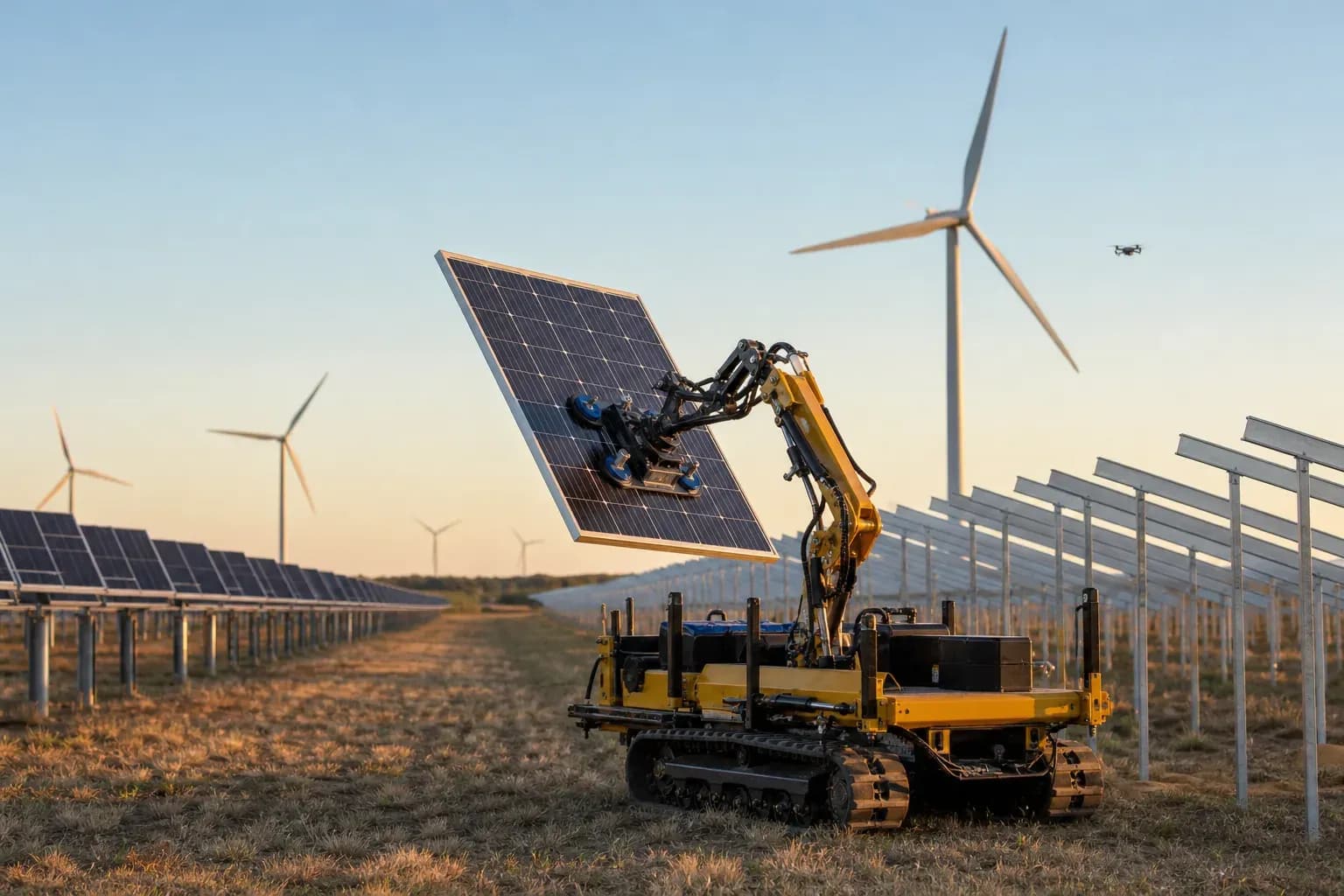
AI and robotics in renewable energy have moved from lab demos to real work sites. Software now forecasts wind output and sorts grid connection requests, and robots install and clean solar panels or crawl over wind turbine blades. This guide covers the top 10 applications in use or in active testing today. For each one it explains what the technology does, who is using it and what the official results show.
The common thread across AI and robotics in renewable energy is speed. The US Department of Energy (DOE) says AI can help with four parts of running the grid: planning, permitting, operations and reliability, and resilience. Robots take on heavy, repetitive or dangerous jobs in the field.
Forecasting Wind and Solar Output
Wind and solar output changes with the weather, which makes it harder for grid operators to plan. Forecasting is one of the most established uses of AI and robotics in renewable energy so far. In its AI for Energy report, DOE lists advanced AI forecasting of renewable output for grid operators as one of the main near-term opportunities.
Google and DeepMind tested this on about 700 megawatts (MW) of Google's wind farms in the central United States. A neural network trained on weather forecasts and past turbine data predicted wind output 36 hours ahead, and the system used those predictions to recommend hourly delivery commitments to the grid a day in advance. Google reported that machine learning raised the value of its wind energy by roughly 20%, compared with making no time-based commitments.
Power that can be scheduled is worth more to the grid than power that simply shows up. Better forecasts let wind and solar owners sell more of their output as firm commitments.
Speeding Up Grid Connections
New solar, wind and battery projects often wait years to connect to the grid while operators study their impact. PJM Interconnection, the largest grid operator in North America, is using AI to speed up that process.
In April 2025, PJM announced a multiyear collaboration with Google and Tapestry, an Alphabet-incubated grid project. Tapestry is building AI tools and models, powered by Google Cloud and Google DeepMind, to manage and optimize PJM's generation interconnection process. Google said the plan is to bring dozens of existing databases and tools for studying interconnection requests into a single model of PJM's network.
Solar, wind and storage make up most of the projects waiting in PJM's queue. Faster studies mean those projects can start delivering power sooner.
Faster Environmental Permitting
Large renewable projects on federal land or with federal funding need an environmental review under the National Environmental Policy Act (NEPA). Those reviews involve thousands of pages of documents. DOE's Pacific Northwest National Laboratory (PNNL) is building PermitAI to help.
PermitAI collects past environmental review documents into searchable datasets and builds AI tools on top of them. Its NEPATEC 2.0 public dataset covers about 140,000 documents from roughly 60,000 NEPA projects. PNNL's tools handle tasks such as searching past reviews, sorting public comments and drafting review sections.
In beta testing reported by PNNL, its search tool cut NEPA research time by about 50%, and its comment tool saved an average of 94% of the time spent on comment processing. Its drafting tool was estimated to cut drafting time for environmental impact statement sections by up to about 15%. People still make the decisions; the AI handles the repetitive reading and sorting.
Running Virtual Power Plants
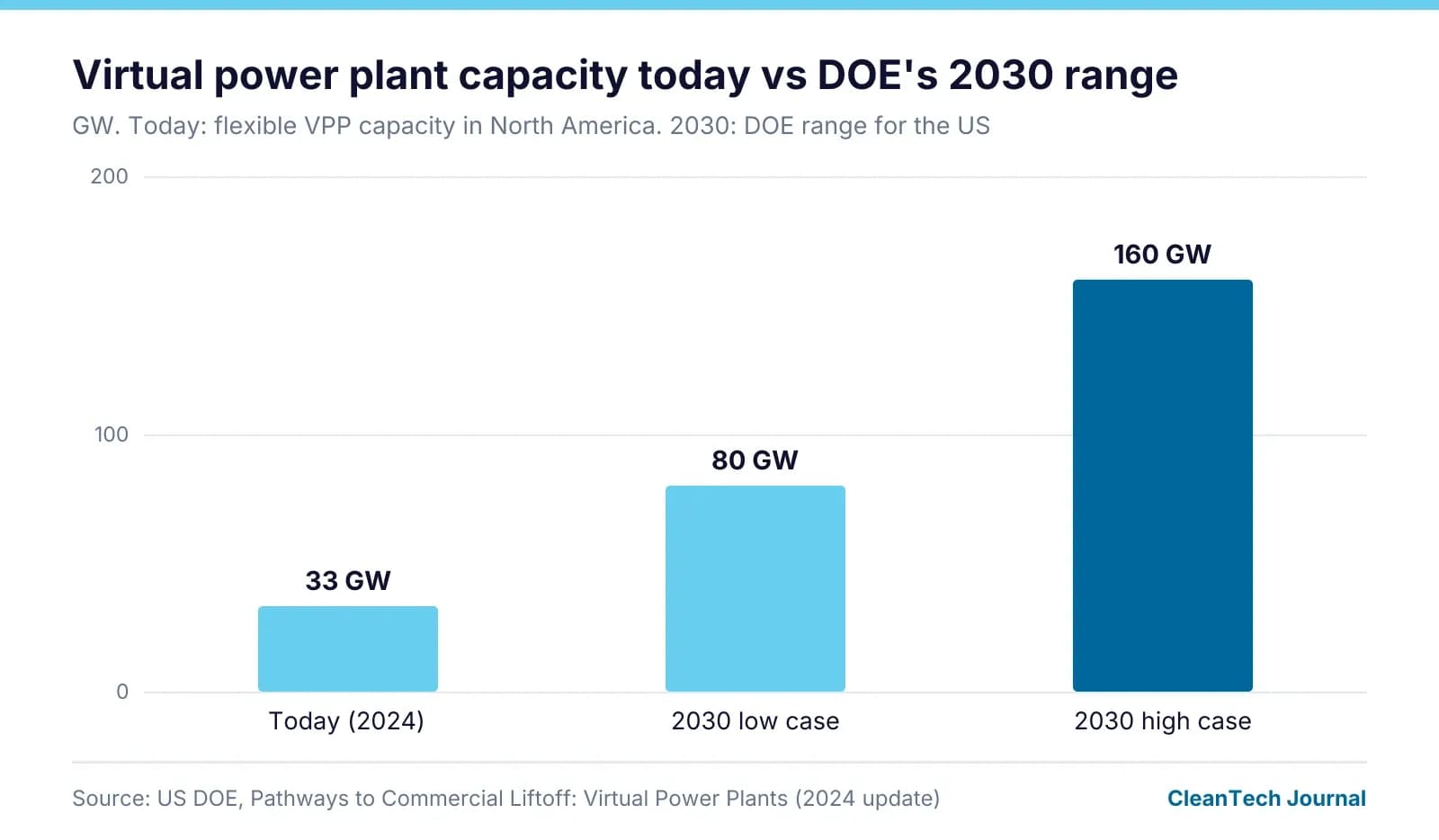
A virtual power plant (VPP) links thousands of home batteries, smart thermostats, EV chargers and rooftop solar systems so they can act together like one power plant. Software coordinates when each device charges, discharges or turns down, so the group can respond to the grid like a single plant.
DOE puts flexible VPP capacity in North America at about 33 gigawatts (GW) today. In its Pathways to Commercial Liftoff report on VPPs, DOE sets out a path to triple US VPP capacity to 80–160 GW by 2030. At that scale, VPPs could cover 10–20% of peak demand. DOE estimates that managing all available flexible demand could save on the order of $10 billion a year, mainly by deferring spending on new generation and grid equipment.
CTJ explains how one part of this works in how a home battery earns money in a virtual power plant.
Robots That Install Solar Panels
Solar modules keep getting bigger and heavier, and the industry needs more installers. AES built Maximo, a robot that uses AI and computer vision to pick up panels, place them on racks and fasten them while working alongside construction crews.
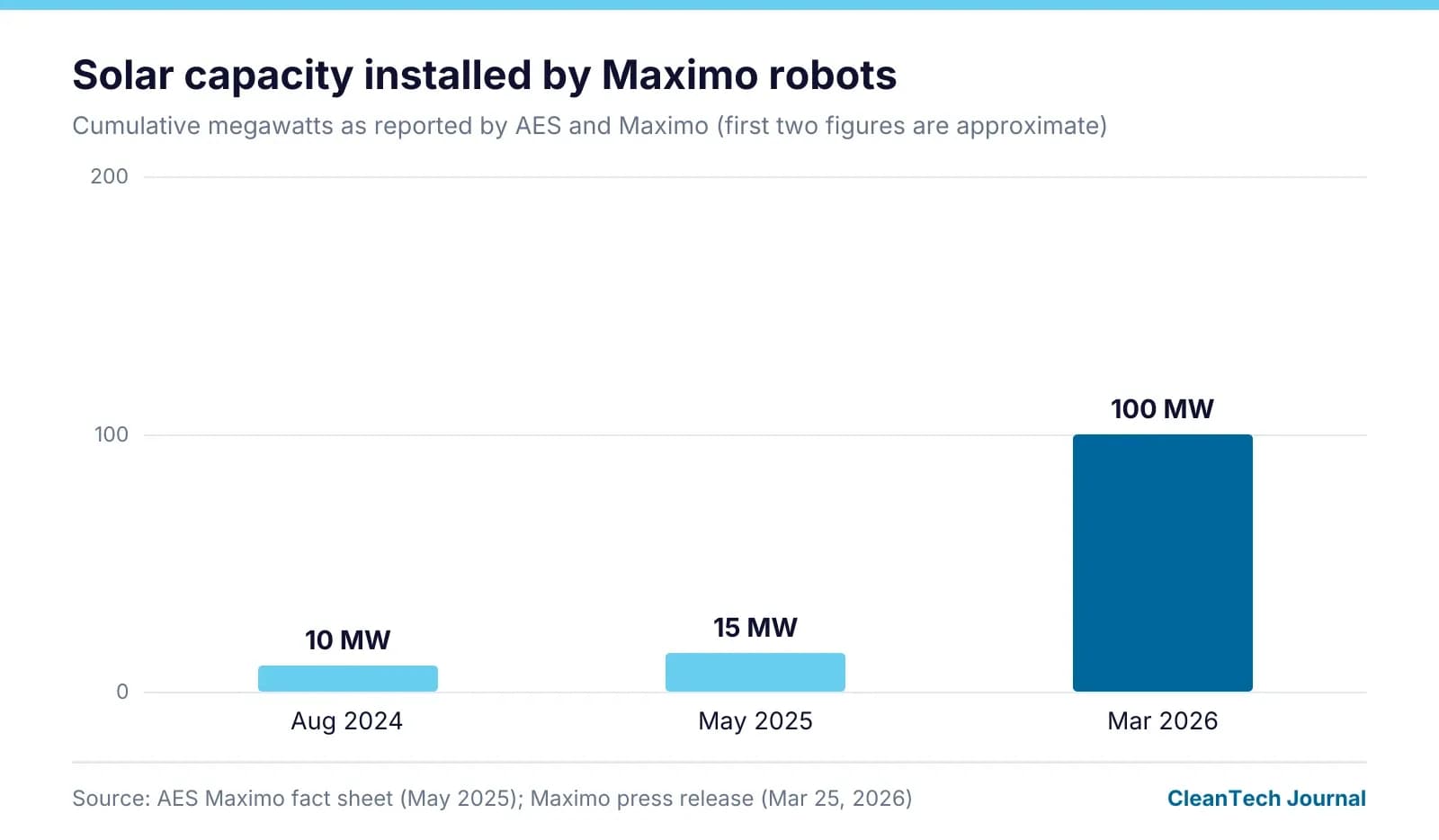
AES says Maximo cuts the time for mechanical module installation by 50% compared with traditional methods. The robot had installed nearly 10 MW when AES launched it in August 2024 and nearly 15 MW by May 2025. In March 2026, Maximo announced it had installed 100 MW at AES's Bellefield project in California. A fleet of four Maximo units worked in parallel there. Crews working with the robots installed as many as 24 modules per shift hour per person, which the company says is nearly double traditional methods in the region.
Robots That Clean Solar Panels
Dust and dirt on solar panels block sunlight and cut output, especially in deserts. Washing large solar farms by hand takes a lot of labor and water. Autonomous cleaning robots solve both problems by running along each row of panels, usually at night, and brushing off dust with microfiber and airflow instead of water.
Ecoppia, one of the first companies in this space, deployed water-free robots at the Ketura Sun solar park in Israel. The company described it as the world's first solar park cleaned entirely by autonomous robots, with almost 100 robots cleaning the panels every night.
CTJ has covered this topic in depth, including how AI-powered cleaning robots improve solar plant performance and whether waterless robotic cleaning saves water while keeping output high.
Robots That Inspect Wind Turbine Blades
Wind turbine blades are among the largest single-piece composite structures ever built, and they take a beating from lightning, hail, rain and a billion load cycles over their lifetime. Ground inspections with cameras only see surface damage. By the time a crack is visible, the damage underneath can be severe.
Sandia National Laboratories built a crawling robot called ARROW(e) under DOE's Blade Reliability Initiative, funded by the Wind Energy Technologies Office. An operator launches it from the turbine nacelle. It holds itself to the blade with suction, crawls to the spot that needs checking and scans it. Cameras check the surface, and phased-array ultrasonic imaging looks for hidden damage at any layer inside the blade. Sandia also tested drones that use thermal cameras to find damage below the surface.
Catching damage early allows smaller, cheaper repairs and keeps blades turning longer.
Robots for Offshore Wind Maintenance
Sending technicians to offshore wind farms is expensive and risky. The UK's Offshore Renewable Energy (ORE) Catapult expects robots and autonomous systems to play a major role in offshore wind operations and maintenance by 2030. ORE Catapult estimates that the UK market for these systems could be worth £56 million by 2030 and £496 million by 2050.
One example is MIMRee, a £4 million project funded by Innovate UK and led by ORE Catapult. It showed that a team of robots, led by an autonomous vessel that scans turbine blades for defects while they turn, could inspect and repair offshore wind farms. ORE Catapult estimated that resident robots at future wind farms could cut operating costs by 27% and the overall cost of energy by 10%. They would also move workers from offshore jobs to onshore control rooms.
Discovering New Battery Materials
Batteries store solar and wind power for when it's needed, and finding better battery materials usually takes years of trial and error. AI can shrink that search.
Microsoft and DOE's Pacific Northwest National Laboratory used AI and high-performance computing to screen more than 32 million candidate materials for a new solid-state battery electrolyte. The AI narrowed the field to 18 promising candidates in about 80 hours. PNNL scientists then made and tested one of them, a new material not found in nature. The prototype battery uses up to 70% less lithium than today's lithium-ion batteries. The researchers note it is an early result that still has to prove itself at larger scale.
Finding Geothermal Resources
Geothermal power plants run day and night, but finding hot rock underground is costly because wells are expensive to drill. Machine learning can sift through geological, seismic and satellite data to pick better drilling targets.
DOE's Geothermal Technologies Office has funded machine learning research since 2018. In 2019, it awarded up to $5.5 million to 10 projects applying machine learning to geothermal exploration and production. In 2021, it picked four projects for up to $3.5 million to build on that work. One of these, from Los Alamos National Laboratory, created GeoThermalCloud, an open-source machine learning framework for finding hidden geothermal resources.
The stakes are large. DOE says the US had only 3.7 GW of geothermal power capacity installed in 2021. Its GeoVision study found that with better technology, including exploration methods like these, geothermal generation could grow 26-fold to 60 GW by 2050. CTJ's list of the largest geothermal power plants in the world shows where the industry stands today.
What AI and Robotics in Renewable Energy Still Need
These tools work best alongside people, not in place of them. Most of the projects above keep humans in charge of final decisions: grid planners approve connections, environmental analysts sign off on reviews, and crews supervise installation robots.
Three things will decide how fast AI and robotics in renewable energy spread:
- Proof at scale. Many projects, such as blade-crawling robots and AI-found battery materials, are still moving from demonstration to everyday use.
- Reliable data. AI tools are only as good as the data behind them, which is why projects like PermitAI and PJM's work with Tapestry start by organizing scattered records.
- Safety and security. DOE notes that grid operations are highly security-sensitive, so new AI tools must not add new risks to the grid.
FAQ
How is AI used in renewable energy?
AI forecasts wind and solar output, helps grid operators study connection requests, speeds up environmental reviews, coordinates virtual power plants and helps find new battery materials and geothermal sites. Google reported that machine learning forecasts raised the value of its wind energy by roughly 20%.
How are robots used in solar power?
Robots install and clean solar panels. AES's Maximo robots installed 100 MW of panels at a California project by March 2026, and water-free robots like Ecoppia's clean panels every night in desert solar parks.
Can robots maintain wind turbines?
Yes. Sandia National Laboratories built a crawling robot that scans blades for hidden damage. The UK's ORE Catapult has tested robot teams for offshore wind farms and estimates they could cut operating costs by 27%.
Will AI replace workers in renewable energy?
The projects in this list are designed to work alongside people. Installation robots handle heavy lifting while crews supervise, and AI tools for grid connections and permits leave the final decisions to experts. ORE Catapult expects offshore robots to move workers from risky sea jobs to onshore control rooms.
What are the risks of using AI in the power grid?
DOE says grid operations are highly security-sensitive and that new AI tools must not introduce new risks. DOE has published a separate report on the potential benefits and risks of AI for critical energy infrastructure.
SOURCES
- DOE: AI for Energy: Opportunities for a Modern Grid and Clean Energy Economy
- Google DeepMind: Machine learning can boost the value of wind energy
- PJM: PJM, Google & Tapestry Join Forces To Apply AI To Enhance Regional Planning, Generation Interconnection
- PNNL: PermitAI
- DOE: Pathways to Commercial Liftoff: Virtual Power Plants (fact sheet)
- AES: Maximo fact sheet (May 2025)
- DOE: Sandia's ARROW(e) brings automated wind blade inspections to the field
- ORE Catapult: Robotic & Autonomous Systems for O&M in UK Offshore Wind
- Microsoft Azure: How Microsoft's AI screened over 32 million candidates to find a better battery
- DOE: Machine Learning for Geothermal Energy
Written by
Suraj Kadam
Suraj Kadam is a journalist and Chief Editor of CleanTech Journal, a knowledge and media platform covering clean technology, solar energy, and renewable energy. He reports on emerging technologies, industry developments, policy trends, and innovations shaping the global clean energy transition. Through his editorial work, Suraj aims to make complex clean technology topics accessible to industry professionals, researchers, policymakers, and readers interested in sustainable energy. His work focuses on delivering insightful, informative, and engaging coverage of the evolving renewable energy landscape.