Top 10 Largest Geothermal Power Plants in the World
The largest geothermal power plants in the world by installed capacity, led by The Geysers in California, then Kenya's Olkaria and Italy's Larderello.

Suraj Kadam
Published •25 min read
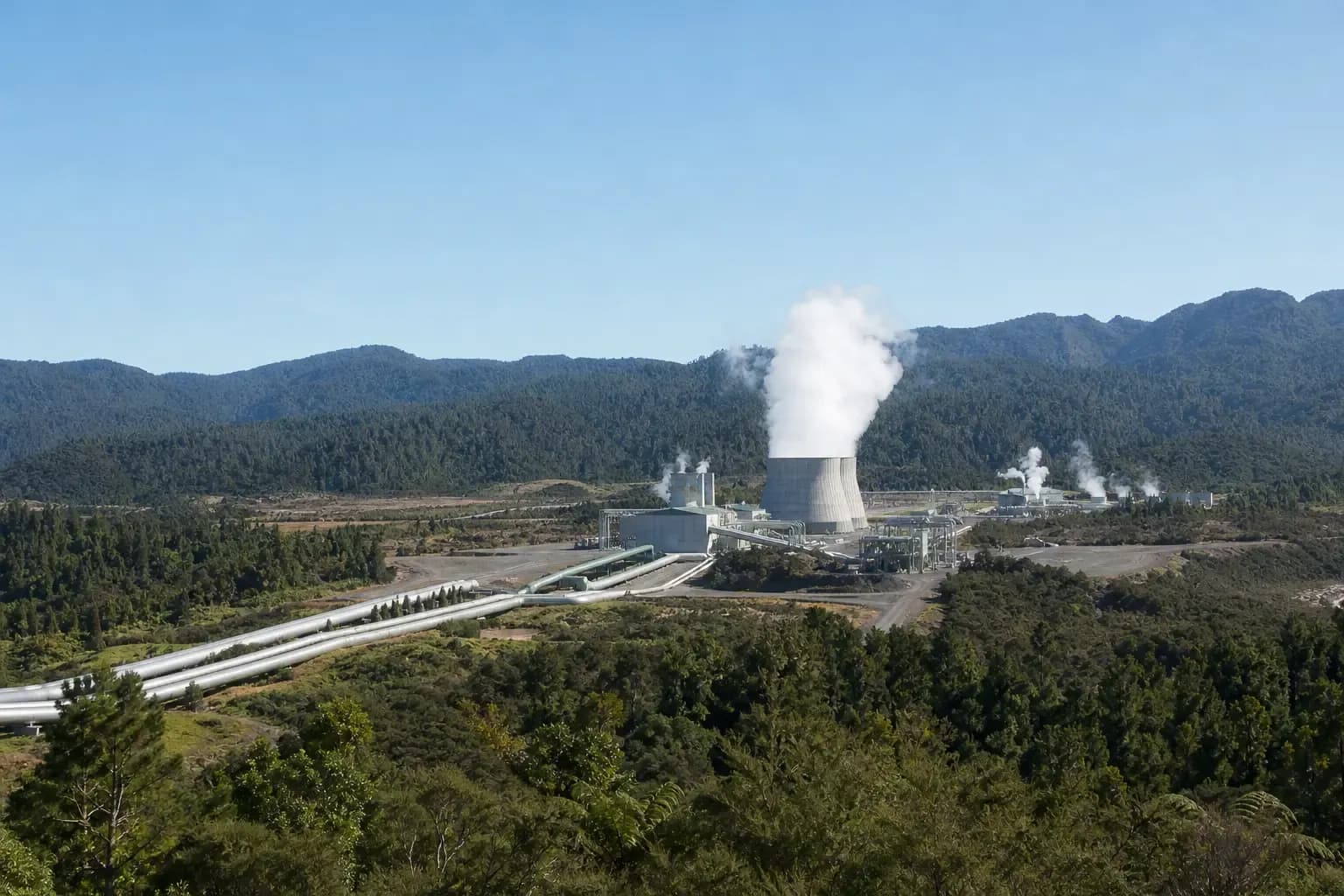
The largest geothermal power plants in the world are not single buildings but whole steam fields, where dozens of wells feed clusters of turbines. The biggest of them all sits about 72 miles north of San Francisco, in the Mayacamas Mountains of California.
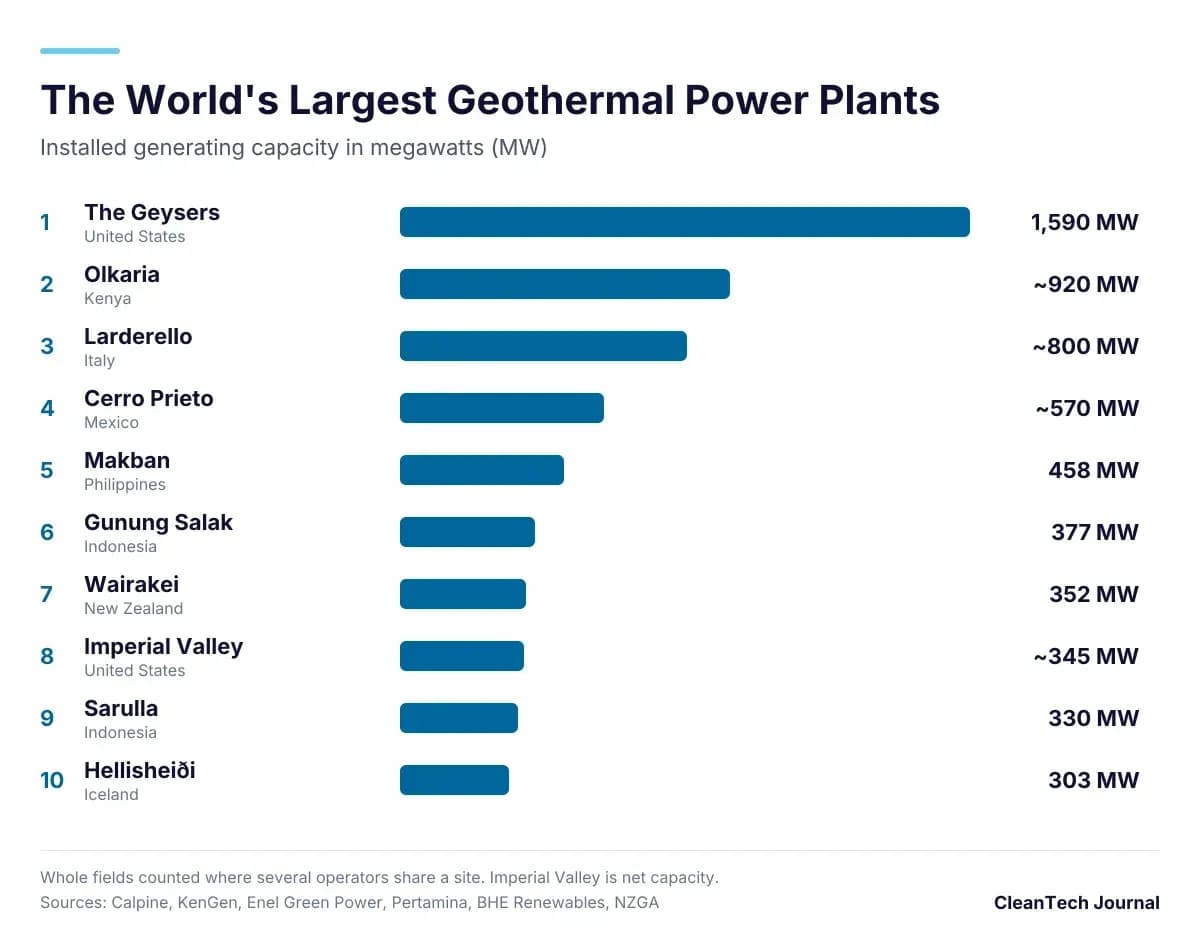
We ranked the 10 largest geothermal power plants by installed generating capacity, using figures from plant operators and national geothermal bodies where they are published. Where a site has several operators, we counted the whole field.
Largest Geothermal Power Plants in the World at a Glance
Rank | Plant or field | Country | Main operator | Capacity |
|---|---|---|---|---|
1 | The Geysers | United States | Calpine | 1,590 MW installed |
2 | Olkaria | Kenya | KenGen and Ormat | About 920 MW |
3 | Larderello | Italy | Enel Green Power | About 800 MW |
4 | Cerro Prieto | Mexico | CFE | About 570 MW |
5 | Makban | Philippines | AP Renewables | 458 MW |
6 | Gunung Salak | Indonesia | Star Energy | 377 MW |
7 | Wairakei | New Zealand | Contact Energy | 352 MW |
8 | Imperial Valley (Salton Sea) | United States | BHE Renewables | About 345 MW net |
9 | Sarulla | Indonesia | Sarulla Operations | 330 MW |
10 | Hellisheiði | Iceland | Reykjavik Energy | 303 MW |
The Olkaria figure is a CleanTech Journal sum of KenGen's listed plants and Ormat's Olkaria III. Installed capacity is the maximum rated output, and actual output is usually lower.
1. The Geysers, United States
The world's largest geothermal field
The Geysers spans about 45 square miles on the border of Sonoma and Lake counties and has an installed capacity of about 1,590 MW. The first large-scale geothermal power plant in the US began operating there in 1960.
Calpine, the main operator, runs 13 of the plants with a net generating capacity of up to 725 MW, enough for 725,000 homes and businesses. It draws steam from 316 active wells, with an average depth of about 8,500 feet.
2. Olkaria, Kenya
Olkaria sits in Hell's Gate National Park in Kenya's Rift Valley and is the largest geothermal complex in Africa. KenGen's plants there total about 770 MW, and Ormat's Olkaria III plant adds 150 MW.
Geothermal is Kenya's largest source of electricity by capacity. The country had 980 MW of geothermal power at the end of 2025, according to ThinkGeoEnergy.
3. Larderello, Italy
Larderello in Tuscany is where geothermal electricity began, and Enel Green Power still operates about 800 MW across the wider Larderello area. That capacity comes from 34 plants with 37 generating units.
Italy had 916 MW of geothermal capacity at the end of 2025, almost all of it in Tuscany.
4. Cerro Prieto, Mexico
Cerro Prieto, near Mexicali in Baja California, is Mexico's largest geothermal field and one of the oldest in the Americas. It is run by the state utility, Comisión Federal de Electricidad.
Several older units have been retired, so its current installed capacity of about 570 MW is below its peak of more than 700 MW.
5. Makban, Philippines
Makban, short for Mak-Ban, straddles the provinces of Laguna and Batangas south of Manila. AP Renewables, a unit of Aboitiz Power, operates the complex, which has an installed capacity of 458 MW.
The Philippines had 2,034 MW of geothermal capacity at the end of 2025, the third-highest in the world.
6. Gunung Salak, Indonesia
Indonesia's largest single geothermal area
Gunung Salak in West Java, about 70 kilometers from Jakarta, has 377 MW of installed capacity. It is operated by Star Energy under a joint operation contract with Pertamina Geothermal Energy.
7. Wairakei, New Zealand
Wairakei, near Taupō on New Zealand's North Island, opened in 1958 as the world's second large-scale geothermal power development. Contact Energy now runs the field's stations, including Wairakei, Te Mihi and Poihipi, with a combined capacity of 352 MW.
8. Imperial Valley (Salton Sea), United States
BHE Renewables runs 10 geothermal plants near the Salton Sea in Southern California, with a combined capacity of about 345 net megawatts, according to the company. The plants started operating between 1982 and 2000.
The Salton Sea area is also drawing attention for lithium, which is found in the hot brine that geothermal plants already bring to the surface.
9. Sarulla, Indonesia
Sarulla in North Sumatra reached its full 330 MW in 2018, when the third of its three units came online. It was developed by a consortium including Medco, Inpex, Itochu, Kyushu Electric and Ormat.
10. Hellisheiði, Iceland
Hellisheiði, in the Hengill area southeast of Reykjavik, produces 303 MW of electricity and also supplies hot water for heating homes in the capital region. It is owned and run by Reykjavik Energy.
The plant is also home to Carbfix, which injects captured carbon dioxide into basalt rock, where it turns into stone.
Where Geothermal Power Is Growing
The US has the most geothermal capacity of any country, at 3,953 MW at the end of 2025, according to ThinkGeoEnergy. Indonesia follows with 2,742 MW, and global capacity reached 17,173 MW.
Most of the largest geothermal power plants in the world sit on volcanic or tectonic hot spots, from California and the Rift Valley to Indonesia and Iceland. New technologies such as enhanced geothermal systems aim to tap heat in places without natural steam, which could spread geothermal energy projects far beyond these regions.
Frequently Asked Questions
How does a geothermal power plant work?
Wells bring hot water or steam up from deep underground. The steam spins a turbine connected to a generator, and the cooled water is usually injected back into the reservoir to keep it supplied.
Is geothermal energy renewable?
Yes, as long as the reservoir is managed carefully. If more heat or water is taken out than the field can replace, output can decline, which is why many plants reinject water.
Why does geothermal power run around the clock?
Underground heat does not depend on the weather or time of day. That lets geothermal plants run steadily, unlike solar and wind, which vary with sunshine and wind speed.
What is enhanced geothermal?
Enhanced geothermal systems create or widen cracks in hot, dry rock and pump water through them to collect heat. They could make geothermal possible in many more places than today's natural steam fields.
Does geothermal power cause earthquakes?
Injecting and withdrawing fluids can cause small earthquakes, usually too weak to be felt. Operators and regulators monitor seismic activity closely, especially at enhanced geothermal sites.
SOURCES
- Calpine: The Geysers by the numbers
- KenGen: Geothermal power generation
- Enel Green Power: Larderello geothermal power plant
- Pertamina Geothermal Energy: Joint operation contracts
- BHE Renewables: Imperial Valley geothermal
- New Zealand Geothermal Association: Wairakei
- ThinkGeoEnergy: Global top 10 geothermal power countries at year-end 2025
- Power Technology: Hellisheidi geothermal power plant
- Power Technology: Top 10 biggest geothermal power plants
Written by
Suraj Kadam
Suraj Kadam is a journalist and Chief Editor of CleanTech Journal, a knowledge and media platform covering clean technology, solar energy, and renewable energy. He reports on emerging technologies, industry developments, policy trends, and innovations shaping the global clean energy transition. Through his editorial work, Suraj aims to make complex clean technology topics accessible to industry professionals, researchers, policymakers, and readers interested in sustainable energy. His work focuses on delivering insightful, informative, and engaging coverage of the evolving renewable energy landscape.