Top 10 Largest Solar Power Plants in Germany by Capacity
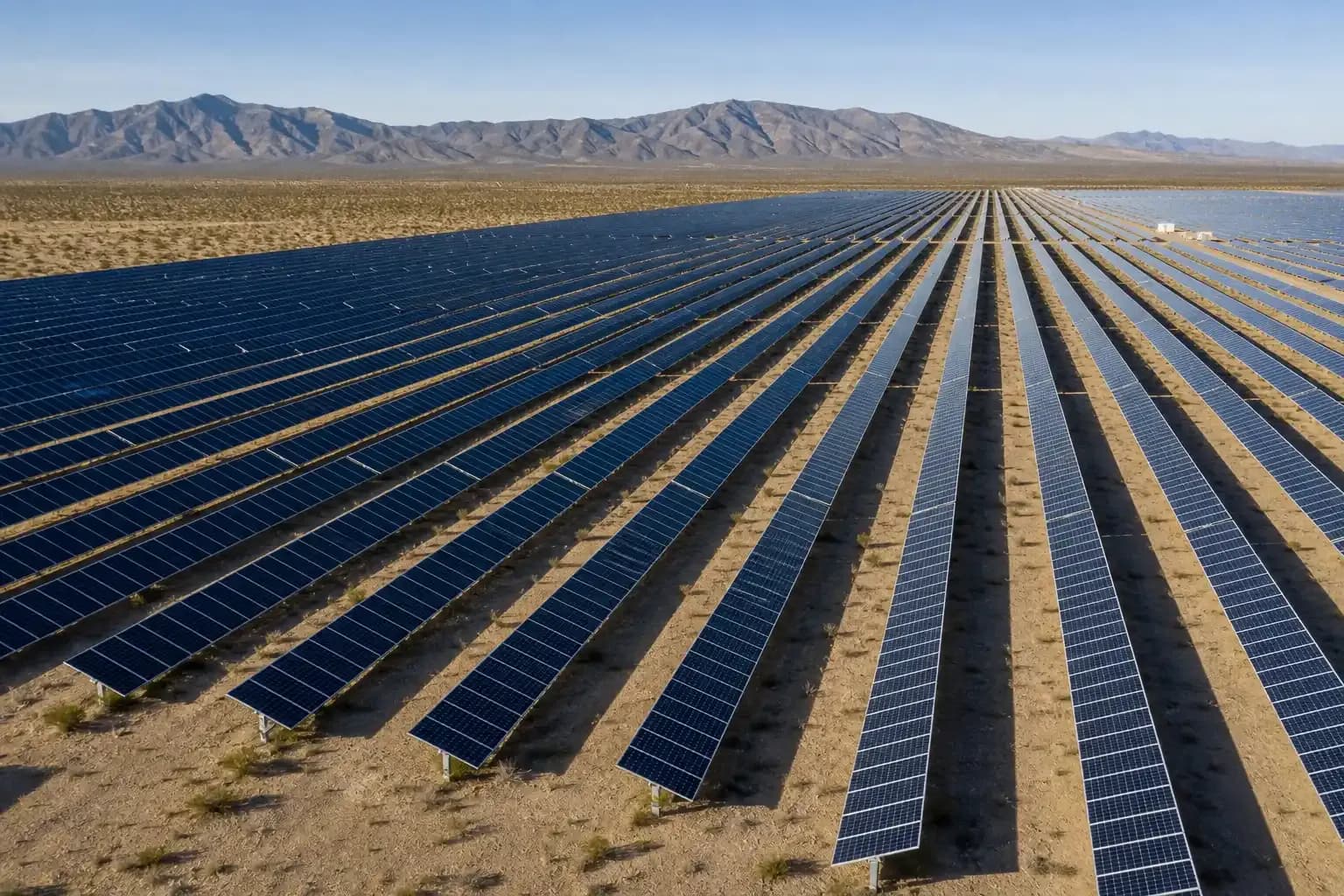
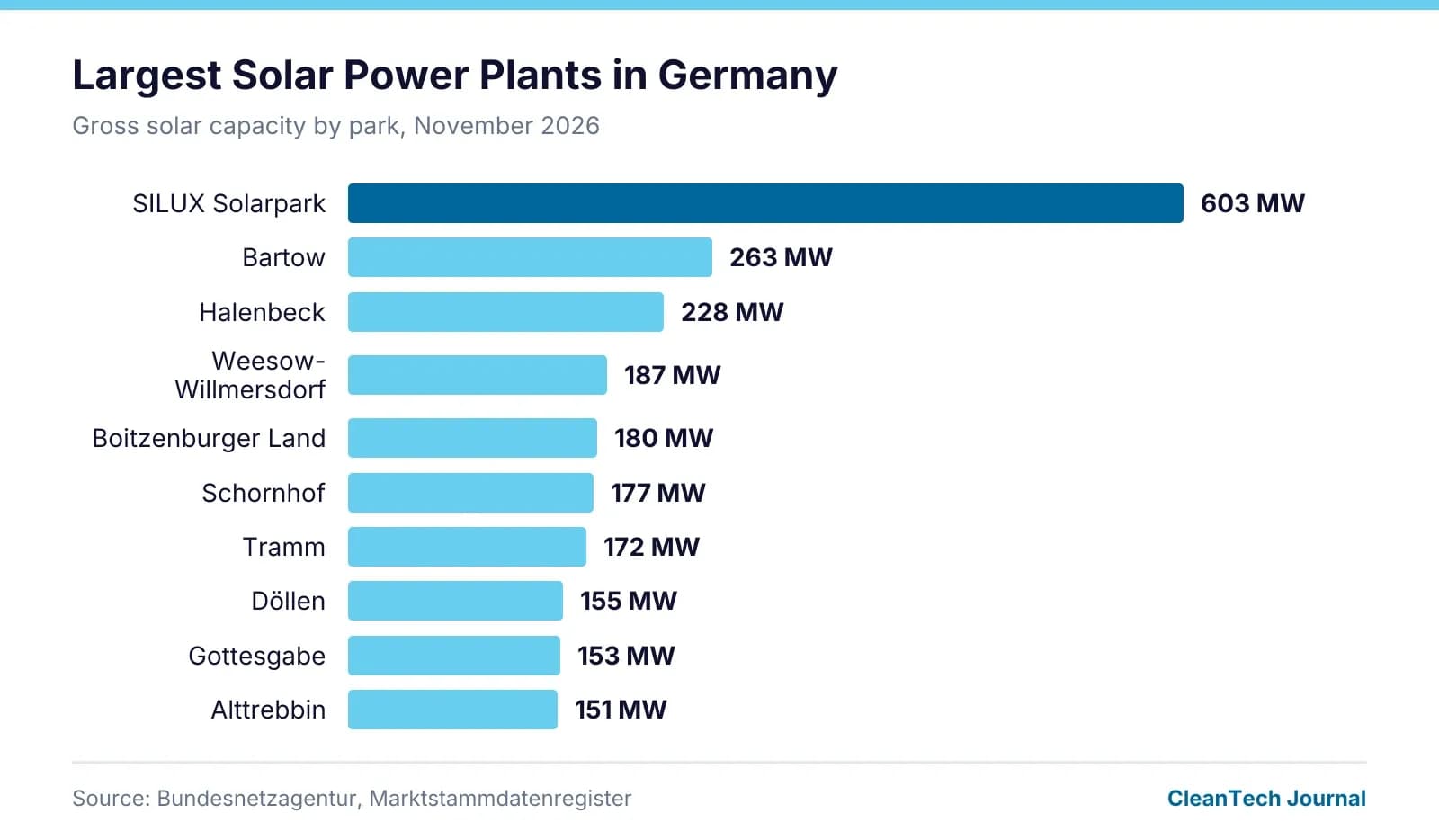
The top 10 largest solar power plants in Germany by capacity, led by SILUX Solarpark in Saxony at 603 MW, using the official German power plant register.

Suraj Kadam
Published •26 min read
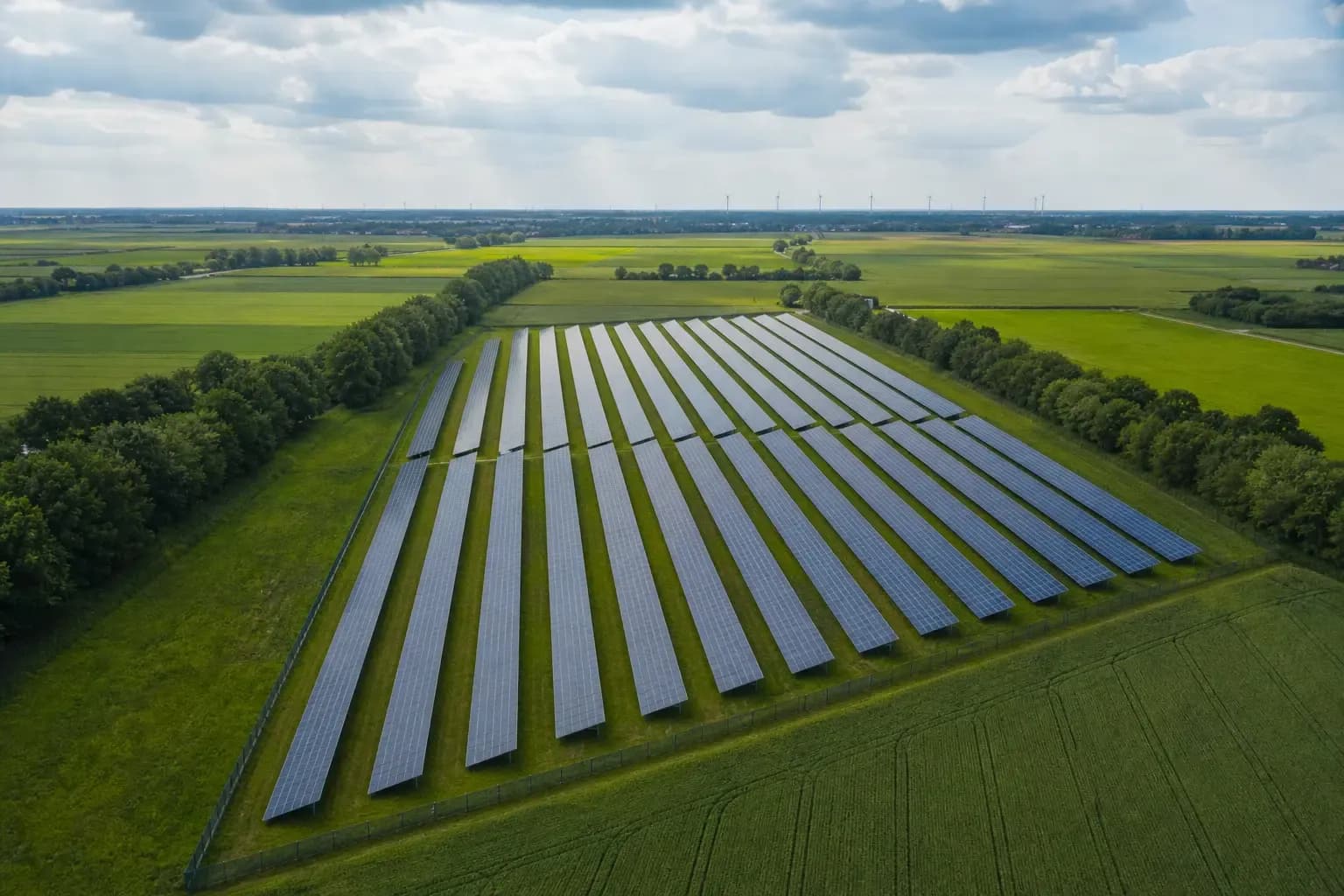
Solar power produced 74.1 terawatt-hours (TWh) of electricity in Germany in 2025, about 17% of the country's net electricity generation and more than lignite, according to the Federal Network Agency. The country ended 2025 with 117 gigawatts (GW) of installed solar capacity and is aiming for 215 GW by 2030.
CleanTech Journal has ranked the 10 largest solar power plants in Germany by gross capacity, using data from the agency's Marktstammdatenregister, the official register of power plants, as of November 2026. Units registered under the same park name are counted together. SILUX Solarpark near Böhlen, in Saxony, leads with 603 megawatts (MW), more than twice the size of second-placed Bartow.
Largest Solar Power Plants in Germany Ranked by Capacity
Rank | Solar park | State | Capacity (MW) | Started operating |
|---|---|---|---|---|
1 | SILUX Solarpark | Saxony | 603 | 2023–2024 |
2 | Bartow | Mecklenburg-Western Pomerania | 263 | 2025 |
3 | Halenbeck | Brandenburg | 228 | 2026 |
4 | Weesow-Willmersdorf | Brandenburg | 187 | 2020–2021 |
5 | Boitzenburger Land | Brandenburg | 180 | 2023 |
6 | Schornhof | Bavaria | 177 | 2020–2023 |
7 | Tramm | Mecklenburg-Western Pomerania | 172 | 2021 |
8 | Döllen | Brandenburg | 155 | 2023 |
9 | Gottesgabe | Brandenburg | 153 | 2022 |
10 | Alttrebbin | Brandenburg | 151 | 2022 |
1. SILUX Solarpark, Saxony
SILUX Solarpark, in Böhlen in the Leipzig district, is the largest solar park in Germany at 603 MW. It is registered as six units, each run by its own SILUX Solarpark company, which started operating between late 2023 and spring 2024.
Its largest unit alone has 162 MW of capacity, more than most complete solar parks in the country. Together, the six units are larger than the next two parks on this list combined.
2. Bartow, Mecklenburg-Western Pomerania
Bartow has 263 MW of solar capacity spread across four units: Bartow Ost 1, 2 and 3, and Bartow West. All four started operating in November 2025.
The park is run by two operating companies, Bartow PV 1 and Bartow PV 2. It is the largest solar park in northern Germany.
3. Halenbeck, Brandenburg
Halenbeck is the newest park in the top 10, with all of its 228 MW starting operation in spring 2026. It is made up of nine units run by two companies, Solarkraftwerk Halenbeck-Rohlsdorf and Solarkraftwerk Halenbeck-Rohlsdorf II.
Most of its units are between 28 and 30 MW, a sign of how the park was built in evenly sized sections.
4. Weesow-Willmersdorf, Brandenburg
Weesow-Willmersdorf has 187 MW of capacity in three units, which started operating between November 2020 and February 2021. When it opened, it was one of the largest solar parks in Germany.
It is run by EnBW Solarpark Weesow-Willmersdorf. Utility EnBW operates three of the 10 parks in this ranking, more than any other company.
5. Boitzenburger Land, Brandenburg
Boitzenburger Land has 180 MW of solar capacity in three units of about 60 MW each. All three started operating in mid-2023.
The park is run by SEBG Energiepark and is located in the Uckermark region, in the far north of Brandenburg.
6. Schornhof, Bavaria
Schornhof, in Berg im Gau in the Neuburg-Schrobenhausen district, has 177 MW of capacity. It is the only park in the top 10 in southern Germany.
It was built in stages between 2020 and 2023 and is registered as 11 units, run by several Anumar companies. Its largest single section has 40 MW of capacity.
7. Tramm, Mecklenburg-Western Pomerania
The Tramm solar park, registered at Barnin in the Ludwigslust-Parchim district, has 172 MW of capacity. It is run by Photovoltaikkraftwerk Tramm.
Unlike most parks on this list, it is registered as just two large units, of 89 MW and 83 MW. Both started operating in December 2021.
8. Döllen, Brandenburg
Döllen has 155 MW of solar capacity and is made up of 13 units, more than any other park in the top 10. All of them started operating in the first half of 2023.
The units are grouped into two blocks, Döllen I and Döllen II, each connected to the grid through its own transformer.
9. Gottesgabe, Brandenburg
Solarpark Gottesgabe, in Neuhardenberg in the Märkisch-Oderland district, east of Berlin, has 153 MW of capacity. It is one of only two parks in the top 10 registered as a single unit.
It started operating in February 2022 and is run by EnBW Solarpark Gottesgabe.
10. Alttrebbin, Brandenburg
Solarpark Alttrebbin has 151 MW of capacity in a single unit, which started operating in February 2022, two weeks after Gottesgabe.
It is run by EnBW SunInvest. Together, the three EnBW parks in this ranking have about 491 MW of capacity.
Brandenburg Leads the List
Six of the 10 largest solar parks in Germany are in Brandenburg, the state that surrounds Berlin. Mecklenburg-Western Pomerania has two, while Saxony and Bavaria have one each.
Just outside the top 10 are the solar parks at Neuhardenberg in Brandenburg, with 147 MW, ASE Elsterheide in Saxony, with 140 MW, and Bohrau, with 133 MW.
Large Solar Is Growing Fast in Germany
Germany now has more than 9,100 operating solar units of 1 MW or more, with about 46,700 MW of capacity. About two-thirds of that capacity started operating in 2022 or later.
Growth has been rapid. Large solar units that started operating in 2025 added about 8,600 MW, almost 15 times the amount added in 2019, and 2026 has already added about 7,900 MW by November.
Frequently Asked Questions
What is the Marktstammdatenregister?
The Marktstammdatenregister (MaStR) is Germany's official register of power plants, run by the Federal Network Agency (Bundesnetzagentur). Every power generation unit in Germany, from rooftop solar panels to large power stations, must be registered, along with its capacity, location and operator. Most of the data is public.
What is the difference between gross and net capacity at a solar park?
Gross capacity is the total output of a park's solar panels, while net capacity is the maximum power the park can feed into the grid. Gross capacity is usually higher. SILUX Solarpark in Saxony, for example, has 603 MW of gross capacity but about 415 MW of net capacity.
How do large solar parks in Germany sell their electricity?
Many large solar parks in Germany win support through government auctions under the Renewable Energy Sources Act (EEG), which pay a market premium on top of the power price. A growing number sell their electricity directly to companies through long-term power purchase agreements (PPAs), without any subsidy.
What is agrivoltaics?
Agrivoltaics, or agri-PV, means using the same land for both farming and solar power. Solar panels are mounted high above crops or in widely spaced rows, so the land can still be farmed or grazed. Germany has several agrivoltaic projects, including one run by RWE in Bedburg, North Rhine-Westphalia.
Why are solar parks often split into several units?
Large solar parks are often built in phases or connected to the grid through several transformers, and each section may be registered separately. Different sections can also have different owners or sell their power in different ways, for example one under the EEG and another through a power purchase agreement.
SOURCES
- Bundesnetzagentur, Marktstammdatenregister
- Bundesnetzagentur, Daten zum Strommarkt 2025
- Bundesnetzagentur, Ausbau Erneuerbarer Energien 2025
Written by
Suraj Kadam
Suraj Kadam is a journalist and Chief Editor of CleanTech Journal, a knowledge and media platform covering clean technology, solar energy, and renewable energy. He reports on emerging technologies, industry developments, policy trends, and innovations shaping the global clean energy transition. Through his editorial work, Suraj aims to make complex clean technology topics accessible to industry professionals, researchers, policymakers, and readers interested in sustainable energy. His work focuses on delivering insightful, informative, and engaging coverage of the evolving renewable energy landscape.