Top 10 Solar Panel Manufacturers in the World by Shipments
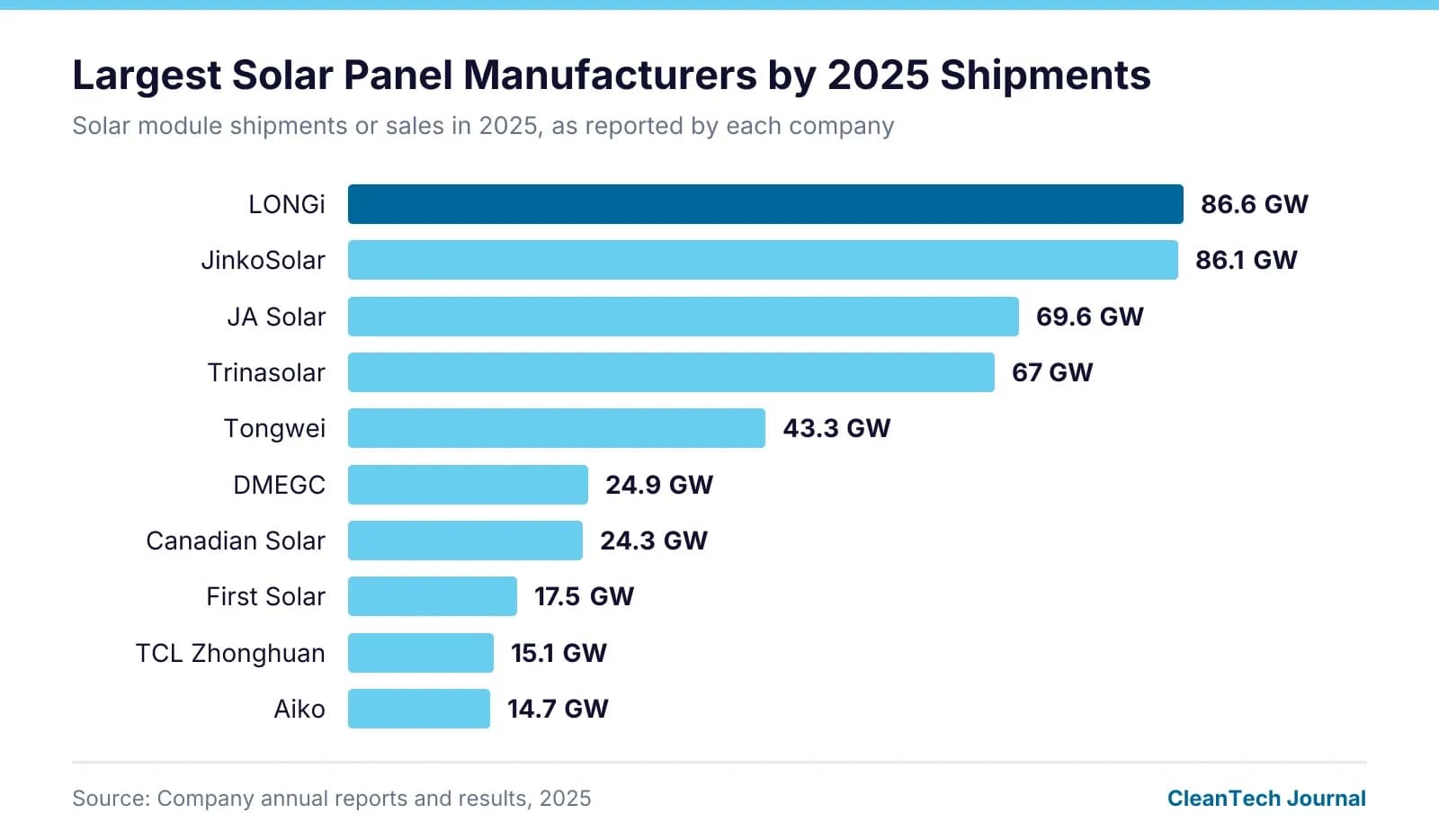
LONGi, JinkoSolar and JA Solar lead the top 10 solar panel manufacturers of 2025, ranked by module shipments the companies reported in their own results.

Suraj Kadam
Published •25 min read
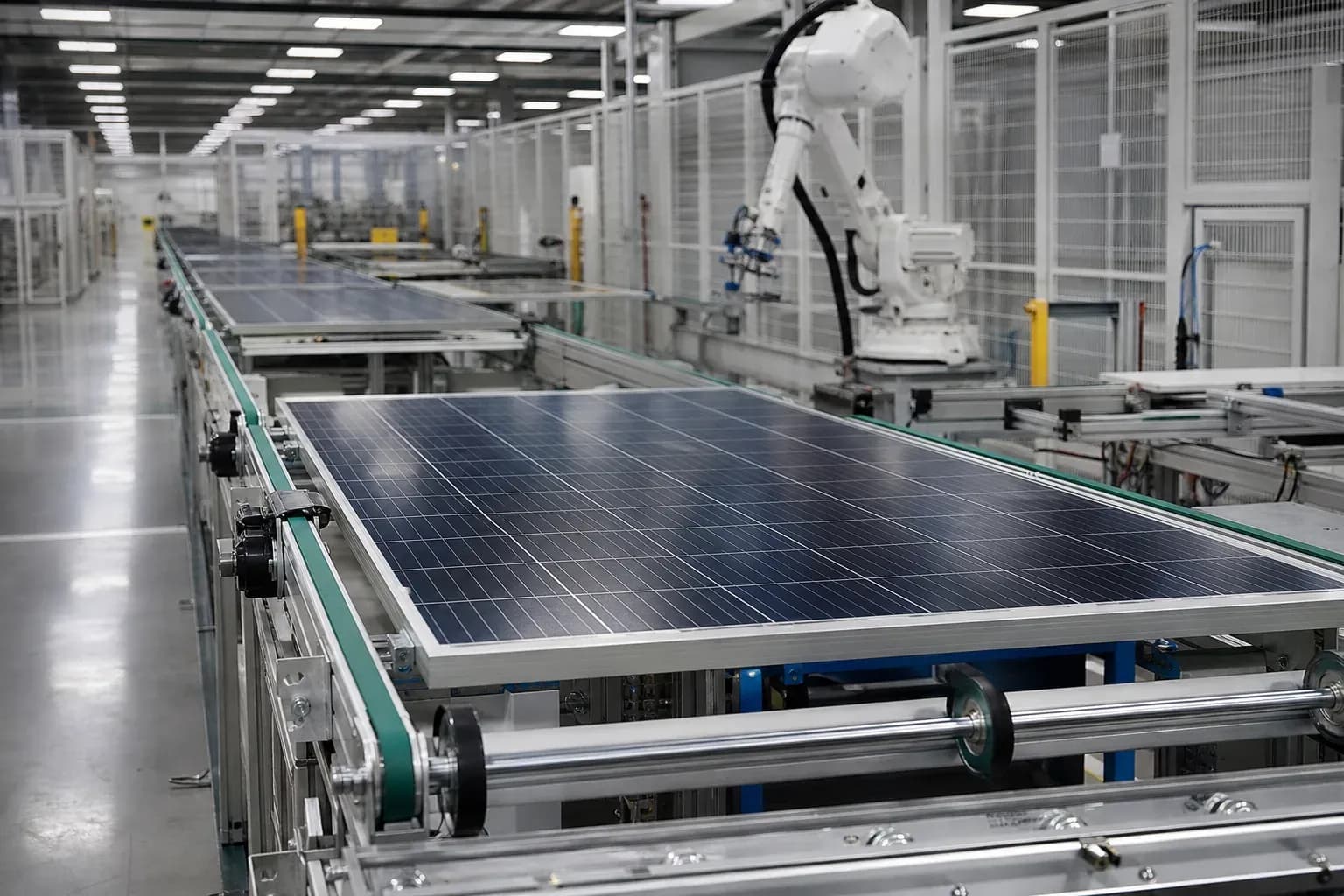
Solar power now covers about 10.5% of the world's electricity demand, and about 698 gigawatts (GW) of new solar capacity was installed in 2025, according to the IEA Photovoltaic Power Systems Programme. At the same time, Chinese module prices have fallen more than 60% since 2023, putting heavy pressure on the companies that make the panels.
CleanTech Journal has ranked the 10 largest solar panel manufacturers in the world by the volume of modules each shipped or sold in 2025, using the figures the companies themselves reported. LONGi leads with 86.58 GW, just ahead of JinkoSolar. Astronergy and GCL System Integration, two other large makers, do not publish their annual shipment figures and are not included.
Solar Panel Manufacturers Ranked by 2025 Shipments
Rank | Company | Headquarters | Module shipments in 2025 (GW) |
|---|---|---|---|
1 | LONGi | China | 86.58 |
2 | JinkoSolar | China | 86.06 |
3 | JA Solar | China | 69.56 |
4 | Trinasolar | China | More than 67 |
5 | Tongwei | China | 43.25 |
6 | DMEGC | China | 24.92 |
7 | Canadian Solar | Canada | 24.3 |
8 | First Solar | United States | 17.5 |
9 | TCL Zhonghuan | China | 15.1 |
10 | Aiko | China | 14.71 |
1. LONGi
LONGi shipped 86.58 GW of solar modules in 2025, the most of any company reporting its own figures. It is also a major maker of silicon wafers, shipping 111.56 GW of them during the year.
The company is betting on back contact (BC) technology, and BC modules made up 22.87 GW of its sales. Its overseas sales grew fastest in Australia, up 76% to 1.3 GW, and in Latin America, up 54%.
LONGi's revenue was CNY 70.35 billion in 2025. The company narrowed its loss as it cut costs across its factories.
2. JinkoSolar
JinkoSolar shipped 86.06 GW of modules in 2025, only about 0.5 GW behind LONGi. Its shipments fell 7.3% from 2024, but picked up late in the year, with 24.2 GW shipped in the fourth quarter alone.
Its main product line, Tiger Neo, has shipped more than 220 GW since its launch. JinkoSolar's revenue fell 29% to CNY 65.5 billion as panel prices dropped.
The company expects to have about 100 GW of annual production capacity by the end of 2026, including 14 GW outside China.
3. JA Solar
JA Solar shipped 69.56 GW of solar cells and modules in 2025, most of them modules. Its module sales reached 66.53 GW, down from 72.68 GW in 2024.
More than half of its module shipments, 51.29%, went to customers outside China. Its revenue fell 30% to CNY 49.13 billion, and it reported a net loss of CNY 4.61 billion.
4. Trinasolar
Trinasolar shipped more than 67 GW of modules in 2025. It is known for large-format modules based on 210 mm silicon wafers, and its cumulative shipments of these modules passed 236 GW by the end of the year.
The company is also growing quickly in battery storage, particularly in Europe and North America. Trinasolar's revenue fell 17% to CNY 66.97 billion, and it reported a net loss of CNY 7.03 billion.
5. Tongwei
Tongwei sold 43.25 GW of modules in 2025, including 9.52 GW outside China. It is better known for what goes into solar panels than for the panels themselves.
The company is the world's largest maker of solar cells, selling 103.03 GW in 2025, and one of the largest producers of high-purity polysilicon. It reported revenue of CNY 84.13 billion and a net loss of CNY 9.55 billion.
6. DMEGC
DMEGC, part of China's Hengdian Group, shipped 24.92 GW of solar products in 2025, up 45% from the year before. That put it about 0.6 GW ahead of seventh-placed Canadian Solar.
Solar is only one part of its business. The company also makes magnetic materials and lithium batteries, and solar made up about CNY 14.3 billion of its CNY 22.59 billion in revenue.
7. Canadian Solar
Canadian Solar shipped 24.3 GW of modules in 2025, including a record 8.1 GW to the United States. Although it is headquartered in Canada, it makes most of its modules in Asia through its subsidiary CSI Solar.
The company is shifting its focus toward battery storage. Its e-STORAGE business shipped a record 7.8 gigawatt-hours (GWh) of batteries in 2025, and its total revenue was USD 5.6 billion.
8. First Solar
First Solar sold 17.5 GW of modules in 2025 and produced 16.1 GW. It is the largest solar manufacturer based in the United States and the only one in the top 10 that makes thin-film panels rather than silicon panels.
Its panels use cadmium telluride, so the company does not depend on the Chinese-dominated polysilicon supply chain. First Solar's net sales reached USD 5.2 billion, and it has sold more than 93 GW of modules worldwide since it was founded.
The company is building its sixth factory in the United States, due to start operating in the second half of 2026, and has 3.2 GW of capacity in India.
9. TCL Zhonghuan
TCL Zhonghuan shipped 15.1 GW of modules in 2025, and revenue from its cell and module business grew 60.45%. The company is best known as one of the world's largest makers of silicon wafers.
Outside China, it sells panels under the TCL Solar and SunPower brands. It also owns Maxeon, a solar company with a long history in high-efficiency panels.
10. Aiko
Aiko sold 14.71 GW of modules in 2025, up 132% from 2024, more than doubling its sales. Its modules use its own all back contact (ABC) cells.
Its modules have been shipped to nearly 70 countries and regions, and overseas customers bought more than half of them in the second half of 2025. Aiko's revenue rose 40% to CNY 15.61 billion.
Chinese Companies Lead the List
Eight of the 10 manufacturers on this list are based in China. Together, the top four, LONGi, JinkoSolar, JA Solar and Trinasolar, shipped about 310 GW in 2025.
This reflects China's grip on the whole supply chain. According to the International Energy Agency, China supplied about 80% of the world's solar modules in 2024 and around 90% of its wafers and polysilicon.
Record Volumes, Falling Profits
Shipments stayed high in 2025, but profits did not. The industry can make far more panels than the world installs, which has pushed prices and margins sharply lower.
JA Solar, Trinasolar and Tongwei all reported losses for the year, and JinkoSolar's revenue fell by almost a third. Many makers are now turning to battery storage and higher-efficiency panels to protect their margins.
Frequently Asked Questions
What is the difference between silicon and thin-film solar panels?
Most solar panels are made from crystalline silicon cells cut from thin wafers. Thin-film panels instead use a very thin layer of light-absorbing material, such as cadmium telluride, coated onto glass. Thin-film panels use less material and perform well in hot climates, while silicon panels currently offer higher efficiency and make up most of the market.
What is a TOPCon solar cell?
TOPCon, short for tunnel oxide passivated contact, is a type of silicon solar cell that adds an ultra-thin oxide layer to reduce energy losses at the back of the cell. It has become the most common cell technology in new solar panels because it offers higher efficiency than older PERC cells at a similar cost.
What is a back contact solar panel?
In a back contact (BC) solar panel, all of the metal contacts that collect electricity are placed on the rear of each cell instead of the front. With no metal lines blocking sunlight on the front, more light reaches the cell, so BC panels can reach higher efficiency and have a cleaner, all-black look.
Which country installs the most solar power?
China installs far more solar power than any other country. It added about 415 GW of solar capacity in 2025, around 60% of the world total, according to the IEA Photovoltaic Power Systems Programme, and has about 1,464 GW installed in total.
How many solar panels make up one gigawatt?
One gigawatt (GW) equals 1,000 megawatts (MW). With today's large utility-scale panels rated at about 650 watts each, one gigawatt of modules is roughly 1.5 million panels.
SOURCES
- LONGi, 2025 Annual Report
- JinkoSolar, Fourth Quarter and Full Year 2025 Financial Results
- JA Solar, 2025 Annual Report
- Trinasolar, 2025 Annual Report Summary
- Tongwei, 2025 Annual Report
- DMEGC, 2025 Annual Report Summary
- Canadian Solar, Fourth Quarter and Full Year 2025 Results
- First Solar, 2025 Annual Report (Form 10-K)
- TCL Zhonghuan, 2025 Sustainability Report
- Aiko, 2025 Annual Report
Written by
Suraj Kadam
Suraj Kadam is a journalist and Chief Editor of CleanTech Journal, a knowledge and media platform covering clean technology, solar energy, and renewable energy. He reports on emerging technologies, industry developments, policy trends, and innovations shaping the global clean energy transition. Through his editorial work, Suraj aims to make complex clean technology topics accessible to industry professionals, researchers, policymakers, and readers interested in sustainable energy. His work focuses on delivering insightful, informative, and engaging coverage of the evolving renewable energy landscape.