Top 10 Oil and Gas Companies in the Middle East and Africa
The top 10 oil and gas companies in the Middle East and Africa, from Saudi Aramco to ADNOC, NNPC and Sonatrach, with 2025 production for each.

Suraj Kadam
Published •25 min read
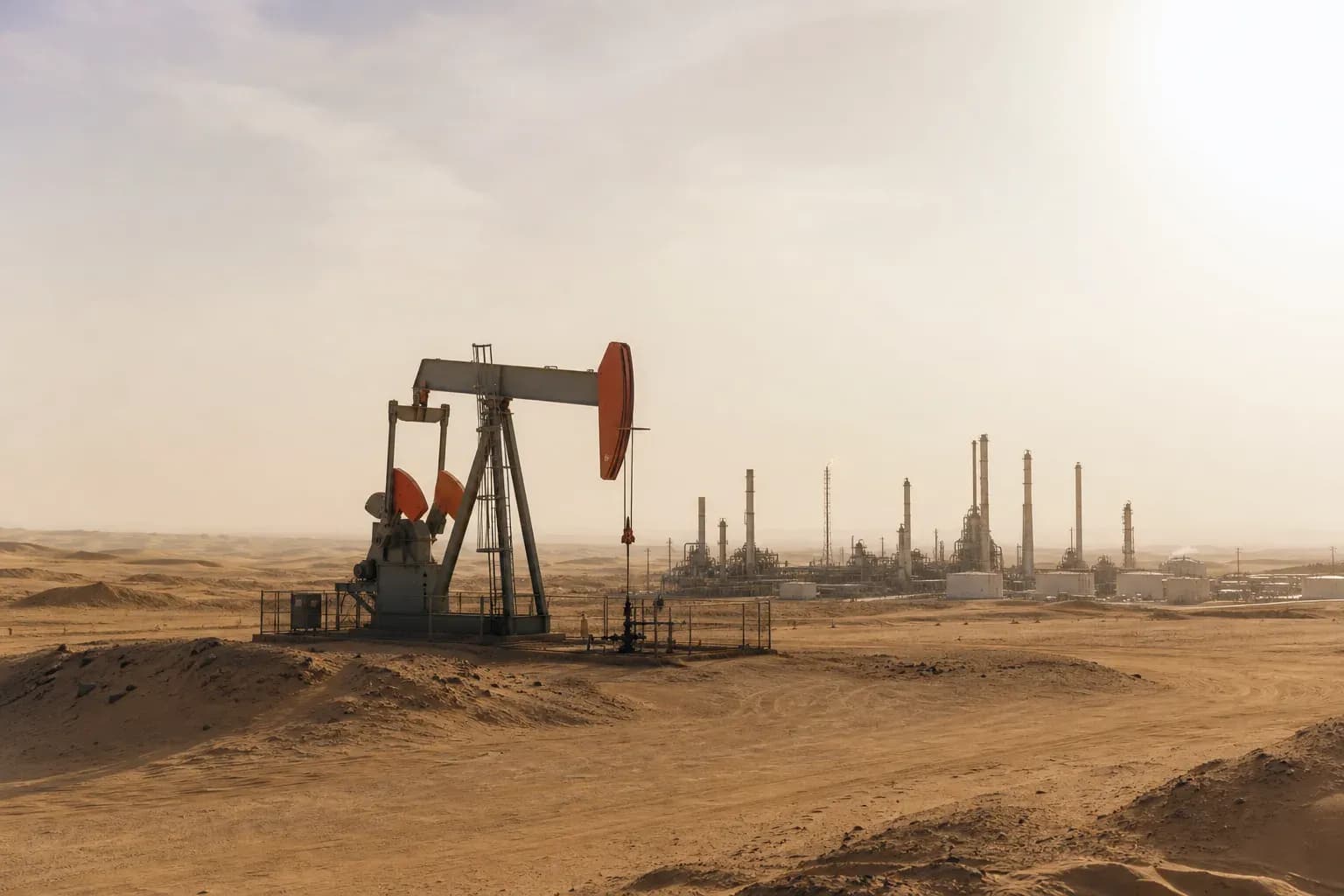
The top 10 oil and gas companies in the Middle East and Africa are almost all state-owned national oil companies, led by Saudi Aramco. Saudi Arabia produced about 9.47 million barrels per day (b/d) of crude oil in 2025, more than Iraq and Iran combined, and Aramco's total oil and gas output reached 12.9 million barrels of oil equivalent per day.
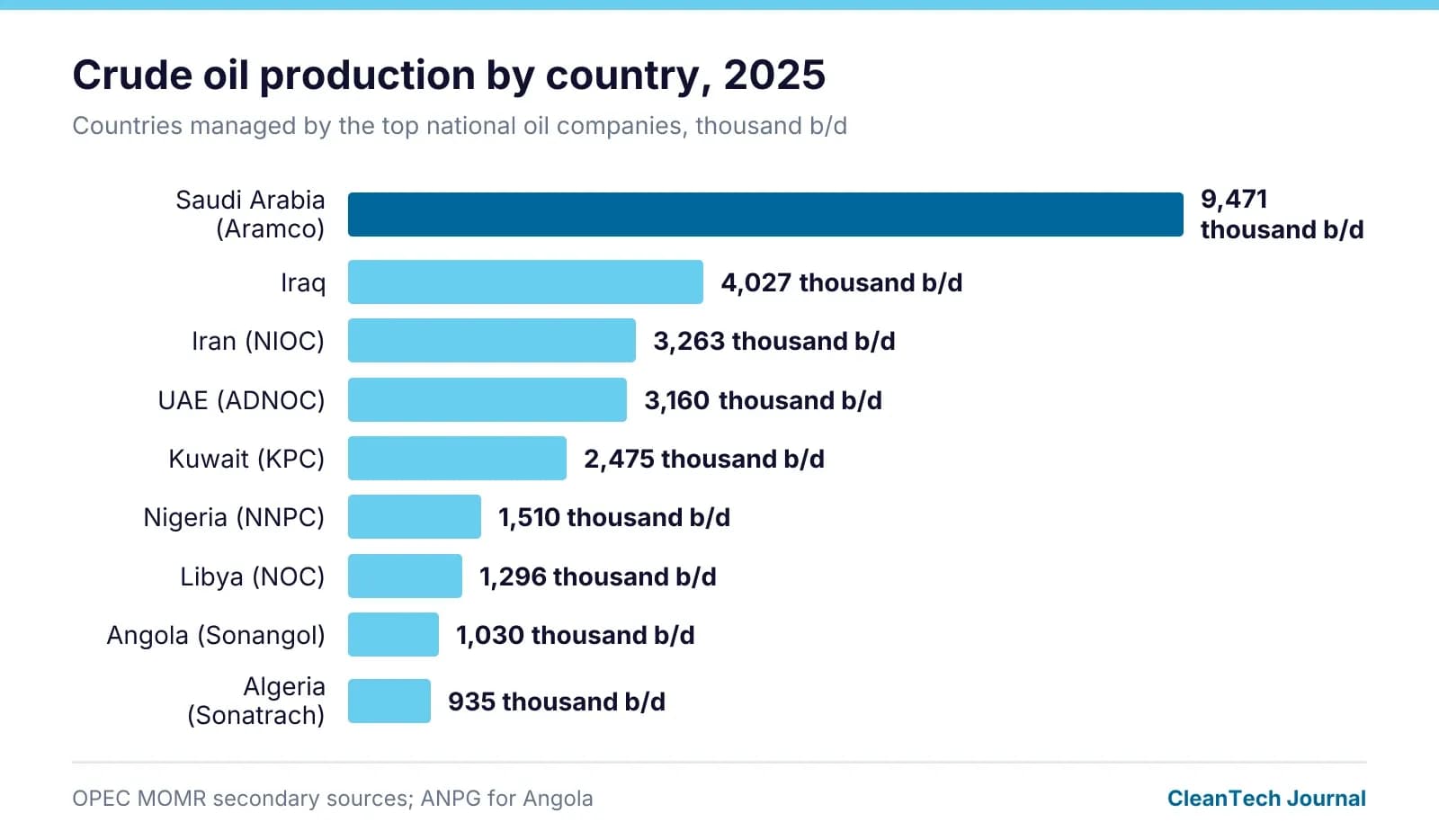
Most of these companies do not publish full accounts, so they cannot be ranked by revenue. Instead, we ranked them by the 2025 crude oil production of the country each one manages, using OPEC secondary-source estimates, and added the latest company figures where they are published. Gas-focused QatarEnergy is included separately at the end because Qatar's output is mainly natural gas.
Oil and Gas Companies in the Middle East and Africa at a Glance
Rank | Company | Country | 2025 crude production (thousand b/d) |
|---|---|---|---|
1 | Saudi Aramco | Saudi Arabia | 9,471 |
2 | Iraq's state oil companies (Basra Oil Company and others) | Iraq | 4,027 |
3 | National Iranian Oil Company (NIOC) | Iran | 3,263 |
4 | ADNOC | United Arab Emirates | about 3,160 |
5 | Kuwait Petroleum Corporation (KPC) | Kuwait | 2,475 |
6 | NNPC Limited | Nigeria | 1,510 |
7 | National Oil Corporation (NOC) | Libya | 1,296 |
8 | Sonangol | Angola | about 1,030 |
9 | Sonatrach | Algeria | 935 |
10 | QatarEnergy | Qatar | Gas producer: 77 million tonnes a year of LNG capacity |
Sources: OPEC Monthly Oil Market Report secondary sources for OPEC members; Angola's National Agency of Petroleum, Gas and Biofuels (ANPG) for Angola; QatarEnergy for Qatar. Production is national output, most of which is produced by or with the national company.
The five Gulf producers on this list, Saudi Arabia, Iraq, Iran, the UAE and Kuwait, pumped about 22.4 million b/d of crude in 2025, more than 80% of all OPEC output.
1. Saudi Aramco
Saudi Aramco is the largest oil company in the world and by far the largest in the Middle East and Africa. It produced 12.9 million barrels of oil equivalent per day of oil and gas in 2025 and reported $445.7 billion in total revenue, according to its full-year 2025 results.
Saudi Arabia held an estimated 11.6 million b/d of effective crude production capacity in 2025, according to the U.S. Energy Information Administration (EIA), which gives Aramco spare capacity to raise output quickly. During the 2026 war with Iran, Saudi Arabia rerouted crude exports to the Red Sea through its 7 million b/d East-West pipeline to the port of Yanbu.
2. Iraq's State Oil Companies
Iraq produced about 4.03 million b/d of crude in 2025, making it the second-largest producer in the region. Its oil industry is state-owned, and most production is managed by government companies, many of them working with foreign partners under service contracts.
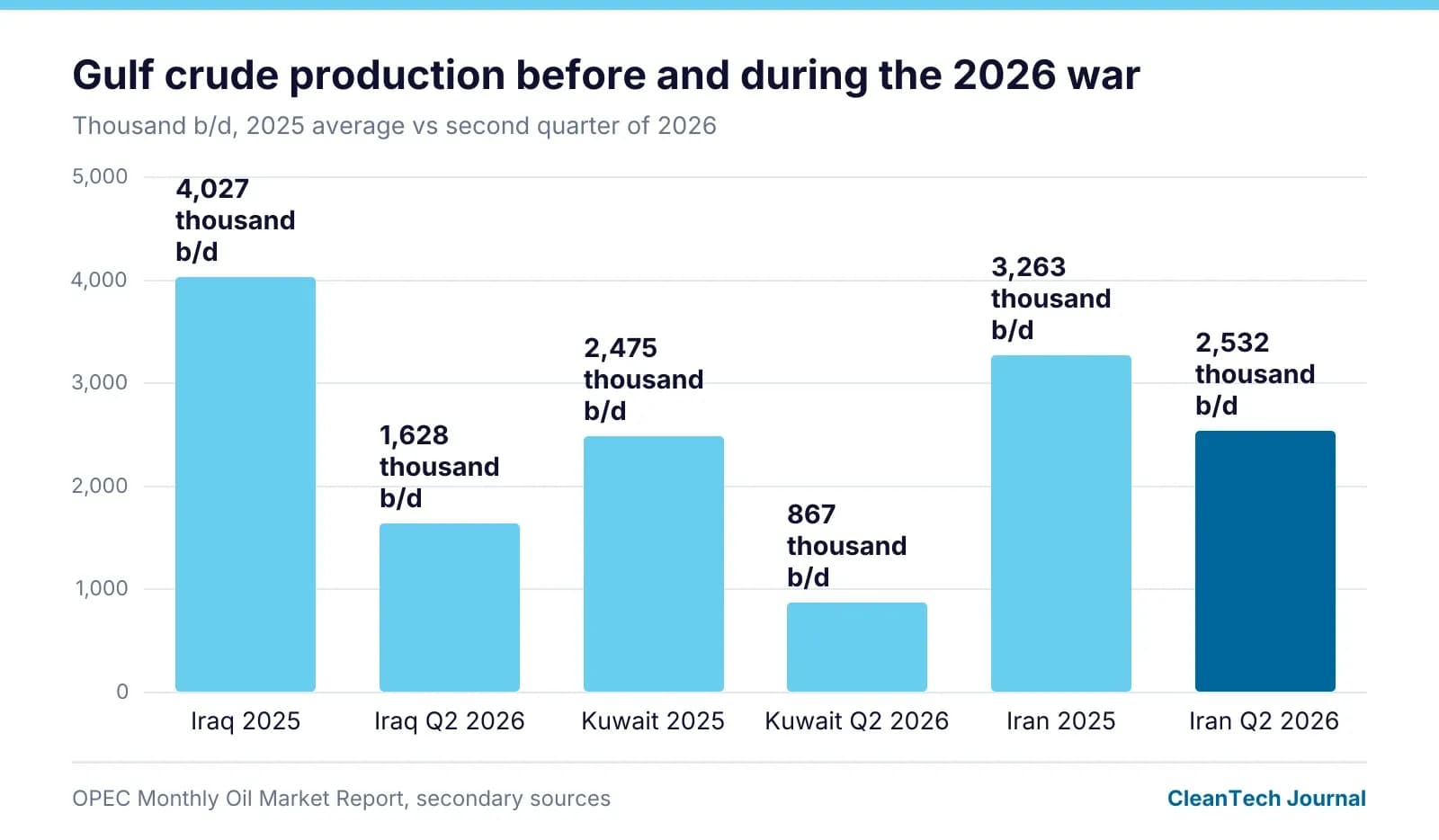
Iraq holds about 145 billion barrels of proven oil reserves, the world's fifth-largest. About 93% of its crude exports leave through terminals near Basra, which made it very exposed to the 2026 Hormuz disruptions: Iraqi output fell to about 1.6 million b/d in the second quarter of 2026 before recovering.
3. National Iranian Oil Company (NIOC)
The National Iranian Oil Company manages the oil and gas industry of Iran, which produced about 3.26 million b/d of crude in 2025. Iran holds the world's fourth-largest proven oil reserves, but sanctions and limited investment keep output far below its 1970s peak of more than 6 million b/d.
Most Iranian crude exports go to China. Output dropped to about 2.5 million b/d in the second quarter of 2026 after the war began in late February.
4. ADNOC
The Abu Dhabi National Oil Company (ADNOC) runs the oil industry of the United Arab Emirates, which produced about 3.16 million b/d of crude in 2025 on OPEC estimates (3.4 million b/d according to the EIA). ADNOC says it has a production capacity of around 4.85 million b/d of oil and 11.5 billion cubic feet per day of gas across 29 producing fields.
ADNOC plans to reach 5 million b/d of oil capacity by 2027. The UAE left OPEC and OPEC+ on May 1, 2026, which frees ADNOC from group quotas, and in May 2026 it began a $55 billion investment program for 2026 to 2028.
5. Kuwait Petroleum Corporation (KPC)
Kuwait Petroleum Corporation is the state holding company for Kuwait's oil industry, which produced about 2.48 million b/d of crude in 2025. Its subsidiary Kuwait Oil Company (KOC) produces about 90% of the country's oil.
KPC's oil production capacity exceeds 3 million b/d, and it aims to reach 4 million b/d by 2035. Its Al-Zour refinery in southern Kuwait can process 615,000 b/d of crude.
6. NNPC Limited
NNPC Limited is Nigeria's national oil company. Nigeria produced about 1.51 million b/d of crude in 2025, the most of any African OPEC member on OPEC estimates.
NNPC reported a profit after tax of ₦7.2 trillion for 2025, up 33% from 2024, on revenue of ₦34.5 trillion, which fell 24% because of lower crude prices and smaller fuel sales volumes after Nigeria deregulated petrol prices in October 2024. The company has said it is building a track record toward a possible stock market listing.
7. National Oil Corporation (NOC) of Libya
Libya's National Oil Corporation manages the country's oil sector, which produced about 1.30 million b/d of crude in 2025, up from 1.09 million b/d in 2024, an increase of about 19%.
Because Libya ships its oil across the Mediterranean rather than through the Strait of Hormuz, its output held steady in 2026 at about 1.3 million b/d, according to OPEC estimates.
8. Sonangol
Sonangol is Angola's state oil company. Angola produced about 1.03 million b/d of crude in 2025, down from about 1.14 million b/d in 2024, according to data from the national regulator ANPG. Angola left OPEC at the end of 2023 in a dispute over its production quota.
Sonangol's own share of production was about 217,000 barrels of oil equivalent per day in 2025, and it reported a net profit of more than $750 million. Most of Angola's deepwater oil is operated by international companies such as TotalEnergies and ExxonMobil, with Sonangol as a partner.
9. Sonatrach
Algeria's Sonatrach is one of the world's major gas suppliers. In 2025, it produced 193.7 million tonnes of oil equivalent of hydrocarbons, including 47.5 million tonnes of crude oil and 134.3 billion cubic meters of natural gas. Algeria's crude output alone was about 935,000 b/d.
Sonatrach is the largest natural gas supplier to Italy and the second-largest to Spain, through the TransMed and Medgaz pipelines and LNG cargoes. Algeria was Europe's third-largest natural gas supplier in 2024, after Norway and the United States.
10. QatarEnergy
QatarEnergy is the state energy company of Qatar and one of the world's largest LNG producers. Qatar's liquefied natural gas (LNG) production capacity is 77 million tonnes per year, all of it from the offshore North Field.
QatarEnergy is in the middle of the world's largest LNG expansion. The North Field East project is adding four trains of 8 million tonnes per year each, which will raise capacity to 110 million tonnes, then to 126 million tonnes by 2027 and 142 million tonnes by 2030 with later phases.
How the 2026 War Changed These Companies
Since the war with Iran began on February 28, 2026, tanker traffic through the Strait of Hormuz has been disrupted. Gulf output fell sharply: Iraq and Kuwait produced less than half their 2025 levels in the second quarter of 2026, according to OPEC estimates.
Companies with export routes outside the strait have coped better. Saudi Aramco shifted exports to the Red Sea, and Saudi Arabia told OPEC it pumped about 10.6 million b/d in October 2026. African producers such as Nigeria and Libya, which do not ship through Hormuz, kept output steady.
Frequently Asked Questions
What is the largest oil company in the Middle East?
Saudi Aramco, which produced 12.9 million barrels of oil equivalent per day in 2025 and reported $445.7 billion in revenue, making it the largest oil company in the world.
What are the top 10 oil and gas companies in the Middle East and Africa?
Saudi Aramco, Iraq's state oil companies, NIOC, ADNOC, Kuwait Petroleum Corporation, NNPC, Libya's National Oil Corporation, Sonangol, Sonatrach and QatarEnergy.
What is the largest oil company in Africa?
By crude output, Nigeria's NNPC, as Nigeria produced about 1.51 million b/d in 2025. By total hydrocarbons, Algeria's Sonatrach is larger because of its gas production of 134.3 billion cubic meters a year.
Are Middle East oil companies state-owned?
Yes, almost all of them. Saudi Aramco has a small share of its stock listed on the Saudi Exchange, and ADNOC has listed some subsidiaries, but governments control all of the major oil companies in the region.
How did the 2026 Iran war affect Gulf oil production?
It cut output sharply in the first half of 2026, as shipments through the Strait of Hormuz were disrupted. Iraq's crude production fell to about 1.6 million b/d in the second quarter, before recovering later in the year.
SOURCES
- OPEC Monthly Oil Market Report: crude production by secondary sources
- Saudi Aramco: Full-year 2025 results
- EIA: The UAE's exit from OPEC
- ADNOC: Sustainability Report 2025
- Nairametrics: NNPC profit rises 33% to N7.2 trillion in 2025
- Ver Angola: ANPG December 2025 production data
- TSA Algérie: Sonatrach 2025 results
- QNA: Qatar reinforces LNG leadership
- Forbes: Top 10 oil-producing countries, according to the EIA
Written by
Suraj Kadam
Suraj Kadam is a journalist and Chief Editor of CleanTech Journal, a knowledge and media platform covering clean technology, solar energy, and renewable energy. He reports on emerging technologies, industry developments, policy trends, and innovations shaping the global clean energy transition. Through his editorial work, Suraj aims to make complex clean technology topics accessible to industry professionals, researchers, policymakers, and readers interested in sustainable energy. His work focuses on delivering insightful, informative, and engaging coverage of the evolving renewable energy landscape.