What Is Natural (Geological) Hydrogen? Where It's Being Explored
What is natural hydrogen? Learn how geological hydrogen forms underground, how much may exist and where it's explored, from Mali and the US to France.

Suraj Kadam
Published •20 min read
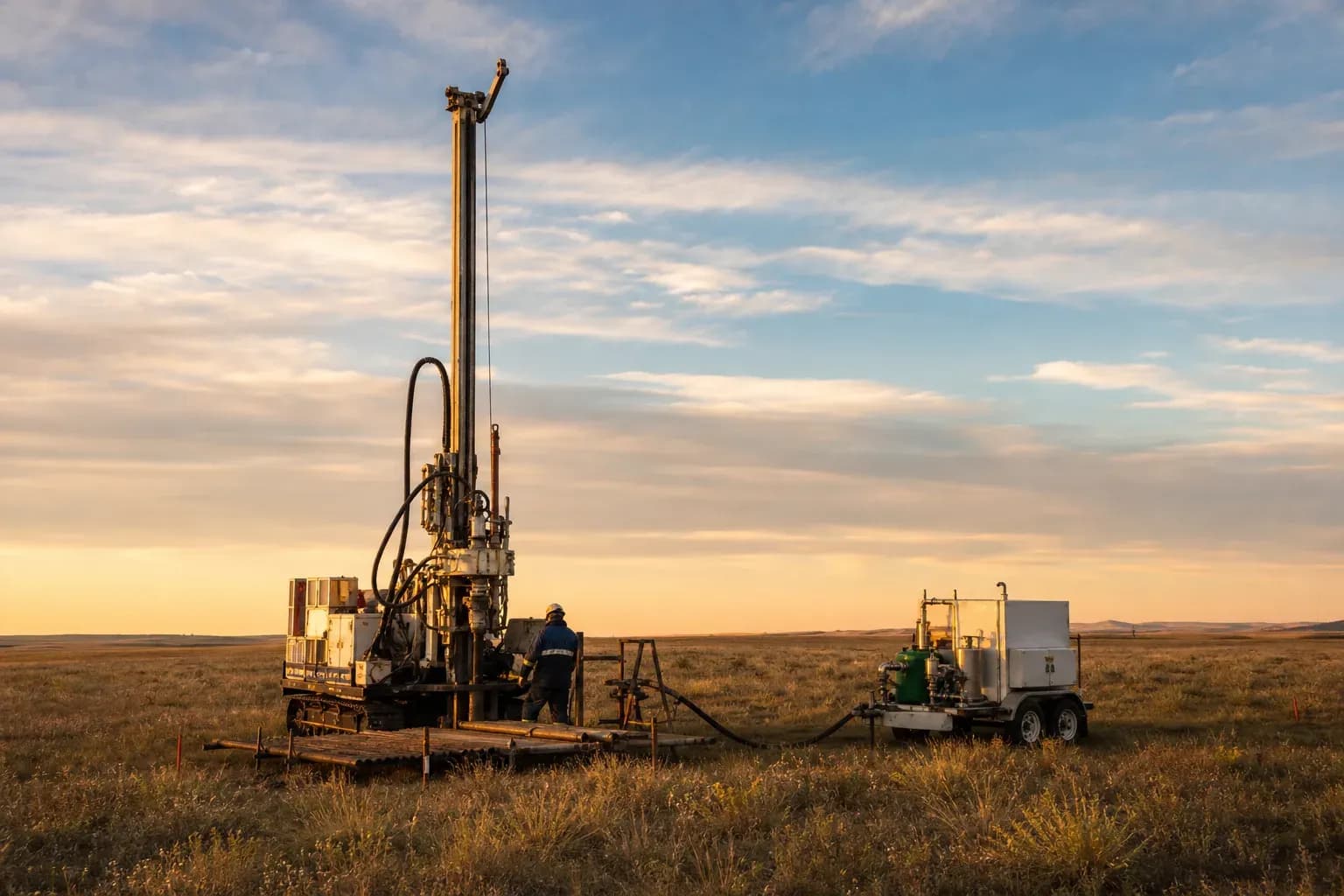
Natural hydrogen is hydrogen gas that forms on its own underground, through reactions between water and rocks deep in the Earth's crust. Also called geological, geologic, "white" or "gold" hydrogen, it can be extracted with a drill rather than made in a factory. This guide explains how natural hydrogen forms, how much of it there might be, and where companies and governments are exploring for it in 2026.
The topic has moved fast. The International Energy Agency (IEA), in its Global Hydrogen Review 2026, says geological hydrogen exploration now spans almost 30 countries, though it remains at an early stage. Only one well in the world, in Mali, produces natural hydrogen today.
What Is Natural Hydrogen?
Almost all hydrogen used today is made in industrial plants. The IEA says global hydrogen demand passed 100 million tonnes (Mt) for the first time in 2025. Most of that hydrogen comes from natural gas or coal, and low-emissions production, such as splitting water with renewable electricity, reached only about 1 Mt.
Natural hydrogen is different because nature makes it. The IEA uses "geological hydrogen" as the umbrella term, and it covers two things:
- Natural hydrogen, produced by geological and geochemical reactions that happen on their own. The job is to find and tap existing accumulations, much like natural gas.
- Stimulated geological hydrogen, where people speed up or trigger those same reactions underground, for example by injecting water into iron-rich rocks.
When hydrogen is burned or used in a fuel cell, the only by-product is water. That's why natural hydrogen draws so much interest: it could supply a low-carbon fuel without the energy cost of making it.
How Natural Hydrogen Forms Underground
The US Geological Survey (USGS) names three main ways hydrogen forms in the subsurface:
- Serpentinization: water reacts with iron-rich rocks and releases hydrogen. The IEA considers this the most significant source.
- Radiolysis: natural radiation in rocks splits water molecules.
- Deep sources: hydrogen can occur in the lower crust and mantle, under high heat and pressure.
Forming hydrogen is only the first step. Like oil and gas, a usable deposit needs three parts, according to the USGS: a source that generates the gas, a reservoir rock with pores or fractures to hold it, and a seal of tight rock, such as salt, to keep it from leaking away.
For a long time, geologists assumed hydrogen was too reactive and too quick to escape to build up underground. That's why so few wells looked for it. Hydrogen was rarely a drilling target, and the places where it forms often differ from places where oil and gas are found.
How Much Natural Hydrogen Could There Be?
In December 2024, USGS geologists Geoffrey Ellis and Sarah Gelman published the first estimate of the world's in-place geologic hydrogen. Their model gives a very wide range, from about 1 billion tonnes to 10 quadrillion tonnes. The most probable value is about 5.6 trillion tonnes.
The authors stress that most of this hydrogen is likely too deep, too far offshore or in pockets too small to recover economically. Even so, the numbers are large. The IEA notes that if just 1% of the best estimate could be recovered, it would cover around 560 years of today's hydrogen use.
The IEA also cautions that resource potential remains highly uncertain and has to be proven by drilling. No estimate yet exists for how much any single well could produce.
Mali: The Only Producing Natural Hydrogen Well
The modern story of natural hydrogen starts in Bourakébougou, a village in Mali. Workers drilling for water there in 1987 found gas instead, and the well was sealed. It was reopened decades later, and tests showed the gas was about 98% hydrogen, with small amounts of nitrogen and methane.
Since 2012, the well has supplied the gas to generate electricity for the village. The IEA puts its output at around 5 tonnes of hydrogen a year. The company that runs it, now called Hydroma, later drilled 24 more boreholes in the surrounding area, and researchers reported that these also found natural hydrogen.
The output is tiny compared with global demand, but Bourakébougou proved that a natural hydrogen well can produce steadily for years.
United States
The US leads the world in natural hydrogen exploration drilling, according to the IEA. The first well drilled specifically for natural hydrogen was in Nebraska in 2019. Since then, activity has focused on the Midcontinent Rift, with drilling in Nebraska, Kansas and Iowa and further work in Arizona and Idaho.
In January 2025, the USGS released the first map of where geologic hydrogen may be found in the lower 48 states. It highlights a mid-continent region covering Kansas, Iowa, Minnesota and Michigan, the Four Corners states, the California coast and parts of the Eastern Seaboard.
Rules are still taking shape. There is no dedicated federal framework, and in April 2026, Iowa became the first state to pass a law written specifically for natural hydrogen. In the US, landowners often hold underground rights, so companies can lease land directly from them.
France
France's interest centers on the Lorraine coal basin in the northeast. In 2023, researchers from France's national research agency CNRS and the University of Lorraine, working with the company La Française de l'Énergie (FDE), found dissolved natural hydrogen in a well at Folschviller. Based on gas data from 1,100 meters down, the researchers estimated the deposit could hold up to 46 million tonnes of hydrogen.
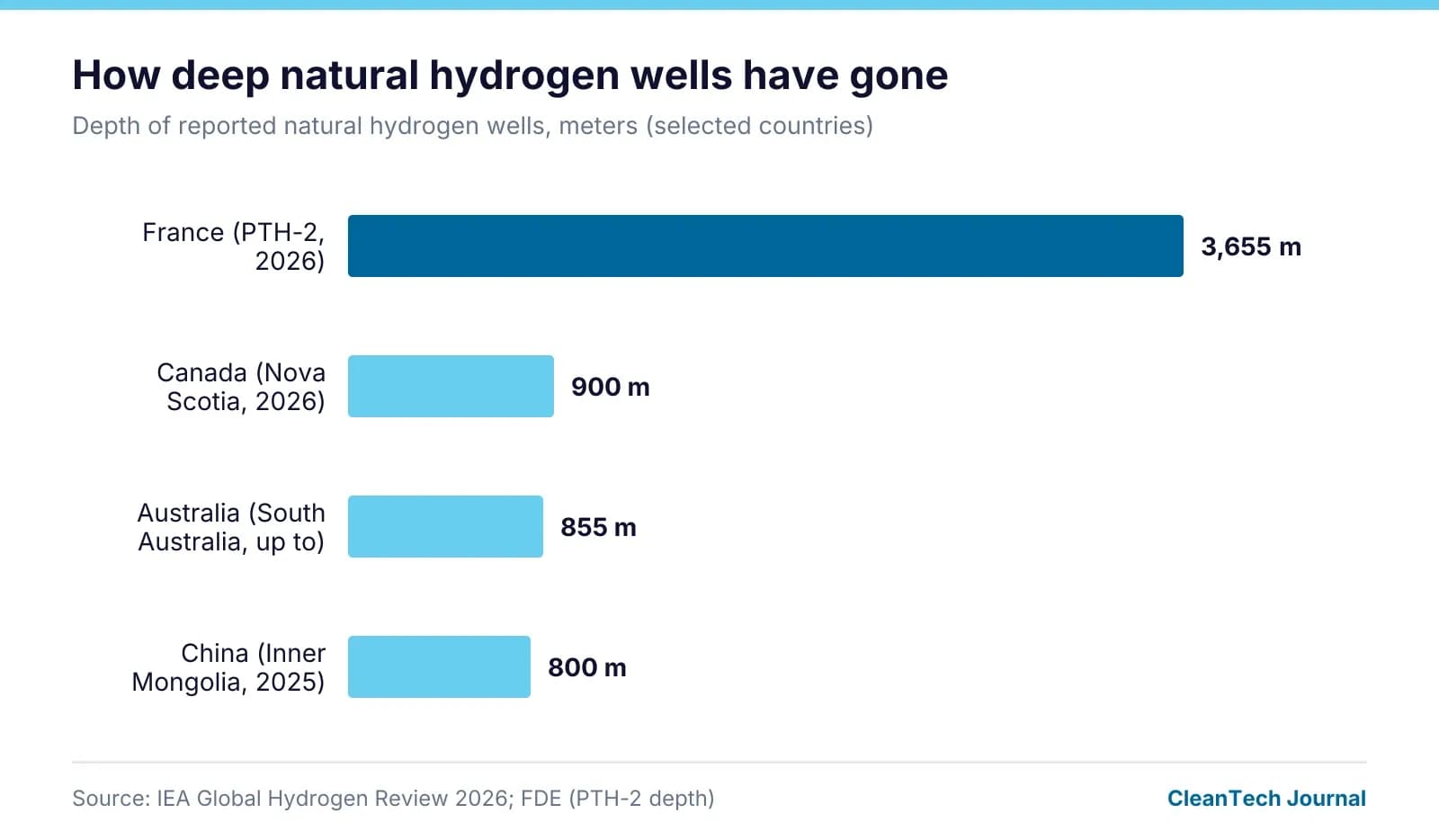
France added natural hydrogen to its Mining Code in 2022. In January 2026, the government granted FDE an exclusive five-year exploration permit, known as the "Trois Évêchés" permit, covering 2,254 square kilometers. In March 2026, FDE finished drilling its PTH-2 well to 3,655 meters, the deepest well ever drilled just for natural hydrogen. The company reported in June 2026 that hydrogen concentrations rise sharply with depth, and it plans flow tests below 3,000 meters in the second half of 2026.
Australia
South Australia was the first Australian state to open its doors to natural hydrogen. It made hydrogen a regulated substance in February 2021, which allowed the first exploration licences aimed at natural hydrogen. Western Australia added similar rules in 2024.
Drilling began in 2023. Gold Hydrogen drilled Ramsay 1 on the Yorke Peninsula, the first well in Australia drilled specifically for natural hydrogen, and reported hydrogen and helium indications in its Ramsay wells. The IEA says four wells have now been drilled in South Australia, to depths of up to 855 meters.
Helium is part of the appeal. The two gases can occur together, and helium sells for much more than hydrogen, which can help pay for exploration.
Albania and Ophiolite Rocks
One of the most striking finds came from a mine. In February 2024, a team led by researchers at France's Grenoble Alpes University reported in Science that the Bulqizë chromite mine in Albania releases at least 200 tonnes of hydrogen a year. That's the highest natural hydrogen flow measured so far. The gas bubbling up in one mine pool was about 84% hydrogen.
The mine sits in an ophiolite, a slab of ocean-floor and mantle rock pushed up onto land. These rocks are rich in iron minerals that make hydrogen through serpentinization. The IEA says the Albania find points to the potential for hydrogen accumulations in some ophiolite systems. The same kind of rock is drawing explorers to the Semail Ophiolite in Oman and the United Arab Emirates.
Other Countries Exploring Natural Hydrogen
The IEA groups countries by how far they have gone:
- Exploration wells drilled: Canada drilled its first well in Saskatchewan in November 2025, then a 900-meter well in Nova Scotia in April 2026. China drilled its first natural hydrogen well, 800 meters deep, in Inner Mongolia in 2025. Colombia carried out exploratory drilling in 2025.
- Wells planned: In Oman, a research pilot well has tested stimulated hydrogen production. In the United Arab Emirates, a national oil company is aiming to drill in 2026. Spain plans a 4,000-meter appraisal well, and the Philippines has awarded exploration contracts after a 2024 auction.
- Surface surveys: Brazil, South Africa, Morocco and Kazakhstan are at the field study and soil gas survey stage, and Belgium has funded a national research program.
- New rules, little activity yet: Poland added natural hydrogen to its mining law in 2023, and Germany's 2026 Hydrogen Accelerator Act allows standard mining permits.
In the UK, the Royal Society says Scotland and Cornwall have rock formations where natural hydrogen could form, but no nationwide assessment has been done.
Stimulated Hydrogen: Helping the Rocks Along
Instead of hunting for deposits, some groups want to make the rocks produce hydrogen on demand. The US Department of Energy's research agency ARPA-E launched up to $20 million in funding in 2024 to develop ways to stimulate hydrogen generation underground at low cost. The projects study how to speed up the slow reactions between water and iron-rich rocks and how to manage hydrogen reservoirs.
Private money is following. The IEA reports that geological hydrogen start-ups have raised nearly $0.5 billion in venture capital since 2023, about 15% of venture funding for hydrogen production technologies. US-based Koloma accounts for nearly 90% of the natural hydrogen share. Vema, a US start-up working on stimulated hydrogen, has drilled its first pilot wells.
What Natural Hydrogen Still Has to Prove
Natural hydrogen is promising, but the industry is still pre-commercial. The IEA and the Royal Society point to several open questions:
- Flow rates: Explorers still have to show that reservoirs can deliver hydrogen steadily, in large enough volumes, for years.
- Purity: Hydrogen often comes mixed with nitrogen, methane or helium, so it may need separating.
- Recharge: The IEA says it is still unknown whether some reservoirs refill during production. The Royal Society calls claims of an unlimited, renewable supply unfounded.
- Rules and incentives: Most low-emissions hydrogen support schemes, including the US 45V tax credit model and EU renewable fuel rules, don't yet cover geological hydrogen.
Timelines are long. The IEA notes that for oil and gas projects started after 2010, it took about five years on average just to go from early exploration to discovery. CTJ's ranking of the top hydrogen companies by revenue shows how the established hydrogen industry looks today.
FAQ
What is natural hydrogen?
Natural hydrogen is hydrogen gas that forms on its own underground, mainly when water reacts with iron-rich rocks. It is also called geological, geologic, white or gold hydrogen. Unlike most hydrogen today, it doesn't have to be made from natural gas or with electricity.
Where has natural hydrogen been found?
The only producing well is in Bourakébougou, Mali, where the gas is about 98% hydrogen. Exploration wells have been drilled in the US, France, Australia, Canada, China and Colombia, and a mine in Albania releases at least 200 tonnes of hydrogen a year.
Is natural hydrogen renewable?
Not proven. Hydrogen forms continuously underground, but the IEA says it is unknown whether reservoirs refill during production. The Royal Society calls claims of an unlimited, renewable supply unfounded.
How much natural hydrogen is there?
A 2024 USGS model put the most probable amount of hydrogen underground at about 5.6 trillion tonnes, with a very wide range. Most of it is probably too deep, too far offshore or too scattered to recover.
When will natural hydrogen be produced at scale?
No one knows yet. The IEA says exploration is still at a pre-commercial stage, and most projects are only now drilling their first wells. Oil and gas projects have typically taken around five years just to go from early exploration to discovery.
SOURCES
- IEA: Global Hydrogen Review 2026
- USGS: USGS releases first-ever map of potential geologic hydrogen in the U.S.
- USGS: Model predictions of global geologic hydrogen resources
- USGS: Geologic Hydrogen Prospectivity Map Explorer
- Scientific Reports: Natural hydrogen in the Bourakebougou field, Mali
- CNRS: A gigantic hydrogen deposit in northeast France
- FDE: FDE confirms exceptionally high natural hydrogen concentrations in the Lorraine region
- Grenoble Alpes University: Discovery of a large hydrogen reservoir in an underground mine in Albania
- South Australia Department for Energy and Mining: Natural hydrogen
- Royal Society: Natural hydrogen could be part of a green future
Written by
Suraj Kadam
Suraj Kadam is a journalist and Chief Editor of CleanTech Journal, a knowledge and media platform covering clean technology, solar energy, and renewable energy. He reports on emerging technologies, industry developments, policy trends, and innovations shaping the global clean energy transition. Through his editorial work, Suraj aims to make complex clean technology topics accessible to industry professionals, researchers, policymakers, and readers interested in sustainable energy. His work focuses on delivering insightful, informative, and engaging coverage of the evolving renewable energy landscape.