Top 10 Oil and Gas Companies in the World Ranked by Revenue
The top 10 oil and gas companies in the world ranked by 2025 revenue, from Saudi Aramco's $445.7 billion to Eni, with production and profit for each.

Suraj Kadam
Published •29 min read
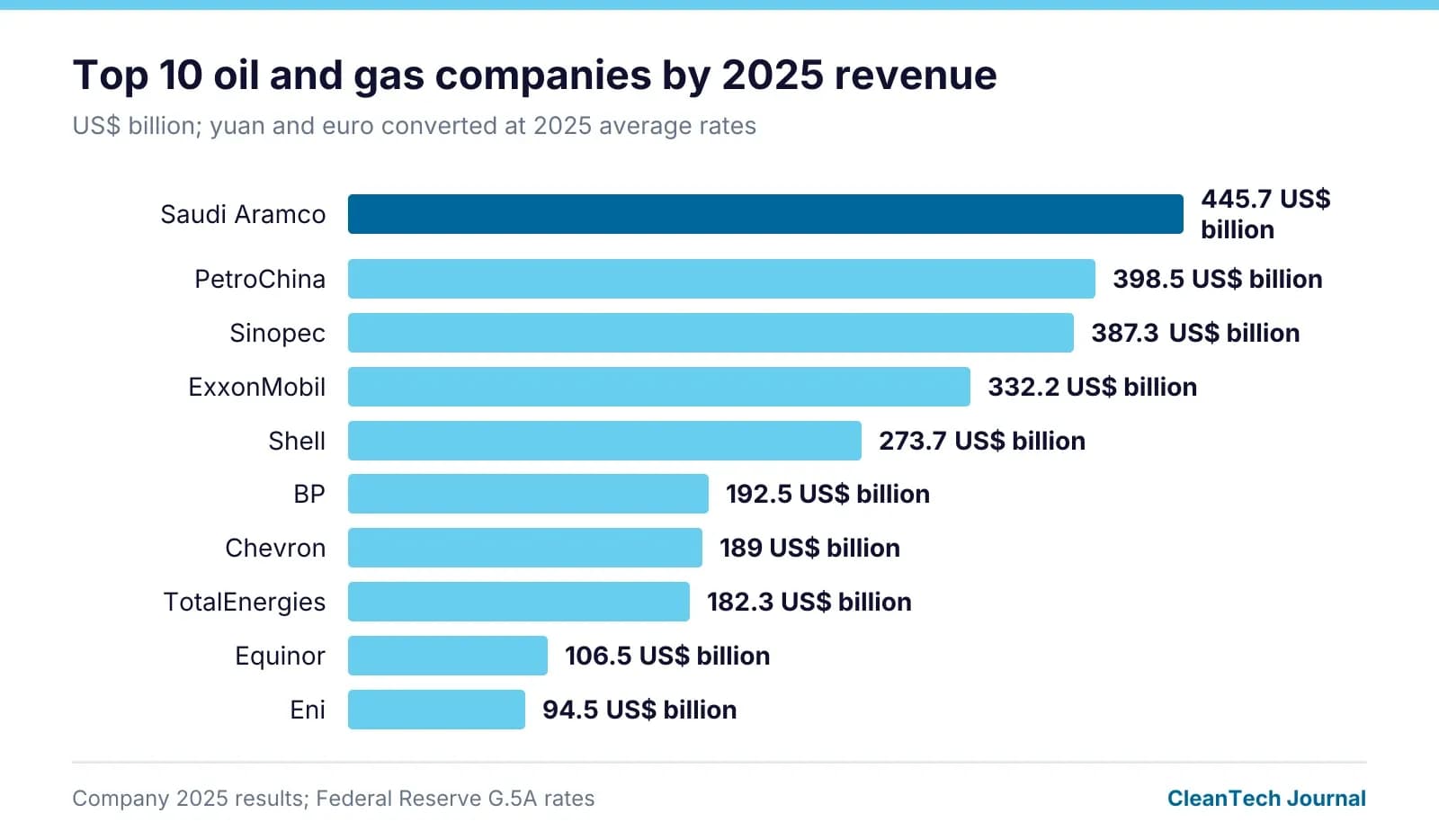
The top 10 oil and gas companies in the world are led by Saudi Aramco, which reported $445.7 billion in total revenue for 2025. China's PetroChina and Sinopec follow with close to $400 billion each, and ExxonMobil is the largest Western oil company at $332.2 billion.
We ranked the world's largest integrated oil and gas companies (groups that produce oil and gas and also refine and sell fuels) by their full-year 2025 revenue, using each company's own annual results. Chinese yuan figures are converted at the Federal Reserve's 2025 average rate of 7.1875 yuan per dollar, and euro figures at $1.13 per euro.
Top 10 Oil and Gas Companies in the World at a Glance
Rank | Company | Headquarters | 2025 revenue (US$) | Reported revenue |
|---|---|---|---|---|
1 | Saudi Aramco | Saudi Arabia | $445.7 billion | $445.7 billion |
2 | PetroChina | China | $398.5 billion | RMB 2,864.5 billion |
3 | Sinopec | China | $387.3 billion | RMB 2,783.6 billion |
4 | ExxonMobil | United States | $332.2 billion | $332.2 billion |
5 | Shell | United Kingdom | $273.7 billion | $273.7 billion |
6 | BP | United Kingdom | $192.5 billion | $192.5 billion |
7 | Chevron | United States | $189.0 billion | $189.0 billion |
8 | TotalEnergies | France | $182.3 billion | $182.3 billion |
9 | Equinor | Norway | $106.5 billion | $106.5 billion |
10 | Eni | Italy | $94.5 billion | €83.6 billion |
CleanTech Journal calculations from company 2025 results. Yuan converted at the Federal Reserve's 2025 average exchange rates (7.1875 yuan and $1.1306 per euro, rounded to $1.13).
How We Ranked the World's Largest Oil Companies
We included integrated oil and gas companies that publish full annual accounts, and ranked them by 2025 revenue. Revenue measures the size of the whole business, including refining, fuel retail, gas and chemicals, not oil production alone.
Some very large state oil companies are not on the list because they do not publish full income statements, including ADNOC, Kuwait Petroleum Corporation and the National Iranian Oil Company. For a regional view, see our ranking of the top 10 oil companies in Europe. We also left out Russian companies such as Rosneft and Lukoil, whose reporting is limited under sanctions, and pure refiners such as Phillips 66 and Marathon Petroleum. Just outside our top 10 is Brazil's Petrobras, with $89.2 billion in 2025 sales revenue.
1. Saudi Aramco
Saudi Aramco is the world's largest oil company by revenue and by production. It reported total revenue and other income related to sales of $445.7 billion for 2025, down 7.2% from $480.4 billion in 2024, according to its full-year 2025 results. Net income fell to $93.4 billion.
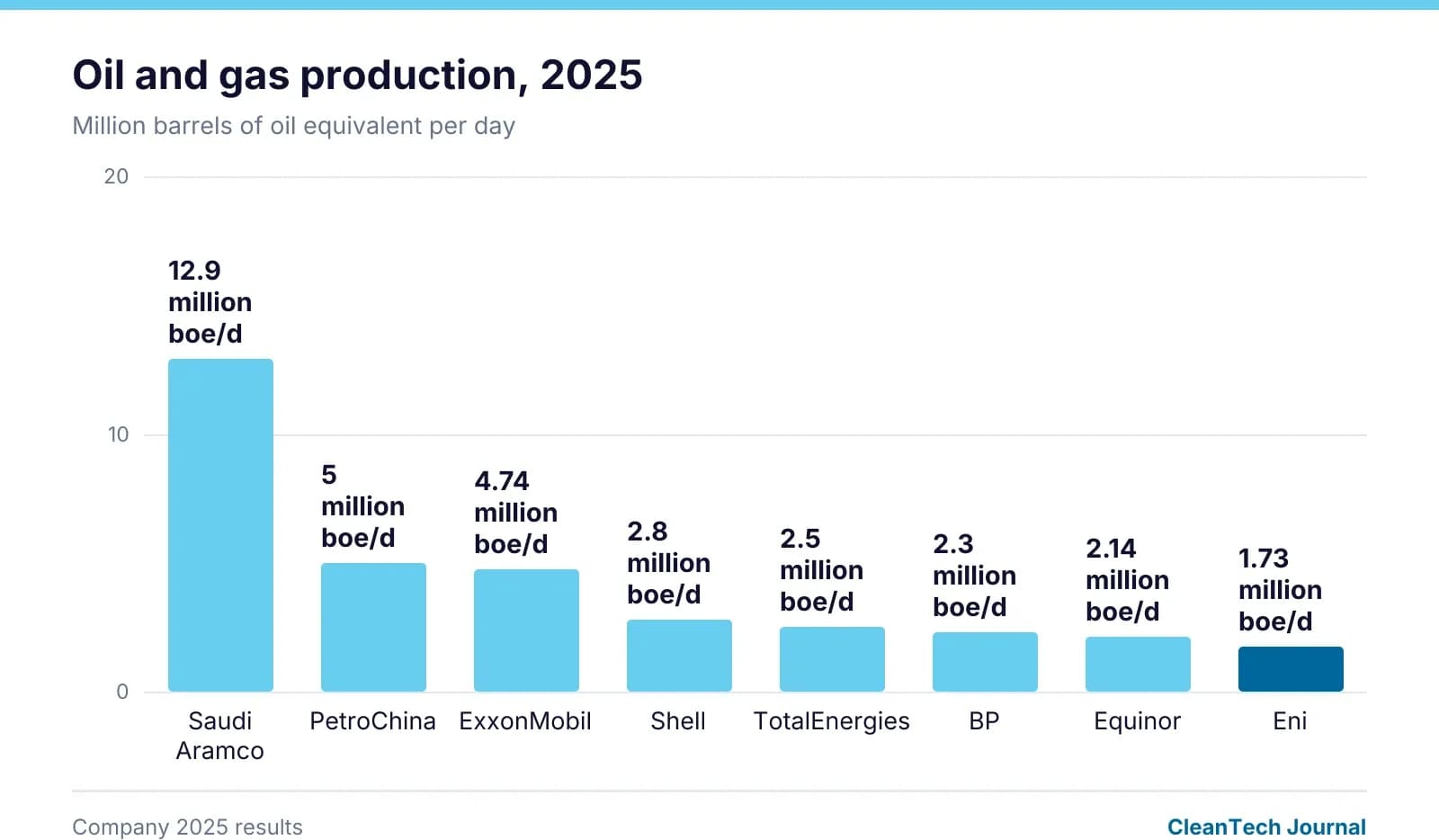
Aramco's total hydrocarbon production rose to 12.9 million barrels of oil equivalent per day in 2025, from 12.4 million. That is more than double the output of any other company on this list. Aramco brought its Marjan crude oil increment on stream during the year and started production at the Jafurah gas field, part of a plan to raise sales gas capacity by about 80% by 2030 from 2021 levels.
2. PetroChina
PetroChina, the listed arm of state-owned China National Petroleum Corporation (CNPC), reported revenue of RMB 2,864.5 billion in 2025, about $398.5 billion. That was 2.5% lower than in 2024, as oil and gas prices fell. Net profit attributable to shareholders dropped 4.5% to RMB 157.3 billion.
PetroChina's oil and gas output reached a record 1,841.9 million barrels of oil equivalent in 2025, up 2.5%, or about 5.0 million barrels per day. Its gas production grew 4.5%. The company also processed about 1.38 billion barrels of crude oil in its refineries and runs more than 22,000 fuel stations.
3. Sinopec
Sinopec (China Petroleum & Chemical Corporation) is one of the world's largest oil refiners. It reported operating revenue of RMB 2,783.6 billion in 2025, about $387.3 billion, down 9.5% from 2024. Profit attributable to shareholders fell 36.8% to RMB 31.8 billion under Chinese accounting standards, hit by weak chemical margins and growing competition from electric vehicles and other new energy.
Fuels dominate Sinopec's sales. Gasoline, diesel and kerosene brought in RMB 1,339.0 billion of revenue in 2025. Its oil and gas production reached a record 525.3 million barrels of oil equivalent, smaller than PetroChina's, because Sinopec's business is weighted toward refining and chemicals.
4. ExxonMobil
ExxonMobil, based in Spring, Texas, is the largest Western oil company. It reported total revenue of $332.2 billion for 2025 and earnings of $28.8 billion, down from $33.7 billion in 2024, according to its 2025 results.
Production averaged 4.74 million barrels of oil equivalent per day, the company's highest in more than 40 years. Growth came mainly from the Permian Basin in Texas and New Mexico and from offshore Guyana, where the Yellowtail project started up ahead of schedule. ExxonMobil returned $37.2 billion to shareholders during the year.
5. Shell
Shell, headquartered in London, reported total revenue of $273.7 billion for 2025, down from $289.1 billion in 2024. Adjusted earnings fell 22% to $18.5 billion as oil and liquefied natural gas (LNG) prices weakened.
Shell produced about 2.8 million barrels of oil equivalent per day in 2025 and is one of the world's largest LNG traders. During the year, it exited onshore Nigeria, Canadian oil sands and its Singapore refinery and chemicals business, while increasing its stakes in deepwater oil and LNG.
6. BP
BP, also based in London, reported total revenues and other income of $192.5 billion in 2025, almost unchanged from $194.6 billion a year earlier. Its underlying replacement cost profit fell 16% to $7.5 billion.
Production averaged about 2.3 million barrels of oil equivalent per day. BP started seven major oil and gas projects in 2025 and made 12 discoveries, including Bumerangue offshore Brazil, which it calls its largest find in 25 years. It also agreed to sell 65% of its Castrol lubricants business as it refocuses on oil and gas.
7. Chevron
Chevron, headquartered in Houston, reported total revenue of $189.0 billion for 2025, down 6.8% from $202.8 billion in 2024. Net income fell about 30% to $12.5 billion as lower oil prices offset higher production.
2025 was Chevron's first full year after completing its acquisition of Hess, which gave it a stake in Guyana's large offshore oil fields. Worldwide production rose 12% to a record, with U.S. output up 16%, helped by Hess and the Permian Basin. Chevron's proved reserves ended the year at about 10.6 billion barrels of oil equivalent.
8. TotalEnergies
France's TotalEnergies reported revenues from sales of $182.3 billion in 2025, or $201.2 billion including excise taxes. Adjusted net income fell 15% to $15.6 billion.
TotalEnergies produced 2.5 million barrels of oil equivalent per day in 2025, 46% of it gas, and is the world's third-largest LNG company. It is also building a large power business, with 39.7 gigawatts (GW) of gross electricity capacity, including 24.1 GW of renewables.
9. Equinor
Norway's Equinor, majority-owned by the Norwegian state, reported total revenues and other income of $106.5 billion in 2025, up from $103.8 billion in 2024. It was one of the few companies on this list to grow revenue.
Equinor's production reached a record 2.14 million barrels of oil equivalent per day, up 3.4%, helped by new fields such as Johan Castberg in the Barents Sea.
10. Eni
Italy's Eni reported total revenues of €83.6 billion in 2025, about $94.5 billion, down from €91.2 billion in 2024. Adjusted net profit fell 5% to €4.99 billion.
Eni produced 1.73 million barrels of oil equivalent per day in 2025 after starting six major projects in Angola, Indonesia, Norway and Congo. It is also building separate businesses around its transition activities, such as its renewable power and retail arm, Plenitude.
Why Revenue Fell at the World's Oil Giants
Lower oil prices were the main reason. Brent crude averaged about $69 a barrel in 2025, roughly 14.5% lower than in 2024. Most companies on this list reported lower revenue and profit, even though several, including Aramco, ExxonMobil, Chevron and PetroChina, produced record volumes.
Size also depends on business mix. Sinopec and PetroChina have huge revenue because they refine and sell most of China's fuel, while Aramco earns most of its money from producing crude oil. Aramco's 2025 net income of $93.4 billion was more than three times ExxonMobil's.
Frequently Asked Questions
What is the largest oil and gas company in the world?
Saudi Aramco, with $445.7 billion in 2025 revenue and 12.9 million barrels of oil equivalent per day of production. It is the largest by both revenue and output.
What are the top 10 oil and gas companies in the world?
By 2025 revenue: Saudi Aramco, PetroChina, Sinopec, ExxonMobil, Shell, BP, Chevron, TotalEnergies, Equinor and Eni.
What is the largest US oil company?
ExxonMobil, with $332.2 billion in 2025 revenue and record production of 4.74 million barrels of oil equivalent per day. Chevron is second with $189.0 billion.
Why are ADNOC and Kuwait Petroleum not on the list?
They are among the world's biggest oil producers, but they do not publish full annual income statements, so their revenue cannot be compared with the companies in this ranking.
Did oil companies make less money in 2025?
Most did. With Brent oil prices about 14.5% lower than in 2024, revenue and profit fell at Aramco, PetroChina, Sinopec, ExxonMobil, Shell, Chevron and TotalEnergies.
SOURCES
- Saudi Aramco: Full-year 2025 results press release
- PetroChina: 2025 annual results (via Barchart release)
- Sinopec: Annual results for the year ended 31 December 2025 (HKEX)
- ExxonMobil: 2025 results
- Shell plc: 4th quarter 2025 and full year results
- BP p.l.c.: Fourth quarter and full year 2025 results
- Chevron: Fourth quarter 2025 results
- TotalEnergies: Fourth quarter and full year 2025 accounts
- Equinor: Annual reports and key figures 2025
- Federal Reserve: G.5A annual foreign exchange rates
Written by
Suraj Kadam
Suraj Kadam is a journalist and Chief Editor of CleanTech Journal, a knowledge and media platform covering clean technology, solar energy, and renewable energy. He reports on emerging technologies, industry developments, policy trends, and innovations shaping the global clean energy transition. Through his editorial work, Suraj aims to make complex clean technology topics accessible to industry professionals, researchers, policymakers, and readers interested in sustainable energy. His work focuses on delivering insightful, informative, and engaging coverage of the evolving renewable energy landscape.