Top 10 Oil Companies in Europe Ranked by 2025 Revenue
The top 10 oil companies in Europe ranked by 2025 revenue, from Shell's $273.7 billion to MOL. See each company's profits, production and plans.

Suraj Kadam
Published •29 min read
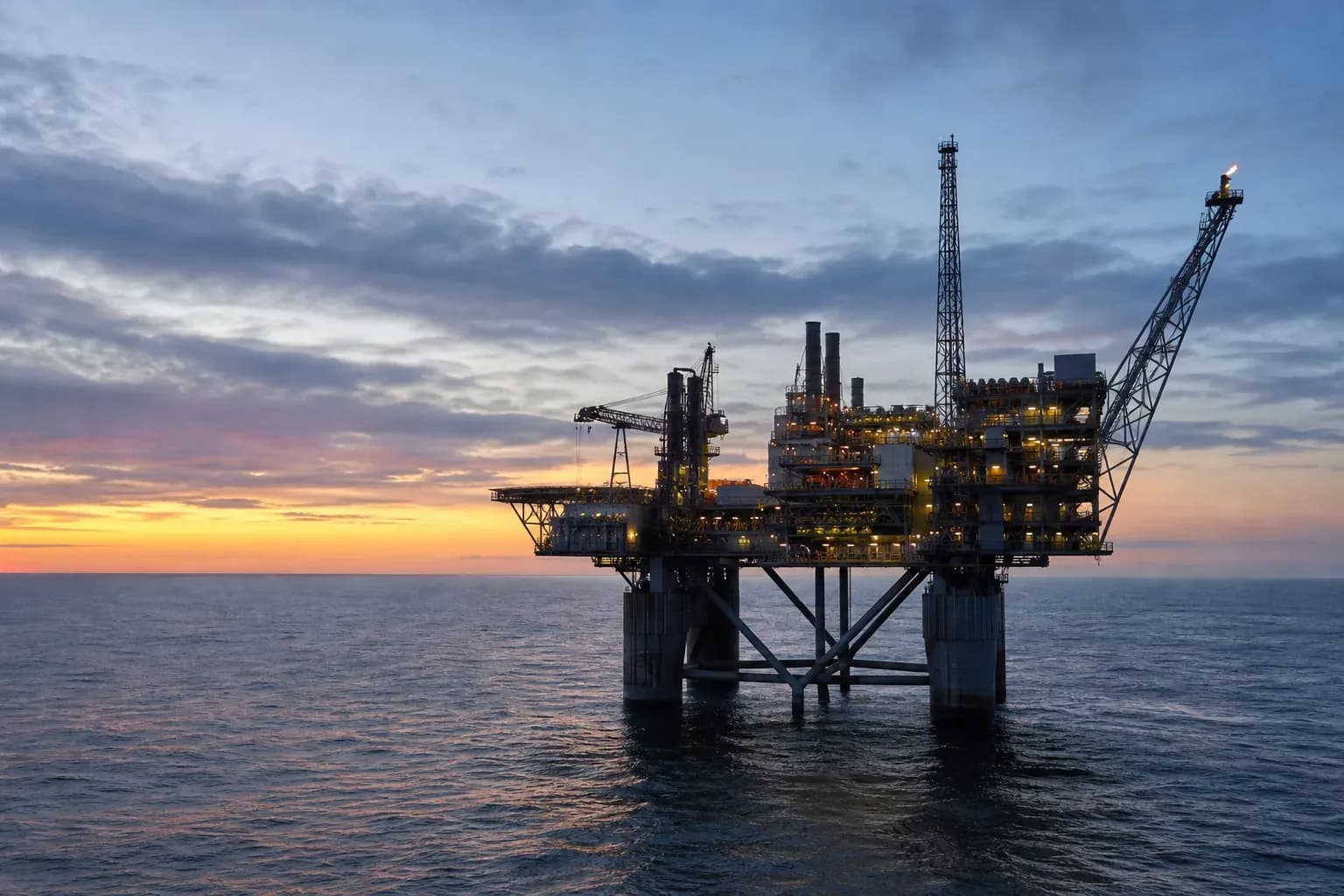
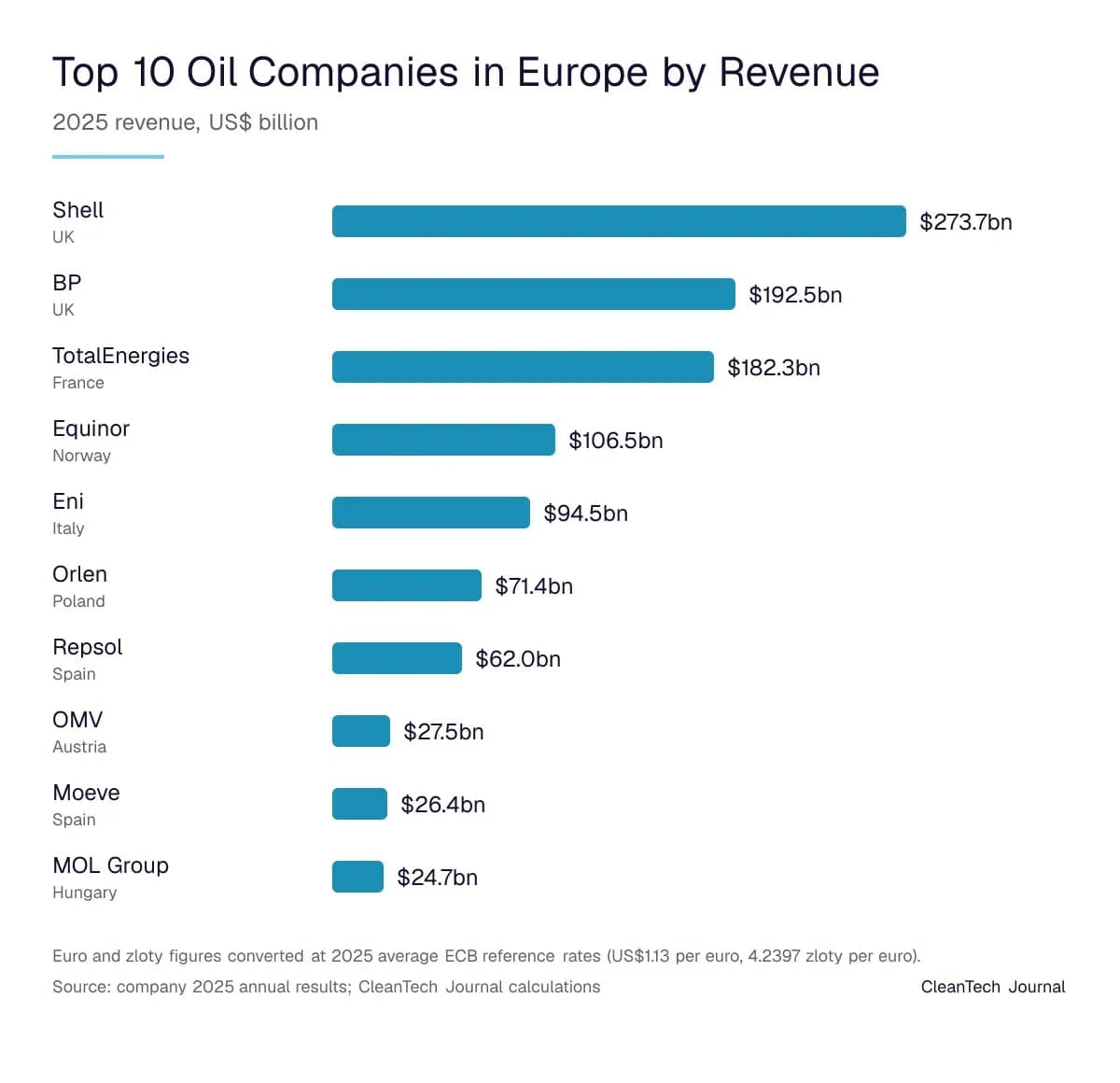
The top 10 oil companies in Europe are led by Shell, which reported $273.7 billion in revenue for 2025, more than any other European energy company. BP and TotalEnergies follow with more than $180 billion each, and Norway's Equinor is the only other European oil company above $100 billion.
We ranked Europe's largest oil and gas companies by their 2025 revenue, using each company's own annual results. Revenue fell at most of them in 2025 as the Brent oil price averaged $69.1 a barrel, 14.5% lower than in 2024, according to Repsol.
Top 10 Oil Companies in Europe at a Glance
Rank | Company | Headquarters | 2025 revenue (US$) | Reported revenue |
|---|---|---|---|---|
1 | Shell | UK | $273.7 billion | $273.7 billion |
2 | BP | UK | $192.5 billion | $192.5 billion |
3 | TotalEnergies | France | $182.3 billion | $182.3 billion |
4 | Equinor | Norway | $106.5 billion | $106.5 billion |
5 | Eni | Italy | $94.5 billion | €83.6 billion |
6 | Orlen | Poland | $71.4 billion | PLN 267.8 billion |
7 | Repsol | Spain | $62.0 billion | €54.9 billion |
8 | OMV | Austria | $27.5 billion | €24.3 billion |
9 | Moeve | Spain | $26.4 billion | €23.4 billion |
10 | MOL Group | Hungary | $24.7 billion | $24.7 billion |
CleanTech Journal calculations from company 2025 results. Euro and zloty figures are converted at 2025 average European Central Bank reference rates of $1.13 per euro and 4.2397 zloty per euro. Where a company reports "total revenues and other income," we use that line; TotalEnergies' figure excludes excise taxes.
How We Ranked Europe's Largest Oil Companies
We included oil and gas companies headquartered in the European Union, the UK and Norway, and ranked them by full-year 2025 revenue. Many of these groups also sell gas, power and chemicals, so revenue measures the size of the whole business, not oil alone.
We left out Russian companies such as Rosneft and Lukoil. Their reporting is limited under sanctions, so their figures are not comparable with the companies below. Just outside our top 10 are Portugal's Galp, with about $22.0 billion in 2025 revenue, and Finland's Neste, with about $21.5 billion, most of it from renewable fuels.
1. Shell
Shell, headquartered in London, is Europe's largest oil company by a wide margin. It reported total revenue of $273.7 billion for 2025, down from $289.1 billion in 2024, according to its 2025 full-year results. Adjusted earnings fell 22% to $18.5 billion as oil and LNG prices weakened.
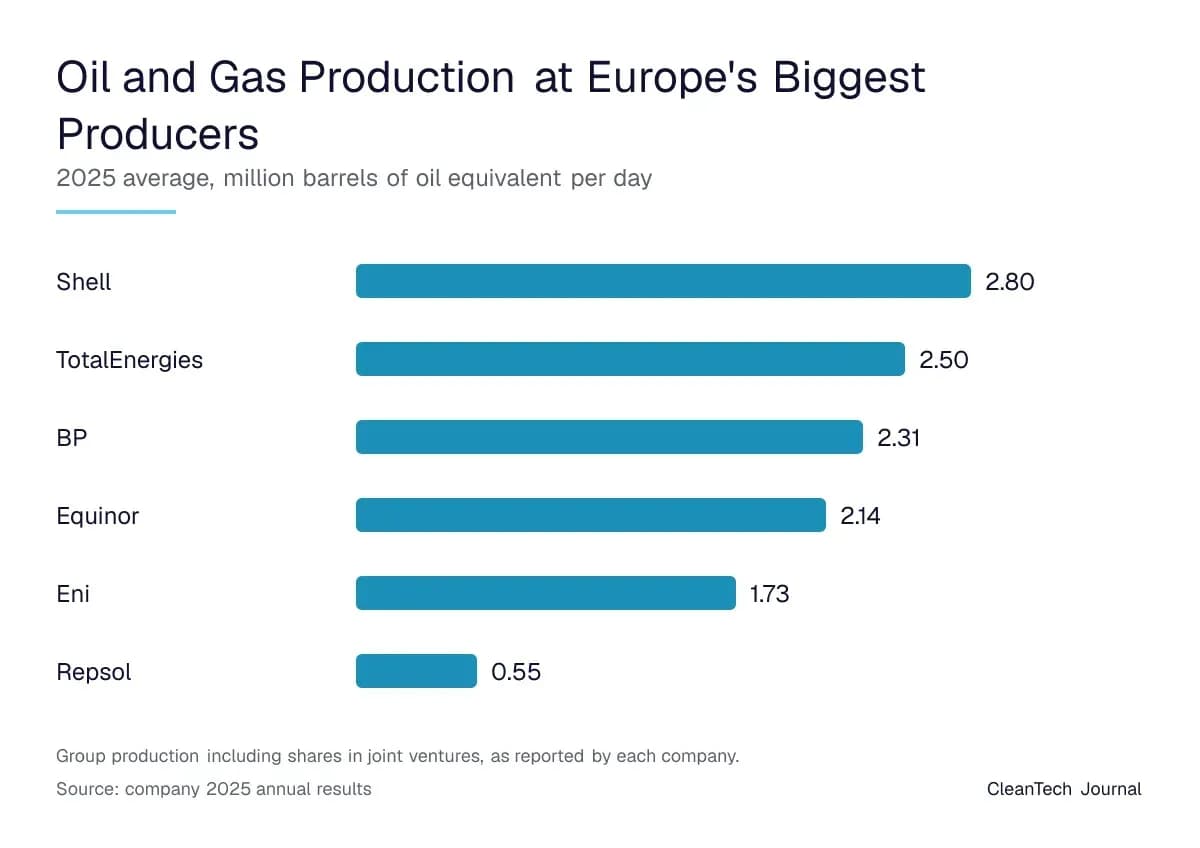
Shell produced about 2.8 million barrels of oil equivalent per day in 2025 and is one of the world's biggest liquefied natural gas (LNG) traders. During the year it exited onshore Nigeria, Canadian oil sands and its Singapore chemicals and refinery business, while increasing its stakes in deepwater oil and LNG. Cash capital spending was $20.9 billion.
2. BP
BP, also based in London, reported total revenues and other income of $192.5 billion in 2025, almost unchanged from $194.6 billion a year earlier. Its underlying replacement cost profit, the measure BP uses for underlying earnings, fell 16% to $7.5 billion.
Production averaged about 2.3 million barrels of oil equivalent per day. BP started up seven major oil and gas projects in 2025 and made 12 discoveries, including Bumerangue offshore Brazil, which the company calls its largest find in 25 years. It also agreed to sell 65% of its Castrol lubricants business as it narrows its focus on oil and gas.
3. TotalEnergies
France's TotalEnergies reported revenues from sales of $182.3 billion in 2025, or $201.2 billion including excise taxes. Adjusted net income fell 15% to $15.6 billion, but its return on average capital employed of 12.6% was the highest among the oil majors for the fourth year running, the company says.
TotalEnergies produced 2.5 million barrels of oil equivalent per day in 2025, 46% of it gas, and is the world's third-largest LNG company. It is also building a large power business, with 39.7 gigawatts (GW) of gross installed electricity capacity, including 24.1 GW of renewables. It invested $17.1 billion in 2025, about $3.5 billion of it in low-carbon energy.
4. Equinor
Norway's Equinor, majority-owned by the Norwegian state, reported total revenues and other income of $106.5 billion in 2025, up from $103.8 billion in 2024, according to its key figures. It was the only company in our top 10 to grow revenue.
Equinor's production reached a record 2.14 million barrels of oil equivalent per day, up 3.4%, helped by new fields such as Johan Castberg in the Barents Sea. Adjusted net income was $6.43 billion. The company paid $20.5 billion in corporate income taxes in 2025, $19.7 billion of it in Norway.
5. Eni
Italy's Eni reported total revenues of €83.6 billion in 2025, about $94.5 billion, down from €91.2 billion in 2024. Adjusted net profit fell 5% to €4.99 billion.
Eni produced 1.73 million barrels of oil equivalent per day in 2025, ahead of its target, after starting six major projects in Angola, Indonesia, Norway and Congo. It is also building separate businesses around its transition activities: investment firm Ares paid €2 billion for a 20% stake in Plenitude, Eni's renewable power and retail arm.
6. Orlen
Poland's Orlen is Central Europe's largest oil company. It reported revenue of PLN 267.8 billion in 2025, about $71.4 billion, down 9% from PLN 294.9 billion as fuel prices fell. Net profit rose to PLN 11.2 billion.
Orlen is more than a refiner. Its businesses span oil and gas production, refining and petrochemicals, power generation and distribution, and fuel retail. Poland accounted for 64% of its 2025 revenue, and the group spent more than PLN 32 billion on investment during the year, including offshore wind.
7. Repsol
Spain's Repsol reported sales of €54.4 billion in 2025, plus €0.4 billion of service and other income, for a total of about $62.0 billion. Net income rose 8.1% to €1.9 billion, while adjusted net income fell 15.1% to €2.57 billion.
Repsol produced about 548,000 barrels of oil equivalent per day in 2025. It is one of Europe's leading makers of renewable fuels: it runs a renewable fuels plant in Cartagena, is building a second in Puertollano due to start in 2026, and sold 100% renewable diesel at 1,558 service stations in Spain and Portugal by the end of 2025.
8. OMV
Austria's OMV reported sales revenues of €24.3 billion in 2025, about $27.5 billion, down 7% from €26.2 billion, mainly because of lower gas marketing volumes. Its clean CCS operating result, OMV's main earnings measure, fell 10% to €4.6 billion.
OMV combines oil and gas production, refining and chemicals. It owns 75% of chemicals maker Borealis and 51.2% of Romania's OMV Petrom, and has about 22,300 employees. Its hydrocarbon sales volumes averaged 288,000 barrels of oil equivalent per day in 2025.
9. Moeve
Moeve, the Spanish company formerly known as Cepsa, reported revenue of €23.4 billion in 2025, about $26.4 billion, down from €24.9 billion in 2024. Net profit almost quadrupled to €341 million, and adjusted EBITDA was €1.69 billion.
Moeve runs refineries, chemicals plants and service stations in Spain and Portugal, alongside oil production. It is shifting toward green hydrogen and sustainable aviation fuel, and in 2025 approved its flagship green hydrogen project in Andalusia. It is also in talks with Galp to combine their downstream businesses.
10. MOL Group
Hungary's MOL Group reported net sales revenues of $24.7 billion in 2025, or HUF 8,696 billion, down from $25.1 billion in 2024. Profit before tax fell 11% to $1.3 billion.
MOL produced an average of 94,700 barrels of oil equivalent per day in 2025 and processed 14.6 million tons of crude oil in its refineries, 1.2 million tons more than in 2024. Its retail business has grown alongside its fuel sales, with 1,409 Fresh Corner convenience stores by the end of 2025.
Why Revenue Fell at Most European Oil Companies
Lower oil prices were the main reason. Brent crude averaged $69.1 a barrel in 2025, down 14.5% from 2024. Nine of the 10 companies reported lower revenue than in 2024, and most saw their main earnings measure fall.
Production held up better than prices. Equinor, Eni and TotalEnergies all grew output, and BP held production broadly flat on an underlying basis. A stronger euro against the dollar also reduced the euro value of dollar-priced oil sales for companies such as Eni and Repsol.
Europe's oil companies are also changing shape. Several are expanding in power, renewable fuels and low-carbon energy, while others, including BP and Shell, have refocused on oil and gas. Readers interested in the energy transition side of these companies can also see our ranking of the top 10 hydrogen companies in the world.
Frequently Asked Questions
What is the largest oil company in Europe?
Shell is the largest oil company in Europe by revenue, with $273.7 billion in 2025. BP was second with $192.5 billion and TotalEnergies third with $182.3 billion.
What are the top 10 oil companies in Europe?
By 2025 revenue: Shell, BP, TotalEnergies, Equinor, Eni, Orlen, Repsol, OMV, Moeve and MOL Group.
Which European oil company produces the most oil and gas?
Shell, at about 2.8 million barrels of oil equivalent per day in 2025, followed by TotalEnergies at 2.5 million and BP at about 2.3 million.
Why are Russian oil companies not included?
Russian companies such as Rosneft and Lukoil report limited data under sanctions, so their figures are not comparable with the European companies in this ranking.
Did European oil companies make less money in 2025?
Most did. With Brent oil prices 14.5% lower than in 2024, nine of the top 10 reported lower revenue, and adjusted profits fell at Shell, BP, TotalEnergies, Eni and Repsol.
SOURCES
- Shell plc: 4th quarter 2025 and full year results
- BP p.l.c.: Fourth quarter and full year 2025 group results
- TotalEnergies: Fourth quarter and full year 2025 accounts
- Equinor: Annual reports and key figures 2025
- Eni: Key figures 2025
- ORLEN Group: Financial performance 2025
- Repsol: Q4 and FY 2025 results
- OMV: Combined Annual Report 2025
- Moeve: Consolidated annual accounts 2025
- MOL Group: Integrated Annual Report 2025
Written by
Suraj Kadam
Suraj Kadam is a journalist and Chief Editor of CleanTech Journal, a knowledge and media platform covering clean technology, solar energy, and renewable energy. He reports on emerging technologies, industry developments, policy trends, and innovations shaping the global clean energy transition. Through his editorial work, Suraj aims to make complex clean technology topics accessible to industry professionals, researchers, policymakers, and readers interested in sustainable energy. His work focuses on delivering insightful, informative, and engaging coverage of the evolving renewable energy landscape.