Best-Selling Electric Cars in the World: The 2025 Top 10
The Tesla Model Y tops the best-selling electric cars in the world, with 1.08 million sales in 2025. See the full top 10 and why Chinese brands dominate.

Suraj Kadam
Published •24 min read
The best-selling electric cars in the world are led by one model by a wide margin: the Tesla Model Y, which sold more than 1.08 million units in 2025. That was more than twice the total of the next car on the list, Tesla's own Model 3.
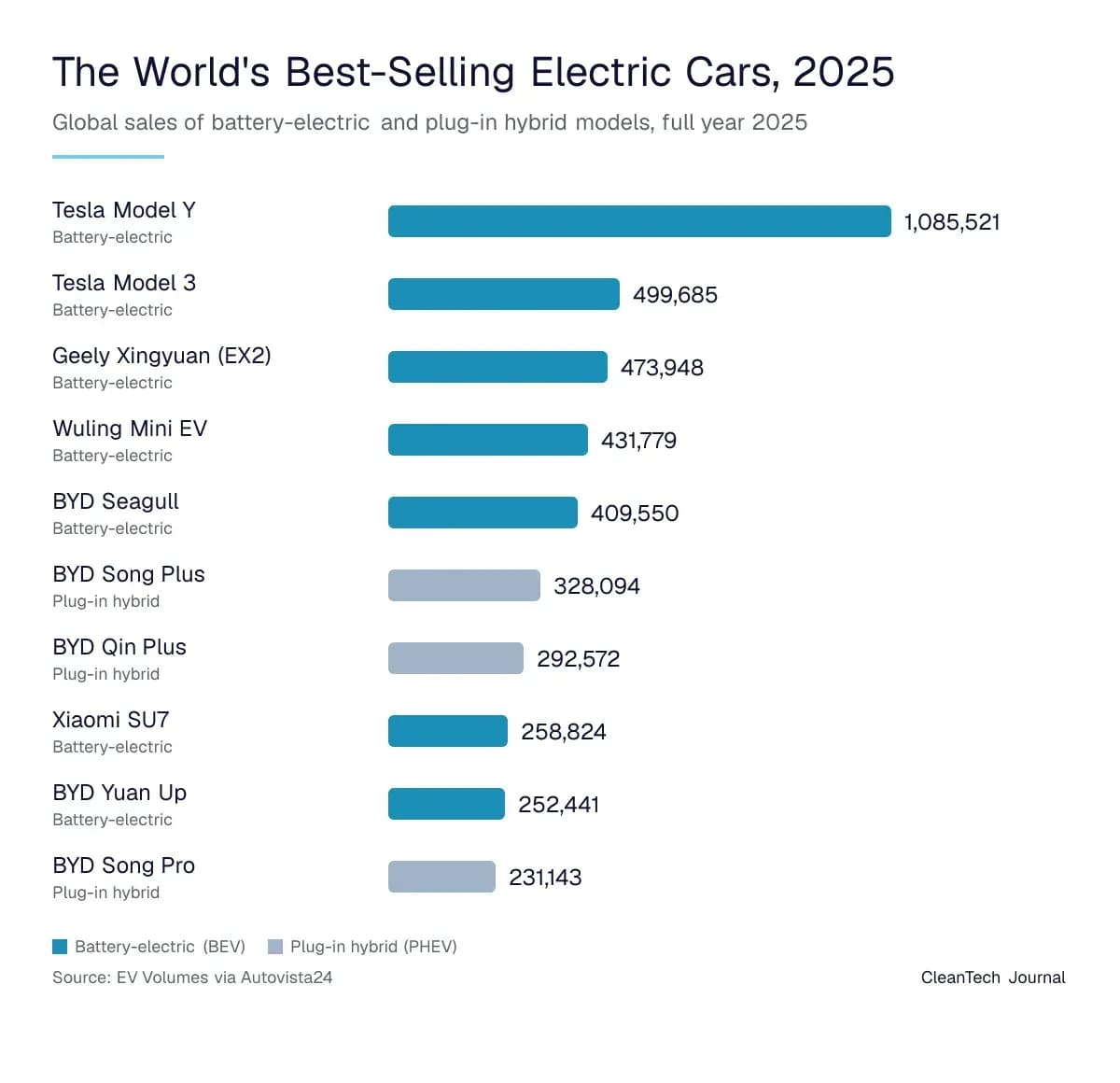
Behind the two Teslas, the global top 10 is dominated by Chinese brands. BYD alone has five models in the ranking, and newer arrivals from Geely and Xiaomi are climbing fast. The figures below are full-year 2025 sales of battery-electric (BEV) and plug-in hybrid (PHEV) cars, from data firm EV Volumes as published by Autovista24.
The Best-Selling Electric Cars in the World in 2025
Rank | Model | Type | 2025 sales | Change vs 2024 |
|---|---|---|---|---|
1 | Tesla Model Y | BEV | 1,085,521 | -7.5% |
2 | Tesla Model 3 | BEV | 499,685 | -5.5% |
3 | Geely Xingyuan (EX2) | BEV | 473,948 | +800% |
4 | Wuling Mini EV | BEV | 431,779 | +65.3% |
5 | BYD Seagull (Dolphin Surf) | BEV | 409,550 | -13.3% |
6 | BYD Song Plus (Seal U) | PHEV | 328,094 | -9.8% |
7 | BYD Qin Plus | PHEV | 292,572 | -15.9% |
8 | Xiaomi SU7 | BEV | 258,824 | +85.3% |
9 | BYD Yuan Up (Atto 2) | BEV | 252,441 | +84.2% |
10 | BYD Song Pro | PHEV | 231,143 | -22.0% |
Global sales data from EV Volumes, via Autovista24. Names in brackets are those used in export markets. The ranking combines EV Volumes' separate BEV and PHEV top-10 lists; together these 10 models sold about 4.26 million cars.
A Closer Look at Each Model
1. Tesla Model Y
The Model Y won the global best-seller title for the fourth year in a row in 2025. Its sales of 1,085,521 were down 7.5% from 2024, but no rival came close.
2. Tesla Model 3
The Model 3 sedan sold 499,685 units, down 5.5%. Together, Tesla's two main models accounted for about 1.59 million sales.
3. Geely Xingyuan (EX2)
Geely's small electric hatchback was the breakout of 2025. Its sales rose about ninefold to 473,948, taking it to third place worldwide.
4. Wuling Mini EV
The tiny city car from SAIC-GM-Wuling sold 431,779 units, up 65.3%.
5. BYD Seagull (Dolphin Surf)
BYD's compact hatchback sold 409,550 units. It is sold as the Dolphin Surf in Europe and is BYD's best-selling battery-electric model.
6. BYD Song Plus (Seal U)
The Song Plus was the world's best-selling plug-in hybrid, with 328,094 sales. The SUV is sold as the Seal U in Europe.
7. BYD Qin Plus
The Qin Plus sedan sold 292,572 units as a plug-in hybrid, making it the second-best-selling PHEV of 2025.
8. Xiaomi SU7
The smartphone maker's first car sold 258,824 units, up 85.3% in only its second year on sale.
9. BYD Yuan Up (Atto 2)
BYD's small SUV sold 252,441 units, up 84.2%. It is sold as the Atto 2 outside China.
10. BYD Song Pro
The Song Pro plug-in hybrid SUV rounds out the top 10 with 231,143 sales.
Why Chinese Brands Dominate the List
China is by far the world's largest electric car market. According to the International Energy Agency, electric cars made up nearly 55% of car sales in China in 2025, compared with 28% in Europe and just under 10% in the United States.
That scale explains why eight of the 10 best-selling electric cars in the world come from Chinese brands. Most of those models sell mainly in China, while the Tesla Model Y and Model 3 sell in large numbers across China, Europe and North America.
Small, affordable models are also doing well. The Wuling Mini EV, BYD Seagull and Geely Xingyuan, all budget city cars, together sold more than 1.3 million units.
How Big the Global EV Market Is
Electric car sales grew 20% to more than 20 million in 2025, about one in four new cars sold worldwide, the IEA reports. The agency expects sales to reach about 23 million in 2026, or 28% of the global car market.
The top 10 models alone accounted for roughly a fifth of global electric car sales in 2025. That leaves room for hundreds of other models, many of them new launches from Chinese brands.
What Is Selling in 2026
Early data suggests the order at the top of the best-selling electric cars in the world is holding. Through August 2026, the Tesla Model Y was again the world's best-selling electric car, outselling the second-place BYD Song by about two to one, with the Geely Xingyuan in third, according to monthly tracking by CleanTechnica. Plug-in cars made up 27% of global car sales in August.
Frequently Asked Questions
What is the best-selling electric car in the world?
The Tesla Model Y, with 1,085,521 sales in 2025, according to EV Volumes. It was also the leader through August 2026.
Which company sells the most electric cars?
BYD. It sold 3,967,070 electric cars in 2025, including plug-in hybrids, about 19% of the global market, according to EV Volumes. Tesla sold 1,635,753 but has the two best-selling individual models.
What is the best-selling plug-in hybrid in the world?
The BYD Song Plus, sold as the Seal U in Europe, with 328,094 sales in 2025.
Are the best-selling electric cars in the world sold in the US?
Only the Tesla Model Y and Model 3 from the top 10 are widely sold in the United States. The Chinese models are sold mainly in China, with some in Europe, Latin America and Asia.
How many electric cars were sold worldwide in 2025?
More than 20 million, up 20% from 2024, according to the International Energy Agency.
SOURCES
- Autovista24: The world's best-selling new BEVs and PHEVs of 2025
- Autovista24: Which brand sold the most EVs in 2025?
- IEA: Global EV Outlook 2026, executive summary
- CleanTechnica: Top selling EVs in the world, August 2026
- CleanTechnica: 20 best selling EV models in the world in 2025
Written by
Suraj Kadam
Suraj Kadam is a journalist and Chief Editor of CleanTech Journal, a knowledge and media platform covering clean technology, solar energy, and renewable energy. He reports on emerging technologies, industry developments, policy trends, and innovations shaping the global clean energy transition. Through his editorial work, Suraj aims to make complex clean technology topics accessible to industry professionals, researchers, policymakers, and readers interested in sustainable energy. His work focuses on delivering insightful, informative, and engaging coverage of the evolving renewable energy landscape.