Can You Sell Solar Power Back to the Grid? Net Metering Explained
Net metering lets you sell solar power back to the grid for bill credits. See how it works, how net billing differs and what your exports could be worth.

Suraj Kadam
Published •14 min read
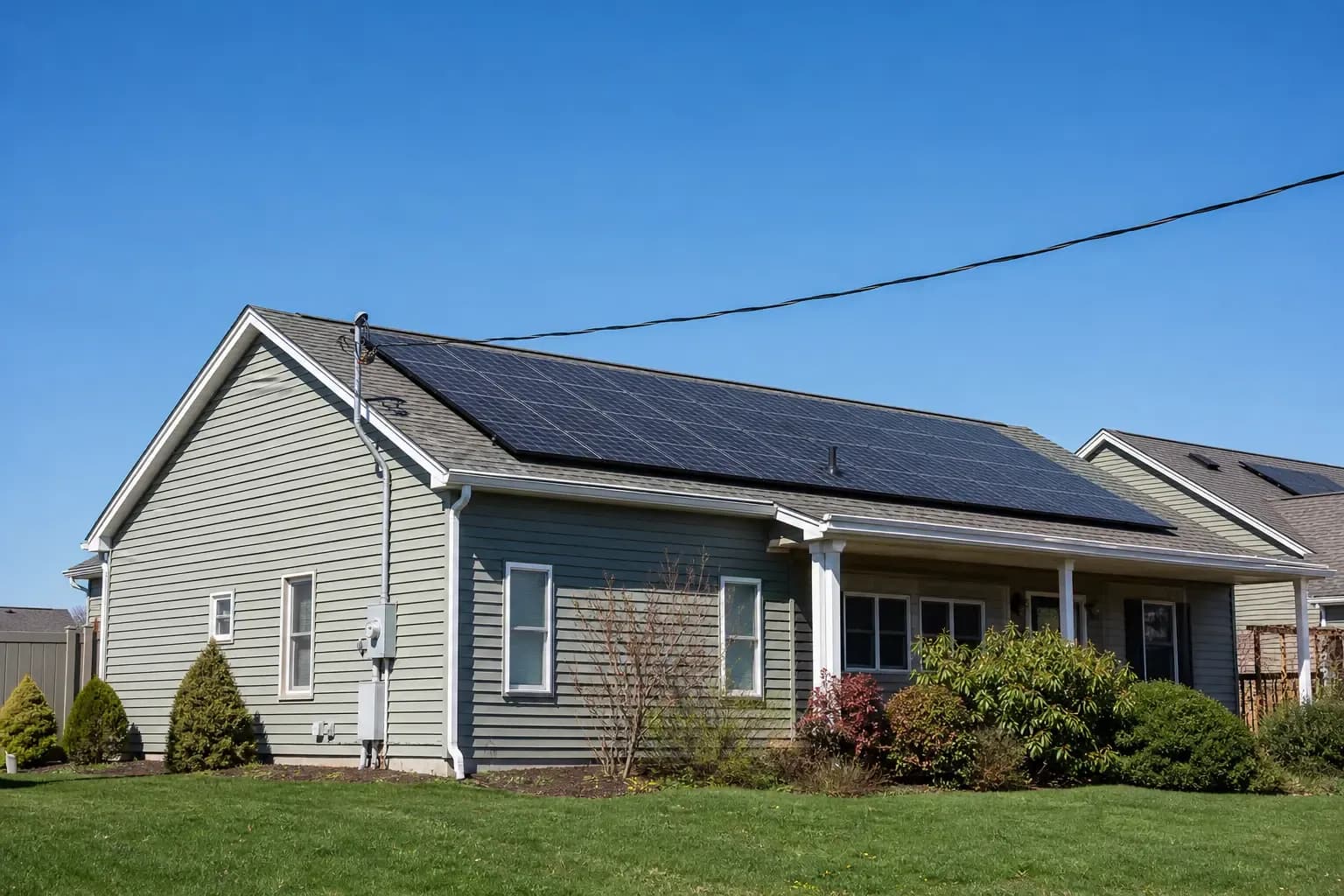
It is noon on a clear day, your rooftop panels are producing more power than your home can use, and the meter is quietly running the other way. That is net metering at work, and it is the main way US homeowners get paid for the solar power they send back to the grid.
The short answer to the question is yes, you can sell solar power back to the grid in most of the country. But how much you earn depends on your state and utility, and a growing number of them are switching to less generous net billing.
How Net Metering Works
The Solar Energy Industries Association describes it as a utility billing arrangement that credits solar customers for the excess electricity they send to the grid. Those credits can then be used to pay for power you draw from the grid later, such as at night or on cloudy days.
In a typical day, it works like this:
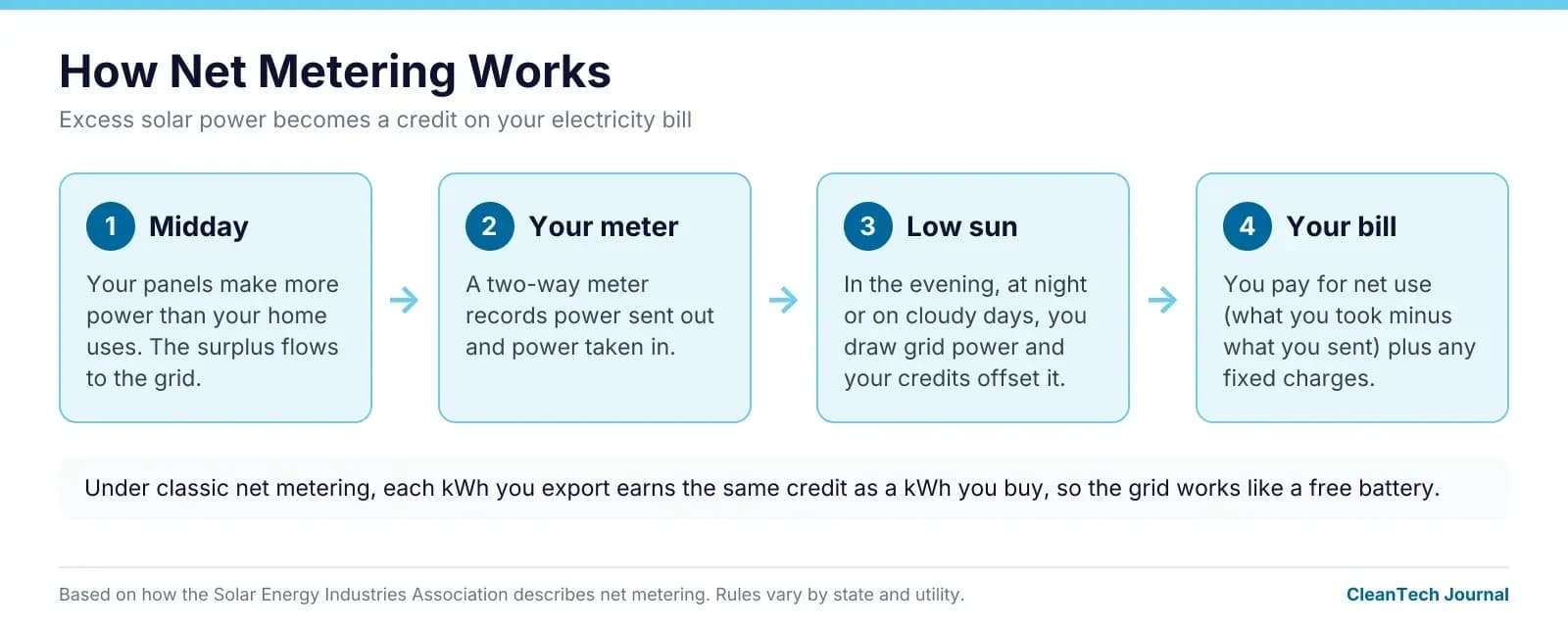
- Midday: your panels produce more than you use, and the surplus flows to the grid
- Your meter: records both the power you send out and the power you take in
- Low sun: in the evening, at night or on cloudy days, you draw power from the grid and your credits offset it
- Your bill: you pay for your net use, the difference between what you took and what you sent, plus any fixed monthly charges
Under the classic system, each kilowatt-hour you export earns the same credit as a kilowatt-hour you buy, so the grid works like a free battery.
Net Metering vs Net Billing
Net billing, sometimes called a successor tariff, pays for exports at a lower rate than you pay for imports. Instead of the full retail price, exported power is credited at a value based on what it is worth to the utility at that time.
Net metering | Net billing | |
|---|---|---|
Credit for exported power | Same as the retail rate | Usually lower, based on value to the grid |
How often use is netted | Usually over the month | Often hourly or instantly |
Value of a home battery | Lower | Higher, since stored power can be used at home or exported at peak times |
The shift is well under way. The NC Clean Energy Technology Center counted 217 distributed solar policy actions across 45 states, Washington, DC and Puerto Rico in the third quarter of 2025 alone, with net metering the most active topic. New net billing tariffs typically net use instantly or hourly, rather than over the standard monthly interval.
What California's Change Shows
California is the best-known example. According to the California Public Utilities Commission, customers applying to connect since April 15, 2023 take service on a net billing tariff, which credits exported energy at values from its Avoided Cost Calculator. The CPUC says these values are usually lower than import rates.
Older customers on the previous tariff, known as NEM 2.0, can keep it for 20 years from interconnection. The CPUC notes that export credits under net billing can be higher than the retail rate on late summer evenings, which is why many new solar buyers in the state now add a battery.
Worked Example: Net Metering vs Net Billing
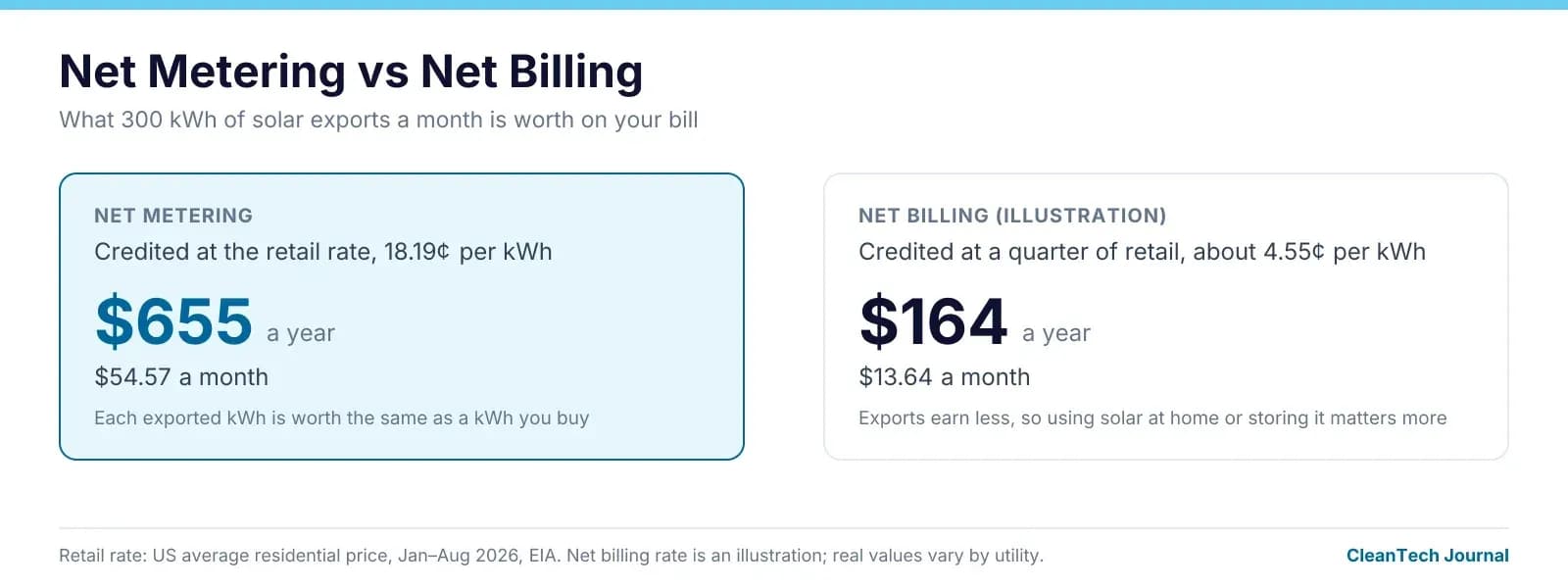
To see the difference, take a home whose solar panels send 300 kWh a month to the grid. We used the US average residential electricity price for the first eight months of 2026, 18.19 cents per kWh, from the US Energy Information Administration.
Under full retail credit, those 300 kWh earn credits at the full retail rate: $54.57 a month, or about $655 a year.
Under net billing, suppose exports are credited at a quarter of the retail rate, about 4.55 cents per kWh. The same 300 kWh would earn $13.64 a month, or about $164 a year. This rate is an illustration only; actual export values vary by utility, season and time of day.
The gap explains why, under net billing, it pays to use more of your solar power at home, for example by running appliances or charging an EV at midday, or by storing it in a battery.
How to Find Out What Your Utility Pays
These rules are set by states and utilities, so the only way to know your export rate is to check locally.
- Look up your utility's solar or distributed generation tariff on its website
- Check your state public utility commission for recent net metering decisions
- Ask installers to show savings under your utility's current tariff, not an old one
- Find out whether you are locked in for a set number of years once connected
Frequently Asked Questions
Do I need a special meter to sell solar power?
Usually, yes. Your utility will typically install or reprogram a bidirectional meter that records power flowing both into and out of your home. This is often done as part of the interconnection process after your system is installed.
Can I get a check for excess solar credits?
Sometimes. Some utilities pay out unused credits once a year, often at a low wholesale rate, while others roll credits forward or let them expire. Check how your utility handles credits at the end of the billing year.
Can home batteries export under these rules?
Rules differ. Many utilities allow batteries charged by solar to export, but some restrict exports from batteries charged by the grid. Your interconnection agreement will set out what is allowed.
Will my export rate change after I install solar?
Many states protect existing customers for a set period, such as the 20 years California gives NEM 2.0 customers. Future changes often apply only to new customers, but the terms differ by state, so check before you sign.
Is solar still worth it without net metering?
It can be. Under net billing, savings come mainly from using your own solar power instead of buying it, so homes with high daytime use, high electricity prices or a battery tend to benefit most.
SOURCES
- California Public Utilities Commission – Net Energy Metering and Net Billing
- US Energy Information Administration – Electric Power Monthly, Table 5.6.B
- NC Clean Energy Technology Center – The 50 States of Solar, Q3 2025
- Solar Energy Industries Association – Net Metering
Written by
Suraj Kadam
Suraj Kadam is a journalist and Chief Editor of CleanTech Journal, a knowledge and media platform covering clean technology, solar energy, and renewable energy. He reports on emerging technologies, industry developments, policy trends, and innovations shaping the global clean energy transition. Through his editorial work, Suraj aims to make complex clean technology topics accessible to industry professionals, researchers, policymakers, and readers interested in sustainable energy. His work focuses on delivering insightful, informative, and engaging coverage of the evolving renewable energy landscape.