How Much Does It Cost to Charge an EV at Home vs a Public Charger?
The cost to charge an EV at home is less than half the price of public charging. See AAA's 2026 cost per mile, yearly totals and ways to pay less.

Suraj Kadam
Published •15 min read
The cost to charge an EV depends far more on where you plug in than on the car you drive. Charging at home costs well under half as much as using public chargers, according to AAA's 2026 analysis of electric vehicle running costs.
AAA put the average US home electricity price at 17.45 cents per kWh in March 2026, compared with 41.8 cents per kWh at public charging stations. That gap shapes almost everything about what an EV costs to run.
Cost to Charge an EV at Home vs a Public Charger
AAA's testing, published in May 2026, translated those prices into a cost per mile for an average battery electric vehicle in mild 75°F weather:
Home charging | Public charging | |
|---|---|---|
Electricity price | 17.45¢ per kWh | 41.8¢ per kWh |
Cost per mile, average EV | About 5.6¢ | About 13.3¢ |
Cost per mile, Tesla Model Y | About 5.2¢ | About 12.4¢ |
In other words, every mile driven on public charging costs about 2.4 times as much as a mile charged at home.
What a Year of Driving Costs
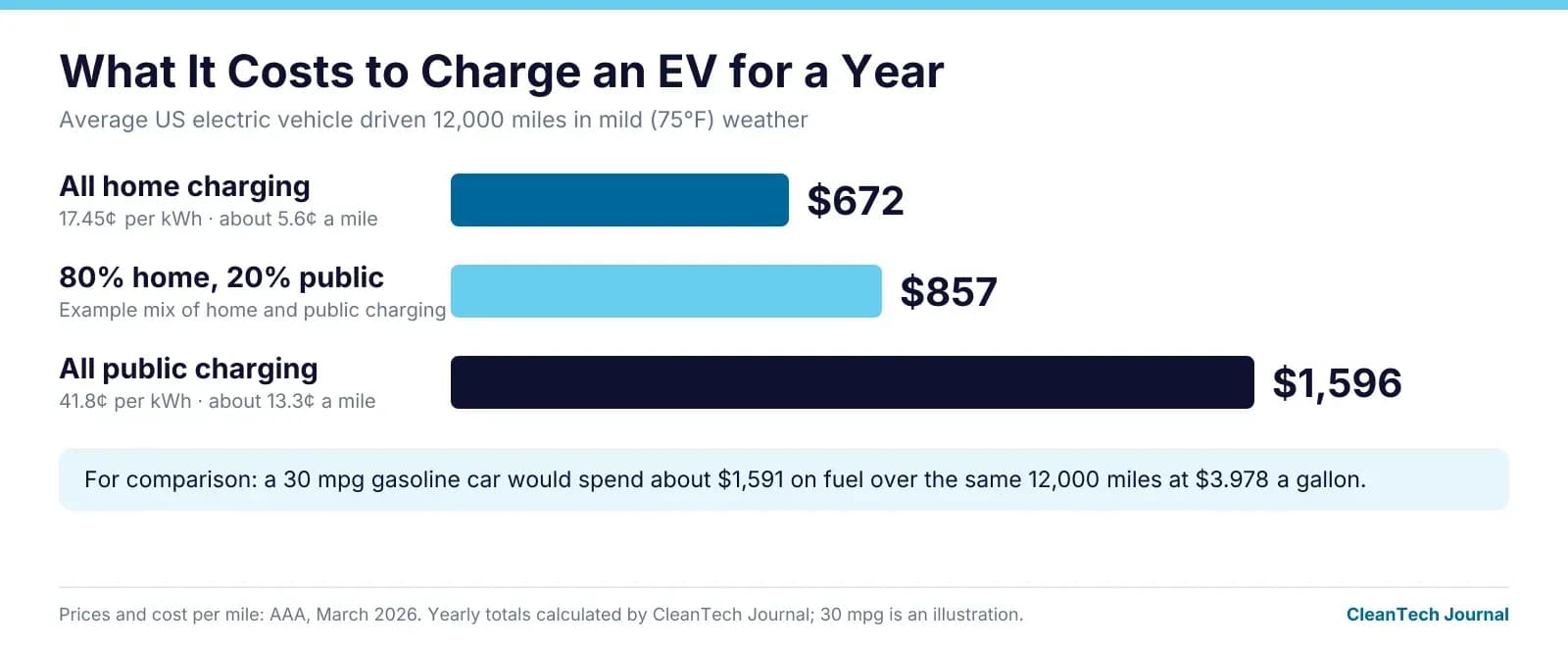
Take a driver who covers 12,000 miles a year in an average EV. We worked out the annual electricity bill using AAA's cost per mile:
- All home charging: about $672 a year
- 80% home, 20% public (an example mix): about $857 a year
- All public charging: about $1,596 a year
The difference between charging only at home and relying only on public stations is about $924 a year. For comparison, a gasoline car averaging 30 miles per gallon would spend about $1,591 on fuel over the same distance at AAA's March 2026 national average of $3.978 a gallon, almost the same as an EV that charges only at public stations.
Why Public Charging Costs More
Public fast chargers are expensive to build and run. Operators pay for high-power equipment, grid connections and site leases, and many face utility demand charges based on their peak power use, all of which is reflected in the price.
Pricing also varies more than at home. The US Department of Energy's fueleconomy.gov notes that public stations may charge per kWh, per minute, per session or through a monthly subscription. Some are free, while drivers without a membership may pay a higher guest rate.
How Cold Weather Changes the Cost
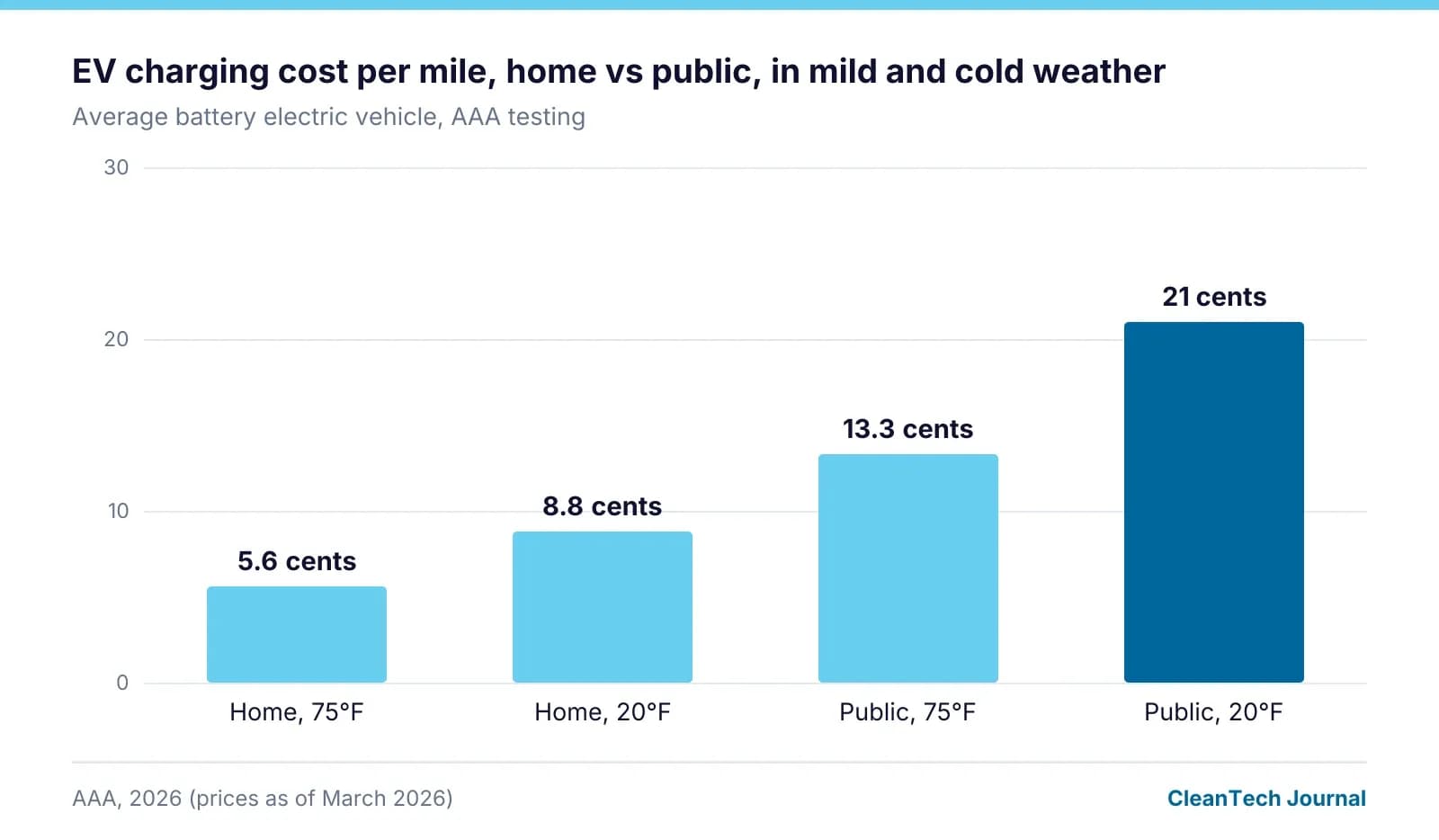
Winter raises the cost to charge an EV wherever you plug in, because batteries and cabin heating use more energy in the cold. In AAA's testing at 20°F, the average EV's cost rose to about 8.8 cents per mile at home and 21 cents per mile on public chargers.
Over 12,000 miles at those winter rates, that would be about $1,056 a year charging at home and $2,520 on public chargers. Real annual costs fall somewhere in between, since few places are that cold all year.
Home Charging: Level 1 or Level 2?
Speed matters as much as price. According to fueleconomy.gov:
- Level 1 (a standard 120-volt outlet): about 5 miles of range per hour
- Level 2 (240 volts): about 25 miles of range per hour on average, ranging from a few miles to around 40 depending on the car
- DC fast charging (public): about 100 to 200 or more miles of range in 30 minutes
The Department of Energy's Alternative Fuels Data Center says many drivers can cover their daily range with Level 1 charging overnight, at no extra cost if a suitable outlet is nearby. A Level 2 charger may need a new circuit installed by an electrician, though state and utility incentives can help with the cost.
Ways to Cut the Cost to Charge an EV
- Charge at home whenever you can. It is the single biggest saving.
- Ask your utility about time-of-use rates. The Department of Energy notes that some utilities offer cheaper rates or incentives for home charging at certain times.
- Use public fast chargers for road trips, not daily top-ups.
- Compare membership plans if you rely on one public network often, since members usually pay less than guests.
- Precondition the battery while plugged in during winter, so less energy is drawn from the battery on the road.
Frequently Asked Questions
How much does it cost to fully charge an EV at home?
Multiply your battery size by your electricity rate. For example, adding 60 kWh at AAA's average home rate of 17.45 cents per kWh would cost about $10.47, before any small losses during charging. Your own rate on your utility bill will give a more exact figure.
Is it cheaper to charge an EV at night?
Often, yes, if your utility offers a time-of-use plan with lower overnight rates. On a flat-rate plan, the time of day makes no difference to the price.
Are there free public EV chargers?
Some workplaces, retailers, hotels and cities offer free charging, usually at Level 2 speeds. Free fast charging is less common and is sometimes included for a limited period with a new EV purchase.
Does fast charging cost more than Level 2 public charging?
Usually. DC fast chargers deliver power much faster and cost more to install and operate, so their prices per kWh tend to be higher than slower Level 2 public chargers.
Do I need a Level 2 charger at home?
Not always. Drivers with short daily commutes can often manage with a standard outlet overnight. A Level 2 charger makes sense if you drive long distances daily or want to recharge fully in a few hours.
SOURCES
- AAA – EV vs Hybrid Efficiency Research Report, 2026
- US Department of Energy, fueleconomy.gov – Charging Your Plug-in Electric Car
- US Department of Energy, Alternative Fuels Data Center – Charging Plug-In Electric Vehicles at Home
Written by
Suraj Kadam
Suraj Kadam is a journalist and Chief Editor of CleanTech Journal, a knowledge and media platform covering clean technology, solar energy, and renewable energy. He reports on emerging technologies, industry developments, policy trends, and innovations shaping the global clean energy transition. Through his editorial work, Suraj aims to make complex clean technology topics accessible to industry professionals, researchers, policymakers, and readers interested in sustainable energy. His work focuses on delivering insightful, informative, and engaging coverage of the evolving renewable energy landscape.