Top 10 Largest Solar Parks in the World by Installed Capacity
The largest solar parks in the world ranked by operating capacity, from India's 9.5 GW Khavda to Dubai, Midong, Bhadla and Saudi gigawatt-scale plants.

Suraj Kadam
Published •39 min read
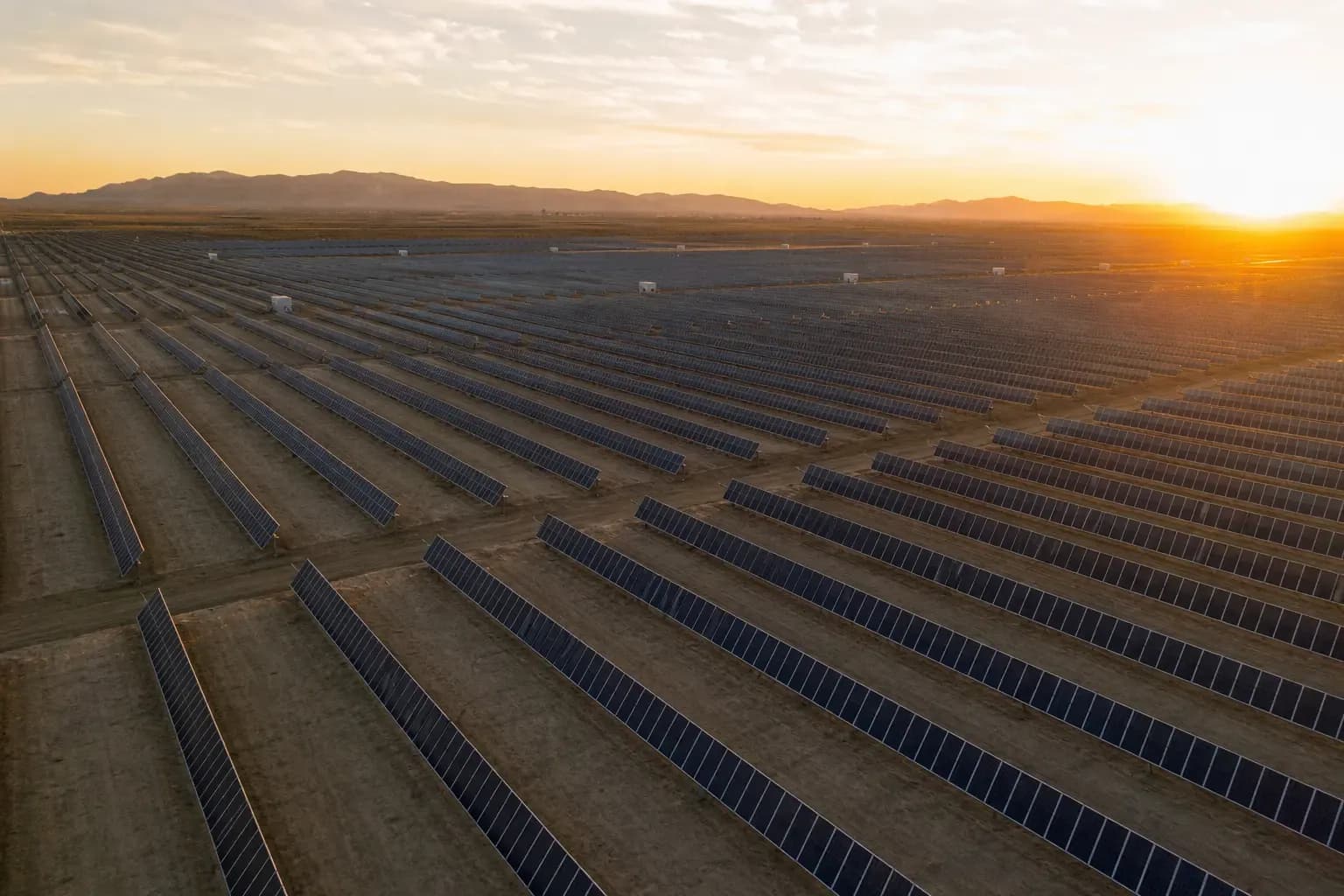
The largest solar parks in the world now operate at gigawatt scale, and most of them sit in desert regions of India, the Gulf and China. Several were built in phases over a decade, while newer projects in Saudi Arabia and Gujarat have added gigawatts in a year or two.
This ranking lists the ten biggest solar plants with an officially reported operating capacity. It uses figures published by the owners, operators or government agencies behind each park, and it notes where a park is a multi-phase complex rather than a single plant. If you want country-level detail, see our list of the largest solar power plants in India.
Largest Solar Parks in the World at a Glance
Ranking metric: operating solar capacity in megawatts (MW), as reported by the owner, operator or a government agency. Planned or tendered capacity is not counted. Where a source does not say whether a figure is AC (inverter output) or DC (panel rating, MWp), we report it as published and say so.
Data dates: each entry gives its own "as of" date, from late 2019 (Benban) to August 2026 (Bhadla). The most recent figure for the top entry is from July 2026.
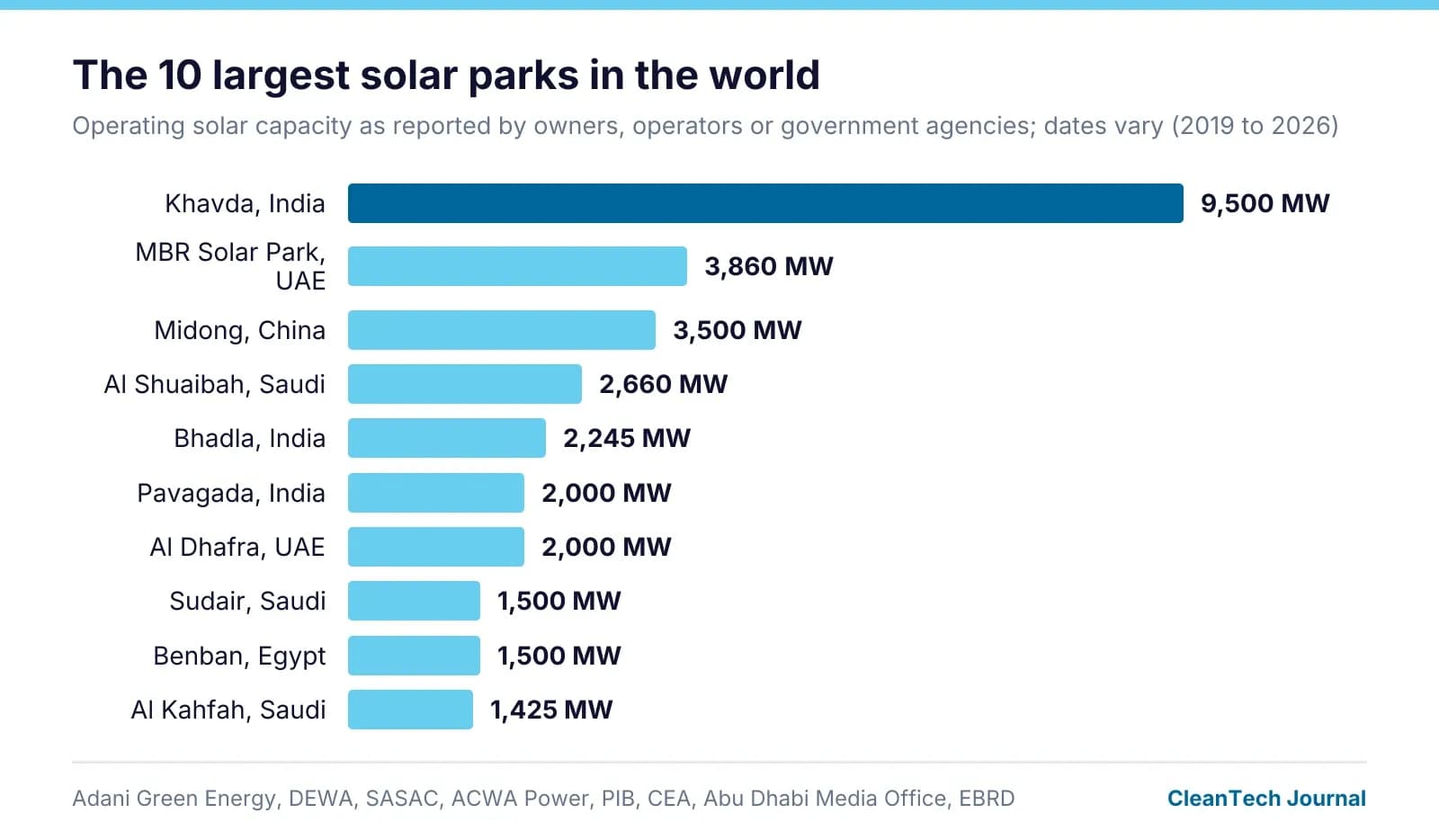
Totals: the ten parks below add up to about 30,190 MW of operating solar capacity. Khavda alone accounts for 31.5% of that total. India holds three places and 45.5% of the combined capacity, while the UAE and Saudi Arabia together hold five places and 37.9%.
What is excluded: China also has solar bases made up of many separate plants, such as the Talatan area in Qinghai. We could not find an official, consolidated figure for their operating solar capacity, so they are not ranked. Single projects with an official figure, such as Midong, are included.
Rank | Solar park | Country | Operating capacity | As of |
|---|---|---|---|---|
1 | Khavda (Adani Green Energy) | India | 9,500 MW (solar only) | July 2026 |
2 | Mohammed bin Rashid Al Maktoum Solar Park | UAE | 3,860 MW | January 2026 |
3 | Midong | China | 3,500 MW | June 2024 |
4 | Al Shuaibah 1 and 2 | Saudi Arabia | 2,660 MWac | 2025 |
5 | Bhadla | India | 2,245 MW | August 2026 |
6 | Pavagada | India | 2,000 MW | June 2024 |
7 | Al Dhafra | UAE | 2,000 MW | November 2023 |
8 | Sudair | Saudi Arabia | 1,500 MW | 2025 |
9 | Benban | Egypt | about 1,500 MW | October 2019 |
10 | Al Kahfah | Saudi Arabia | 1,425 MW | 2025 |
1. Khavda Renewable Energy Plant, India
Adani Green Energy's plant at Khavda in Kutch, Gujarat, leads the largest solar parks in the world by a wide margin. In a July 2026 release, the company said it had already commissioned 9.5 GW of solar capacity at the site, which it put at more than 30% of the project's planned 30 GW. The plant covers 538 square kilometers of barren land.
Khavda is not a solar-only park. It is a multi-phase complex that also includes wind and wind-solar hybrid capacity, and Adani describes it as the world's largest renewable energy plant. In its October 2026 half-year results release, Adani reported 10,752 MW of operating solar, wind and hybrid capacity at Khavda, including 750 MW built for other Adani group companies, and a target of 30 GW by 2029. We rank Khavda on the 9.5 GW solar figure only.
Owner: Adani Green Energy Operating solar capacity: 9.5 GW (Adani does not state AC or DC) Why it ranks first: its solar capacity alone is about 2.5 times that of the second-placed park.
For how Khavda compares with hydro and wind giants, see our ranking of the largest renewable energy projects in the world.
2. Mohammed bin Rashid Al Maktoum Solar Park, UAE
The Mohammed bin Rashid Al Maktoum Solar Park in Dubai is run by the Dubai Electricity and Water Authority (DEWA). In a January 2026 statement, DEWA said the park had reached 3,860 MW of production capacity after adding 1,000 MW from the 1,800 MW sixth phase during 2025. The remaining 800 MW of that phase is due by the fourth quarter of 2026.
The park has been built in phases since 2013. DEWA lists 10 MW in the first phase, 200 MW in the second, 800 MW in the third, 950 MW in the fourth and 900 MW in the fifth. The fourth phase combines 700 MW of concentrated solar power (CSP) with 250 MW of photovoltaics, so about 3,160 MW of the current total is PV. DEWA expects the park to exceed 8,000 MW by 2030, and its seventh phase is planned as 2,000 MW of PV with 1,400 MW of battery storage.
Operator: DEWA Operating capacity: 3,860 MW (PV and CSP combined) Why it ranks here: it is the largest solar-only park on the list and still adding capacity.
3. Midong Solar Project, China
The Midong project in Midong District, Urumqi, in Xinjiang is owned by China Green Development Group, a state-owned enterprise. China's State-owned Assets Supervision and Administration Commission (SASAC) reported in mid-2024 that the group's 3.5 GW (3.5 million kilowatt) Midong photovoltaic project had been connected to the grid.
Midong differs from the multi-plant Chinese bases mentioned above because it is a single project with one owner and an officially reported capacity. That makes it possible to rank it on the same basis as the other parks here.
Owner: China Green Development Group Operating capacity: 3,500 MW (AC or DC not stated in the official notice) Why it ranks here: its official 3.5 GW figure places it just behind Dubai's multi-phase park.
4. Al Shuaibah 1 and 2 Solar PV, Saudi Arabia
Al Shuaibah is a two-plant complex in Makkah Province, about 80 km south of Jeddah. ACWA Power lists Al Shuaibah 1 at 600 MWac and Al Shuaibah 2 at 2,060 MWac, for a combined 2,660 MWac. The company gives commercial operation dates of 28 February 2025 for the first plant and 30 November 2025 for the second.
In its 2025 year-end investor report, ACWA Power lists Shuaibah 1 and 2 among its fully operational assets, with a 35% effective share and a 35-year build-own-operate power purchase agreement. The buyer is the Saudi Power Procurement Company.
Developer: ACWA Power, with partners Operating capacity: 2,660 MWac across two adjacent plants Why it ranks here: it is the largest solar complex in Saudi Arabia on this list.
5. Bhadla Solar Park, India
Bhadla Solar Park in Rajasthan is India's second-largest entry. India's Press Information Bureau (PIB) gave its installed capacity as 2,245 MW in an August 2026 publication, spread across about 5,700 hectares. Construction started in 2015 and was completed in stages by 2020. A 2017 auction at Bhadla set a then record-low tariff of ₹2.44 per unit.
Bhadla is a multi-phase park with several park developers. The Central Electricity Authority's (CEA) solar park status report lists Bhadla Phase II at 680 MW (Rajasthan Solarpark Development Company), Phase III at 1,000 MW (a state government and IL&FS joint venture) and Phase IV at 500 MW (a state government and Adani joint venture), all fully commissioned. Those three phases total 2,180 MW of the park's 2,245 MW.
Location: Rajasthan, India Operating capacity: 2,245 MW Why it ranks here: newer projects in Gujarat, the Gulf and China now report more capacity.
6. Pavagada Solar Park, India
Pavagada Solar Park in Karnataka is managed by Karnataka Solar Power Development Corporation (KSPDCL), a joint venture of the Karnataka Renewable Energy Development Ltd and the Solar Energy Corporation of India (SECI). The CEA's June 2024 status report lists the park at 2,000 MW, all of it commissioned.
The park sits on 12,937 acres of acquired land, or about 52 square kilometers. Like Bhadla, it is listed under India's solar park program, in which separate developers build individual plants inside the park. Karnataka is listed in PIB data as having one approved solar park with 2,000 MW of sanctioned capacity.
Park developer: KSPDCL Operating capacity: 2,000 MW Why it ranks here: it ties with Al Dhafra at 2,000 MW, so their order is not a capacity difference.
7. Al Dhafra Solar PV, UAE
Al Dhafra Solar PV is about 35 km from Abu Dhabi City. The Abu Dhabi Media Office reported its inauguration in November 2023 at 2 GW and described it as the world's largest single-site solar plant. It uses almost 4 million bifacial panels over more than 20 square kilometers of desert.
The plant is owned by TAQA (40%), Masdar (20%), EDF Renewables (20%) and JinkoPower (20%), and the power is bought by Emirates Water and Electricity Company (EWEC). It produces enough electricity for almost 200,000 homes and avoids about 2.4 million tonnes of CO2 a year, according to the same release.
Owners: TAQA, Masdar, EDF Renewables, JinkoPower Operating capacity: 2,000 MW Why it ranks here: unlike most parks on this list, it was built as one single-site plant rather than in separate phases.
8. Sudair Solar PV, Saudi Arabia
Sudair Solar PV is located in Sudair Industrial City, Saudi Arabia. ACWA Power's 2025 year-end investor report lists it at 1,500 MW, with a 35% effective share, a 25-year power purchase agreement and project commercial operation in the fourth quarter of 2024. The company classifies it as fully operational.
The project was developed by a consortium led by ACWA Power and backed by Saudi Arabia's Public Investment Fund. Its power is sold to the Saudi Power Procurement Company.
Developer: ACWA Power-led consortium Operating capacity: 1,500 MW (AC or DC not stated) Why it ranks here: it is a single 1,500 MW plant, slightly ahead of Al Kahfah.
9. Benban Solar Park, Egypt
Benban Solar Park in Egypt's Aswan desert is a cluster of 32 separate plots built by private developers. When construction finished in October 2019, the European Bank for Reconstruction and Development (EBRD), its largest financier, gave its capacity as 1.5 GW over about 37 square kilometers. The EBRD supported 16 of the 32 plots.
According to the EBRD, the park can supply more than one million homes.
Structure: 32 plots, multiple developers Operating capacity: about 1,500 MW (a rounded EBRD figure; AC or DC not stated) Why it ranks here: it remains the largest operating solar park in Africa for which we found an official figure.
10. Al Kahfah Solar PV, Saudi Arabia
Al Kahfah Solar PV is the third Saudi entry and one of the newest plants here. ACWA Power's 2025 year-end investor report lists it at 1,425 MW, with a 50.1% effective share, a 35-year power purchase agreement and project commercial operation in the fourth quarter of 2025. ACWA Power classifies it as fully operational.
The project was developed with Badeel, a company owned by Saudi Arabia's Public Investment Fund. It is part of a group of large plants that ACWA Power brought online in 2025, which also includes Saad 2 and Ar Rass 2.
Developer: ACWA Power with Badeel Operating capacity: 1,425 MW Why it ranks here: it just edges out India's two-site Ananthapuramu-I park for the final place.
How the Top Ten Splits by Country
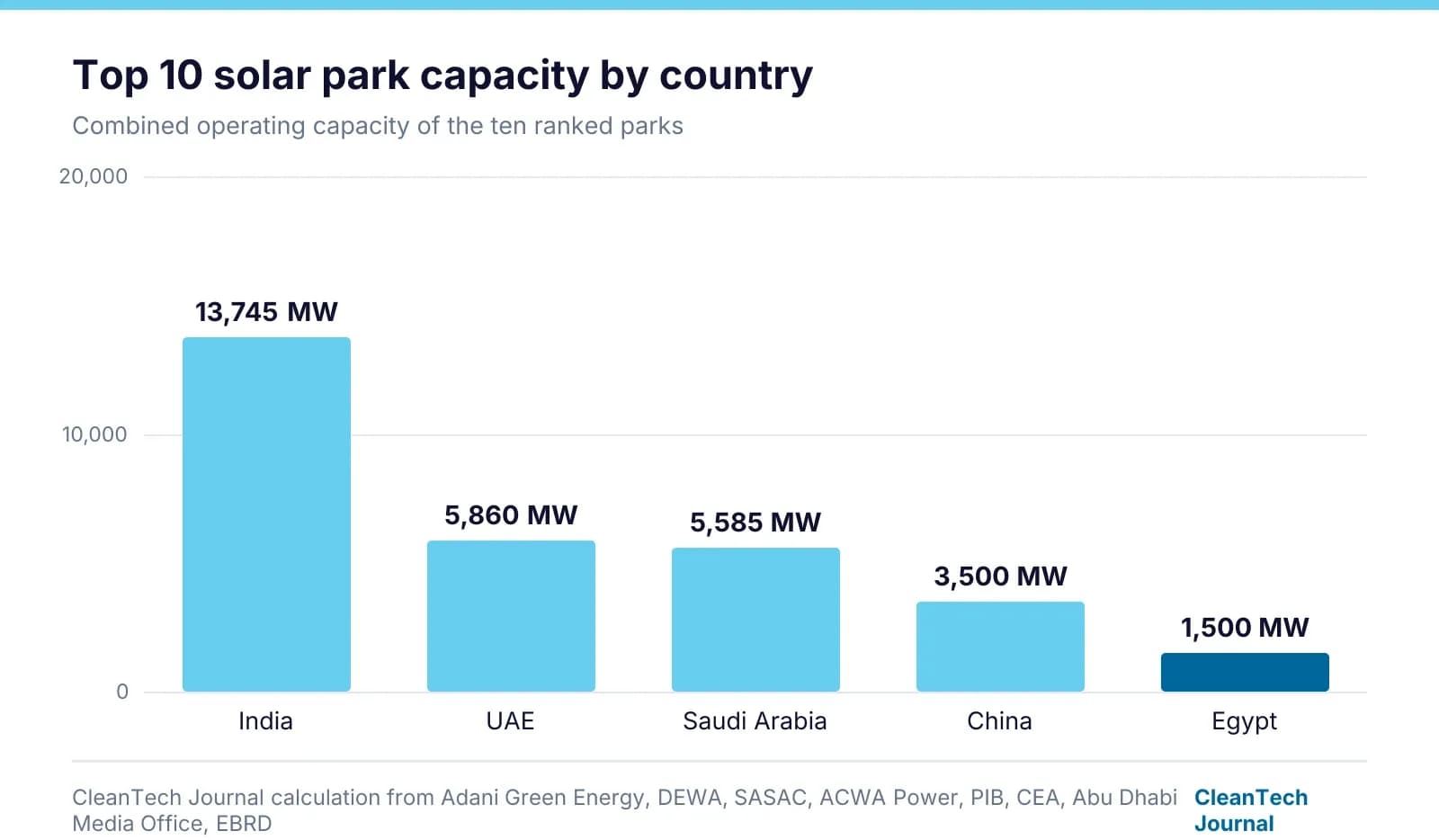
Among the largest solar parks in the world, India leads with 13,745 MW across three parks, or 45.5% of the combined total. The UAE follows with 5,860 MW (19.4%) from two parks, and Saudi Arabia has 5,585 MW (18.5%) from three. China's Midong contributes 3,500 MW (11.6%) and Egypt's Benban about 1,500 MW (5.0%).
No US plant makes the top ten. The biggest American projects are smaller and are covered in our ranking of the largest solar power plants in the United States.
Projects Just Outside the Ranking
Ar Rass 2, Saudi Arabia: ACWA Power reports that 1,000 MW of this 2,000 MW plant came online in August 2025 and a further 1,000 MW in September 2025. However, its 2025 year-end report still lists the project under "under construction and partially operational assets," so we have left it out until it is reported as fully complete.
Ananthapuramu-I, India: the CEA lists 1,400 MW as commissioned, split between the N.P. Kunta site (1,000 MW) and the Galiveedu site (400 MW). Because it spans two sites, we did not rank it as a single park.
Dubai's sixth phase: if DEWA completes the remaining 800 MW of the sixth phase as planned, the Mohammed bin Rashid Al Maktoum Solar Park would reach 4,660 MW, which would not change its second place.
The order at the top of the largest solar parks in the world will keep changing as Khavda and Dubai add the capacity their owners have announced.
Frequently Asked Questions
What is the largest solar park in the world?
By officially reported operating solar capacity, Adani Green Energy's Khavda plant in Gujarat, India, is the largest, with 9.5 GW of solar commissioned as of July 2026. Among solar-only parks, Dubai's Mohammed bin Rashid Al Maktoum Solar Park is the largest at 3,860 MW, according to DEWA.
How big is the Mohammed bin Rashid Al Maktoum Solar Park?
DEWA reported 3,860 MW of capacity in January 2026, including 700 MW of concentrated solar power. It plans to exceed 8,000 MW by 2030.
Which country has the most capacity among the largest solar parks in the world?
India, with 13,745 MW across Khavda, Bhadla and Pavagada, or about 45.5% of the ten parks' combined capacity. The UAE and Saudi Arabia follow.
Is Bhadla still the biggest solar plant in the world?
No. Bhadla's 2,245 MW, as reported by India's PIB, now places it fifth in this ranking, behind Khavda, Dubai's solar park, Midong and Al Shuaibah.
What is the difference between MWac and MWp?
MWac is the alternating-current output a plant can deliver to the grid, while MWp is the combined peak rating of its solar panels, which is usually higher. Many owners do not say which one they report, so this ranking states the unit only where the source does, as ACWA Power does for Al Shuaibah (MWac).
SOURCES
- Adani Green Energy surpasses 20 GW operational capacity (July 2026)
- DEWA: Significant progress in clean energy transition, adding 1,000MW in 2025
- DEWA: Mohammed bin Rashid Al Maktoum Solar Park
- SASAC: China Green Development Xinjiang Midong 3.5 GW PV project connected to grid
- ACWA Power: Al Shuaibah 1 & 2 Solar PV IPP
- ACWA Power Investor Report, twelve months ended 31 December 2025
- PIB: India's Solar Growth Enters a New Era (August 2026)
- CEA: Status Report on Development of UMREPP Solar Parks, June 2024
- Abu Dhabi Media Office: Hazza bin Zayed inaugurates Al Dhafra Solar PV project
- EBRD: Benban, Africa's largest solar park, completed
Written by
Suraj Kadam
Suraj Kadam is a journalist and Chief Editor of CleanTech Journal, a knowledge and media platform covering clean technology, solar energy, and renewable energy. He reports on emerging technologies, industry developments, policy trends, and innovations shaping the global clean energy transition. Through his editorial work, Suraj aims to make complex clean technology topics accessible to industry professionals, researchers, policymakers, and readers interested in sustainable energy. His work focuses on delivering insightful, informative, and engaging coverage of the evolving renewable energy landscape.